New Delhi: An American vlogger’s experience at a rural government hospital in India has triggered a larger conversation about India’s healthcare system, particularly the contrast between the criticism often directed at public healthcare and the growing number of foreigners who are choosing India for medical treatment.
An American vlogger was treated for free at a rural government hospital in India.
He says "This wasn’t food poisoning. I like Indian food so much that I overate" 😅
"Similar treatment in the US could have cost thousands of dollars"
=> India’s free rural hospitals quietly… pic.twitter.com/mRIt7PByZf
— News Algebra (@NewsAlgebraIND) August 17, 2026
According to social-media posts about the incident, the American traveller fell ill while travelling through India and was treated at a rural government hospital. He later joked that it was not food poisoning and that he had simply eaten too much because he liked Indian food so much. What reportedly surprised him was that the treatment was provided free of charge.
The numbers tell a different story
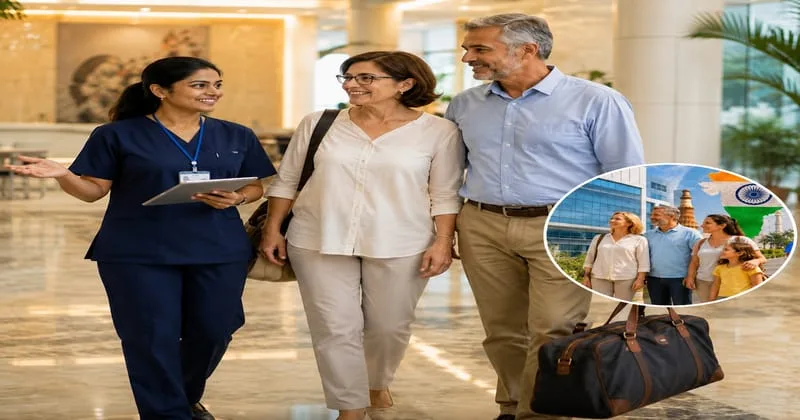
The strongest evidence comes not from a viral video, but from government data. According to the Ministry of Tourism, 507,244 foreign nationals came to India specifically for medical treatment in 2025. Medical-purpose arrivals accounted for about 5.5 per cent of India’s foreign tourist arrivals that year. That is more than half a million international patients in a single year. These people are not travelling to India simply because it is a popular tourist destination. They are making a decision involving something far more important: their health.
India has consequently emerged as an important destination for what the government describes as Medical Value Travel, combining medical treatment with comparatively affordable costs and access to specialised healthcare. The government has also taken steps to facilitate international patients, including extending the e-medical visa and e-medical attendant visa facilities for foreign nationals coming to India for treatment.
Why are foreigners choosing India?
The answer is relatively straightforward: India offers a combination of medical expertise, specialised treatment and comparatively lower costs. India has built a substantial healthcare ecosystem consisting of government hospitals, private hospitals, medical colleges, specialised institutions and highly trained doctors.
For international patients, the cost difference can be particularly important. Medical treatment that can be financially prohibitive in some developed countries may be considerably more affordable in India. This cost advantage, combined with India’s expanding medical infrastructure, has helped the country become an increasingly important destination for international patients. Recent industry assessments have similarly highlighted India’s combination of comparatively affordable treatment and quality medical services as a major driver of medical tourism. The trend is not restricted to foreigners travelling directly from their home countries either. NRIs living in countries such as the United States are increasingly returning to India for healthcare because of lower costs and, in some cases, faster access to treatment.
And then comes the rural hospital story
This is where the American vlogger’s experience becomes particularly interesting. India’s medical-tourism success stories are usually associated with major hospitals in cities such as Delhi, Mumbai, Chennai, Bengaluru and Hyderabad. But the viral story involves something very different: a rural government hospital. The reported experience illustrates another dimension of Indian healthcare: public facilities designed to provide medical services without making the ability to pay the first condition for receiving care.
India’s public-health infrastructure remains enormous, stretching from primary healthcare facilities to community health centres, district hospitals and government medical colleges. The objective is not simply to create world-class private hospitals for international patients. It is also to make healthcare available to India’s enormous rural and lower-income population. That distinction matters. In 2025 alone, the number crossed five lakh foreign medical arrivals. That is not something that can simply be dismissed as government propaganda or tourism marketing.
From being criticised to becoming a destination
There is an important irony here. India has historically been described as a country where patients travel abroad for better healthcare. Today, the direction of travel is increasingly becoming more complicated. Foreign patients are travelling to India for specialised medical care. NRIs are returning to India for procedures. International patients from countries across Asia, Africa and the Middle East are choosing Indian hospitals. And the government is actively developing policies to make India a stronger medical-value-travel destination. This does not mean India has surpassed every Western healthcare system. It means India’s healthcare sector has developed strengths that are increasingly recognised beyond India’s borders.
For the American traveller, the most striking part may not have been sophisticated medical technology. It was accessibility. He reportedly received treatment at a government hospital without the kind of financial shock he might have associated with healthcare in America. The viral account specifically contrasts his experience with the potentially high cost of medical care in the US. India’s cost advantage is one of the major reasons international patients choose the country. And that is precisely where India’s critics need to look beyond political talking points.
Healthcare is ultimately about access
A healthcare system cannot be judged only by the most expensive hospital or the most advanced machine. It must also be judged by a simpler question: Can a person receive treatment when they need it without being financially destroyed? India has attempted to expand that access through public healthcare programmes and schemes such as Ayushman Bharat.
The broader transformation is significant enough that international observers have also highlighted how government-backed health coverage has expanded access to expensive hospital treatment for poorer Indians.
India is developing a reputation for combining medical expertise with affordability. And now, a foreign traveller’s viral experience at a rural government hospital has added another dimension to that story. The Opposition can and should question shortcomings in India’s healthcare system. But if the criticism ignores the country’s growing medical-tourism footprint, expanding healthcare infrastructure and cost advantage, it risks presenting only half the picture. The more interesting question is this: If India’s healthcare system is supposedly so inadequate, why are more than five lakh foreigners choosing to come here for medical treatment?