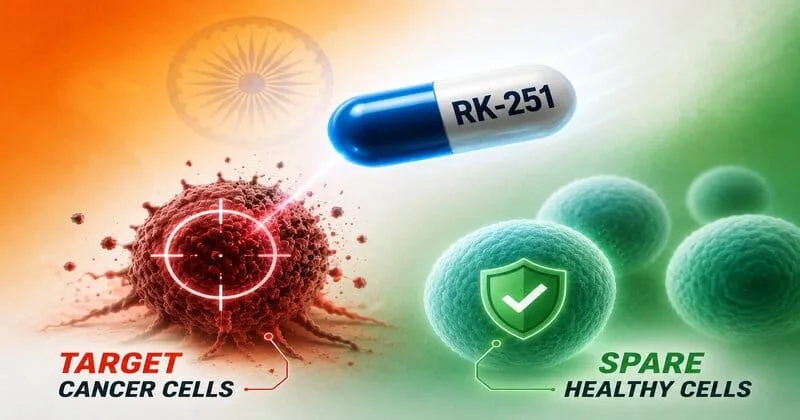
Indian scientists have developed RK-251, a “smart” cancer drug designed to target cancer cells while sparing healthy tissue
New Delhi: Cancer treatment has long faced a major challenge: destroying cancer cells without causing extensive damage to healthy tissues. Conventional chemotherapy can affect both cancerous and normal cells, often resulting in significant adverse effects and side effects. This has driven the search for targeted therapies that can remain inactive while circulating through the body and become activated specifically inside tumour cells.
Scientists have now taken an important step in that direction with the development of RK-251, a new “smart” cancer drug designed to respond to conditions found predominantly inside cancer cells.
The collaborative research was led by Dr Asis Bala of the Institute of Advanced Study in Science and Technology (IASST), an autonomous institute under the Department of Science & Technology, Government of India, and Dr K.P. Bhabak of the Indian Institute of Technology Guwahati (IIT Guwahati).
The drug takes advantage of a biological difference between cancerous and healthy cells. Cancer cells frequently generate elevated levels of reactive oxygen species (ROS), chemically reactive molecules that can contribute to cellular damage and are associated with the altered metabolism of tumour cells.
RK-251 has been designed to use these elevated ROS levels as an activation signal. When the drug enters a cancer cell with high ROS levels, the chemical trigger activates RK-251 and releases a potent anticancer compound called NBDHEX.
NBDHEX works by blocking target proteins that cancer cells can use to support their survival and resistance to treatment. In this way, the drug is designed to remain comparatively inactive in normal cells while becoming more active under the biochemical conditions found inside cancer cells.
In preclinical studies, RK-251 demonstrated strong activity against aggressive triple-negative breast cancer cells, while showing considerably less effect on healthy cells.
Triple-negative breast cancer is considered particularly challenging to treat because the tumour cells lack three commonly targeted receptors, limiting the effectiveness of some established targeted therapies.
The findings therefore highlight the potential of a treatment strategy that does not simply deliver an anticancer compound throughout the body, but instead attempts to activate it selectively within cancer cells.
Researchers also examined the behaviour of the drug candidate in zebrafish embryos (Danio rerio), a model commonly used in early-stage biomedical research.
The study found no obvious signs of toxicity in the tested embryos. The candidate drug also displayed the expected fluorescence in the presence of reactive oxygen species, providing evidence that its ROS-responsive mechanism was functioning as designed. These observations provide encouraging early evidence regarding the drug candidate’s behaviour and safety profile.
The development of RK-251 reflects a broader shift in cancer research toward therapies that seek to distinguish tumour cells from healthy tissue at the molecular level. Rather than exposing the entire body to an active anticancer compound, the strategy is to deliver a relatively inactive drug that becomes activated when it encounters the biological environment of a tumour.
If successfully developed further, such approaches could potentially help reduce treatment-related toxicity while maintaining anticancer activity. However, RK-251 remains at the preclinical research stage. Results obtained in cancer cells and animal models do not establish that the drug will be effective or safe in humans. Further laboratory studies, animal testing and clinical trials will be required before its potential use in patients can be determined.
The research nevertheless represents a significant step toward developing cancer therapies that are designed to “switch on” inside tumour cells while limiting exposure of healthy tissues to active anticancer compounds.
