IIT Guwahati develops advanced anti-counterfeit nanotech system
July 21, 2026
  • Read Ecopy
  • Circulation
  • Advertise
  • Careers
  • About Us
  • Contact Us
Android AppiPhone AppArattai
Organiser
  • ‌
  • Bharat
    • Assam
    • Bihar
    • Chhattisgarh
    • Jharkhand
    • Maharashtra
    • View All States
  • World
    • Asia
    • Europe
    • North America
    • South America
    • Africa
    • Australia
  • Editorial
  • International
  • Opinion
  • RSS @ 100
  • More
    • Op Sindoor
    • Analysis
    • Sports
    • Defence
    • Politics
    • Business
    • Economy
    • Culture
    • Special Report
    • Sci & Tech
    • Entertainment
    • G20
    • Azadi Ka Amrit Mahotsav
    • Vocal4Local
    • Web Stories
    • Education
    • Employment
    • Books
    • Interviews
    • Travel
    • Law
    • Health
    • Obituary
  • Subscribe
    • Subscribe Print Edition
    • Subscribe Ecopy
    • Read Ecopy
  • ‌
  • Bharat
    • Assam
    • Bihar
    • Chhattisgarh
    • Jharkhand
    • Maharashtra
    • View All States
  • World
    • Asia
    • Europe
    • North America
    • South America
    • Africa
    • Australia
  • Editorial
  • International
  • Opinion
  • RSS @ 100
  • More
    • Op Sindoor
    • Analysis
    • Sports
    • Defence
    • Politics
    • Business
    • Economy
    • Culture
    • Special Report
    • Sci & Tech
    • Entertainment
    • G20
    • Azadi Ka Amrit Mahotsav
    • Vocal4Local
    • Web Stories
    • Education
    • Employment
    • Books
    • Interviews
    • Travel
    • Law
    • Health
    • Obituary
  • Subscribe
    • Subscribe Print Edition
    • Subscribe Ecopy
    • Read Ecopy
Organiser
  • Home
  • Bharat
  • World
  • Operation Sindoor
  • Editorial
  • Analysis
  • Opinion
  • Culture
  • Defence
  • International Edition
  • RSS @ 100
  • Magazine
  • Read Ecopy
Home Bharat

IIT Guwahati develops next-generation security technology to combat fake products and forged documents

Researchers at IIT Guwahati have developed a next-generation perovskite nanomaterial-based security system that can help detect and prevent fake currency, forged documents, and counterfeit products using advanced light-emitting technology

WEBDESKWEBDESK
May 30, 2026, 07:00 pm IST
in Bharat
Follow on Google News
Researchers at IIT Guwahati have developed an advanced perovskite nanomaterial-based system to detect and prevent fake currency

Researchers at IIT Guwahati have developed an advanced perovskite nanomaterial-based system to detect and prevent fake currency

FacebookTwitterWhatsAppTelegramEmail

Guwahati: Researchers at the Indian Institute of Technology Guwahati have developed an advanced light-emitting perovskite nanomaterial that could improve protection against fake currency, forged documents, and other counterfeit products. To achieve this, the research team has developed nanocrystals capable of producing light-based security patterns that cannot be replicated using traditional printing and imaging methods.

The findings of this research have been published in the prestigious Advanced Optical Materials journal, in a paper co-authored by Prof. Saikat Bhaumik, Assistant Professor, in collaboration with Prof. P.K. Giri, Professor, and their research scholars Latika Juneja and Garima Choudhary from the Department of Physics at IIT Guwahati.

Counterfeiting has become a global concern, affecting industries ranging from pharmaceuticals and electronics to banking and identity documentation. With the help of modern technologies, offenders have found ways to accurately copy conventional security measures such as barcodes, QR codes, holograms, and watermark labels. These challenges can also have implications for national security, as they can pose risks by enabling financial fraud, illegal activities, and security breaches. This has created increasing demand for smart, difficult-to-reverse-engineer anticounterfeiting systems.

To address this challenge, Prof. Bhaumik and Prof. Giri, along with their research team, have developed light-emitting perovskite nanocrystals, a group of crystalline materials known for their optical and electronic properties. These materials have sizes in the nanometer range (a hundred thousand times shorter than the width of a single human hair), and hold the capability to produce very pure and intense colours with very narrow emission ranges.

This property helps in providing accurate optical signatures and larger colour tunability than traditional fluorescent materials. These properties make it suitable for secure authentication technologies. However, one of the major challenges of these materials is their limitation when exposed to moisture, heat, and environmental conditions, under which they degrade easily.

To solve this problem, the research team developed a double-layer coating around the nanocrystals, making them heat- and chemical-resistant while maintaining their light-emitting properties. Then, with the use of a direct laser writing technique, the team created tiny patterns from these materials. The multi-layer coating enabled the developed nanocrystals to create these patterns without using conventional lithographic masks, which helped in achieving resolutions of 10–40 micrometres, allowing very complex patterns and encoding of information.

Also Read: Infiltrators should return to their countries, those who voluntarily go back will not face any legal action: Amit Shah

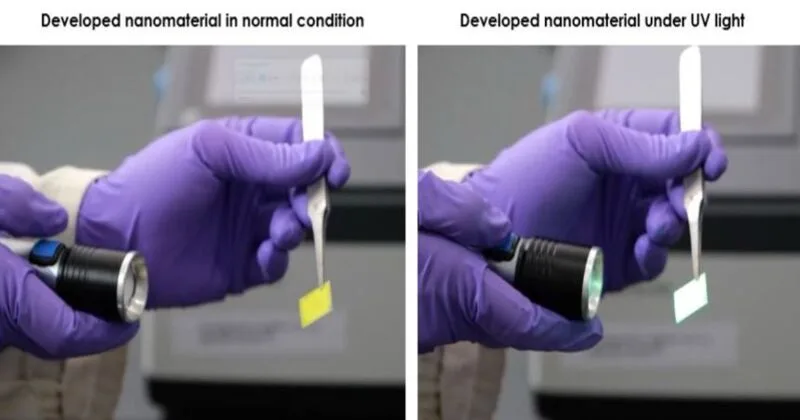
Speaking about the developed technology, Prof. Saikat Bhaumik, Lead author of the research, said A unique feature of this perovskite material is that, unlike normal security labels which always show the same mark, it exhibits very narrow emission spectra and the emission intensity changes depending on the environment. For example, an invisible fluorescent pattern can be erased by heating and regenerated by subjecting it to a chemical process. This means that the security label does not simply “glow” under UV light but rather acts in a very specific and predictable manner when subjected to certain treatments.

However, in the case of the developed materials, to produce a fake, a counterfeiter will need to copy the visible pattern along with the way in which the nanocrystals respond to heat and chemicals. This makes the security system much harder to copy using traditional techniques. It also has the potential to embed information into company products and banknotes for secure information storage and retrieval. The researchers have coined this approach as “4D anticounterfeiting”.

It is notable that the laser patterning technique developed by the IIT Guwahati research team can also be utilised in developing cutting-edge micro-LED displays for smartphones, wearables, and Augmented Reality (AR) systems, among others.

On a broader scale, the developed technology can be applied across several sectors where product authentication and security are critical. Ranging from protecting currency notes, passports, identity cards, and legal documents to industries such as luxury goods and consumer products, these advanced security labels can be integrated to verify product authenticity.

Topics: Counterfeiting TechnologyPerovskite NanomaterialsFake Currency PreventionDocument SecurityResearch InnovationIIT GuwahatiNanotechnology
ShareTweetSendShareSend
✮ Subscribe Organiser YouTube Channel. ✮
✮ Join Organiser's WhatsApp channel for Nationalist views beyond the news. ✮
Previous News

Telangana Congress VP Alam Khan named by police in lawyer murder linked to Waqf disputes

Next News

ABVP National Executive Council Meeting: ABVP calls for industry-academia partnership to boost research ecosystem

Related News

The Rs 200-crore MAHA Water Mission seeks to boost water security and democratise research funding in India

From Rigveda to Research Labs: How ANRF’s Rs 200 crore water mission is securing India’s future

Representative Image

Lighting Up Health Risks: Indigenous nanotech enables fast nicotine detection

RSS Sarkaryavah Dattatreya Hosabale ji at the IIT Guwahati Yuva Sammilan

RSS Centenary ‘Yuva Sammelan’ at IIT Guwahati: Sarkaryavah Hosabale urges youth to work towards nation-building

Representative image

IIT Guwahati & Skyroot Aerospace join forces in space research, additive manufacturing and student training in India

Transforming Education: Assam’s commitment to progress

Representative image

IIT Guwahati develops multi-stage clinical trial method for personalised medical care

Load More

Latest News

New Delhi, Jul 20 (ANI): Protesters seen pelting stones at Delhi Police during CJP protest at Connaught Place, in New Delhi on Monday. (Delhi Police/ANI Video Grab)

Parliament March: CJP-led anarchy- Can these really be India’s youth?

NTA debunks five viral NEET 2026 OMR claims, forbids ai-edited answer sheets

NTA clears air on five viral NEET 2026 OMR cases, warns against fake answer sheets submission

VHP Central Committee Adopts Resolutions on Family Values, Kandhamal Probe

VHP’s Central Managing Committee passes resolutions on family system, seeks action in Swami Laxmanananda murder probe

Keralam Minister moves to stop free food distribution by NGOs in government hospitals, sparks backlash

NEET 2026 | Abhay Yadav Case: NTA warns against AI generated OMR sheets & scorecards; Reiterates strict legal action

Former Aam Aadmi Party (AAP) councillor Tahir Hussian with AAP leader and former Delhi Chief Minister Arvind Kejriwal. Notably, Delhi court convicted Tahir Hussain and four others for the 2020 murder of Intelligence Bureau (IB) staffer Ankit Sharma, who was brutally killed and his body was dumped into a drain in the Chand Bagh area during anti-Hindu Delhi riots

Anti-Hindu Delhi Riots 2020: When evidence outlasted narratives

NCUI Elections: Sahakar Bharati–BJP registers historic victory; Wins 19 of 20 seats & 10 candidates elected unopposed

Representative Image

Tamil Nadu: Authorities ‘demolish’ Annadaana Satram in Thiruvannamalai; Sparks outrage from public

India's BioE3 Policy aims to build a $2.6 trillion bioeconomy by 2047 through biotechnology-driven innovation, jobs and growth

India’s Bioeconomy Revolution: How NITI Aayog’s roadmap seeks to make the country a global biotechnology leader by 2047

Tri-Services Exercise 2025 was led by the Western Naval Command of the Indian Navy along with the Southern Command of the Indian Army and the South Western Air Command of the Indian Air Force as the principal participating formations

Theatre Command: Military reforms for integrated Actions

Load More
  • Privacy
  • Terms
  • Cookie Policy
  • Refund and Cancellation
  • Delivery and Shipping

© Bharat Prakashan (Delhi) Limited.
Tech-enabled by Ananthapuri Technologies

  • Home
  • Search Organiser
  • Bharat
    • Assam
    • Bihar
    • Chhattisgarh
    • Jharkhand
    • Maharashtra
    • View All States
  • World
    • Asia
    • Africa
    • North America
    • South America
    • Europe
    • Australia
  • Editorial
  • Operation Sindoor
  • Opinion
  • Analysis
  • Defence
  • Culture
  • Sports
  • Business
  • RSS @ 100
  • Entertainment
  • More ..
    • Sci & Tech
    • Vocal4Local
    • Special Report
    • Education
    • Employment
    • Books
    • Interviews
    • Travel
    • Health
    • Politics
    • Law
    • Economy
    • Obituary
  • Subscribe Magazine
  • Read Ecopy
  • Advertise
  • Circulation
  • Careers
  • About Us
  • Contact Us
  • Policies & Terms
    • Privacy Policy
    • Cookie Policy
    • Refund and Cancellation
    • Terms of Use

© Bharat Prakashan (Delhi) Limited.
Tech-enabled by Ananthapuri Technologies