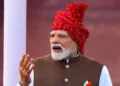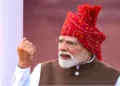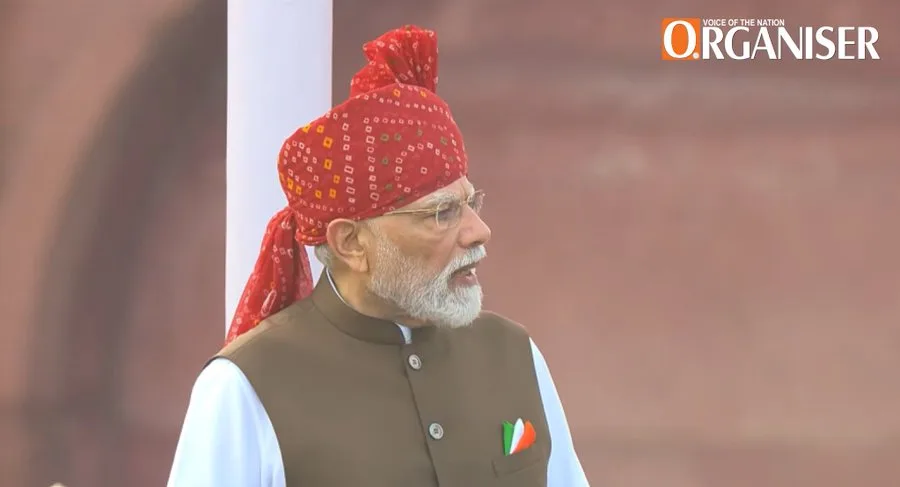
Prime Minister Narendra Modi on Saturday announced a series of initiatives and long-term targets covering technology, education, sports, national preparedness and energy security as he addressed the nation from the ramparts of the Red Fort on the occasion of India’s 80th Independence Day.
The announcements placed young Indians, emerging technologies and self-reliance at the centre of the government’s development agenda. Among the major announcements were a plan to provide artificial intelligence (AI) skill training to one crore youth within a year, a nationwide network for free online coaching for competitive examinations, a sports talent identification programme for children aged 5 to 15, a modern Civil Defence volunteer network, expansion of semiconductor manufacturing and a target of 100 GW of nuclear power capacity by 2047.
The Prime Minister said the initiatives were part of the broader effort to prepare India for the challenges and opportunities of the coming decades. The government’s official summary of the address also highlighted the five-reactor target, additional semiconductor plants and the emphasis on women-led development.
AI Training For One Crore Youth
One of the biggest announcements was the decision to provide AI skill training to one crore young Indians over the next one year.
Referring to the AI Summit held in India earlier this year, PM Modi said the country had already begun building momentum in the field of artificial intelligence and now needed to ensure that its youth had the skills required to lead in the technology.
The Prime Minister announced that the government would work over the coming year to provide AI skill training to one crore youth, with the objective of building a large pool of young people capable of working with and contributing to AI technologies.
The announcement comes at a time when AI is rapidly changing the nature of work across sectors. From software and manufacturing to healthcare, education, financial services and transportation, artificial intelligence is increasingly becoming part of everyday economic activity.
For India, the scale of the proposed programme is significant. Training one crore young people would mean creating a much larger base of AI-aware and AI-skilled workers, particularly at a time when employers globally are increasingly seeking workers who can use emerging technologies.
The initiative also builds on earlier efforts to introduce AI awareness and foundational skills among students. A government backgrounder published earlier this year said the SOAR programme, launched in July 2025, was designed to introduce AI awareness and foundational AI skills to students from Classes 6 to 12. It includes modules focused on AI awareness, aspiration and acquisition, along with training for educators.
The larger challenge, however, will be ensuring that the proposed training reaches youth beyond major cities and established technology hubs. India’s demographic advantage can translate into an economic advantage only if young people in smaller towns, rural areas and less-developed regions are able to access quality training.
The initiative therefore has the potential to become more than a technology programme. If implemented at scale, it could become a major skilling intervention aimed at preparing India’s workforce for an economy increasingly shaped by automation, machine learning and digital technologies.
Free Online Coaching For Competitive Examinations
In another major announcement aimed directly at students and young job aspirants, PM Modi announced a system of free online coaching for competitive examinations.
The Prime Minister said the cost of coaching classes had become a major financial burden for poor and middle-class families. He also pointed to the social pressure surrounding coaching, saying many parents feel compelled to send their children to coaching centres because of expectations around competitive examinations.
To address this, the government plans to create a network that will bring together digital public infrastructure, teachers and educational resources to provide free coaching to students preparing for various examinations.
PM Modi said the initiative could help families save substantial amounts of money spent on coaching while allowing students to access learning resources from home.
Competitive examinations for government jobs, professional courses and higher education have created a large coaching ecosystem in India. Students in several parts of the country travel to major education hubs or spend considerable amounts on private coaching to prepare for these examinations.
The proposed online system seeks to reduce that geographical and financial barrier.
The use of digital infrastructure could allow students in smaller towns and villages to access lectures, study material, mock tests and other educational resources without having to relocate to a coaching centre.
However, the success of the initiative will depend on the quality and accessibility of the platform. Free access alone may not be sufficient if students do not have reliable internet connections, suitable devices or access to high-quality teachers.
The government will also have to ensure that the system can cater to the different requirements of examinations conducted by central and state agencies.
The announcement nevertheless marks an attempt to use India’s digital public infrastructure to address one of the most expensive parts of the competitive examination ecosystem.
Modern Civil Defence Network To Meet New Challenges
PM Modi also announced the creation of a modern and vibrant Civil Defence network to respond to contemporary security and emergency challenges.
The Prime Minister said the government would build a large Civil Defence volunteer force equipped with modern systems and training. The objective, he said, would be to prepare citizens and volunteers to deal with modern-day crises and protect people during emergencies.
The announcement reflects a broader shift in the concept of civil preparedness. Civil Defence traditionally focused on helping communities respond to emergencies such as disasters, attacks and other threats. Modern crises, however, can involve multiple dimensions, including natural disasters, technological disruptions, infrastructure failures and security emergencies.
The proposed network is expected to focus on training volunteers and familiarising them with modern systems and methods of emergency response.
A larger and better-trained volunteer network could provide additional support to government agencies during emergencies. Such a system could also improve awareness among citizens about evacuation, first aid, emergency communication and other basic response mechanisms.
The emphasis on modernisation is particularly relevant as India continues to urbanise and expand critical infrastructure. Large cities, industrial centres and densely populated areas can face complex emergencies that require coordination between government agencies and local communities.
The challenge will be to create a system that is properly trained, coordinated and equipped rather than simply expanding the number of volunteers.
Nationwide Sports Talent Hunt For Children Aged 5-15
Sports was another major focus of the Prime Minister’s Independence Day announcements, with the government announcing a nationwide talent identification programme for children aged between five and 15 years.
The initiative is aimed at identifying promising young athletes from across the country and providing them with specialised training so that they can eventually compete at the highest international level.
PM Modi linked the announcement to India’s ambition to host the 2036 Olympic Games. He said India was emerging as a strong contender to host the Olympics and pointed to the country’s improving performance in international sports.
India is also scheduled to host the Commonwealth Games in 2030, giving the country another major opportunity to strengthen its sports infrastructure and competitive ecosystem.
The Prime Minister noted that the Olympic programme covers around 40 sporting disciplines and roughly 350 events, but India currently does not participate or qualify in a large proportion of them. He said the government wants India to participate in at least three-fourths of Olympic events by 2036.
The nationwide talent hunt is designed to address the problem at the grassroots level.
India has traditionally produced strong athletes in a limited number of sporting disciplines. While sports such as shooting, wrestling, badminton, boxing and athletics have produced international-level performers, India has comparatively limited representation in several other Olympic disciplines.
Identifying talent at a young age could help expand this pool.
The programme could also take sports identification beyond major cities and established academies. Rural India and smaller towns have often produced talented athletes, but many young players lack access to professional coaching, nutrition, sports medicine and proper facilities.
The government’s existing sports initiatives, including Khelo India and the Target Olympic Podium Scheme, have focused on strengthening the competitive ecosystem. The new talent hunt seeks to widen the base from which future athletes can be identified.
The bigger test will be what happens after identification. Finding talented children is only the first step. Sustained coaching, nutrition, sports science, medical support, equipment, competition exposure and financial assistance will be crucial if young athletes are to progress to the international level.
Push For Semiconductor Manufacturing
Semiconductors were another central element of the Prime Minister’s technology and self-reliance agenda.
PM Modi underlined the importance of semiconductor chips to modern life, pointing out that chips are essential for electronic products, medical equipment, transportation systems and a wide range of other technologies.
He said India had already moved towards greater self-reliance in semiconductor manufacturing and that three major semiconductor facilities had been established, with production beginning for exports.
The Prime Minister also announced that additional semiconductor plants would come up in the coming years, with the government expecting several more facilities to begin operations. The government has separately described the expansion of semiconductor manufacturing as an important part of India’s effort to strengthen technological self-reliance.
The semiconductor push is strategically important because chips are at the heart of the global technology economy.
Smartphones, automobiles, computers, communication equipment, defence systems and medical devices all depend on semiconductors. Disruptions in semiconductor supply chains during recent years demonstrated how dependent major economies are on a relatively small number of manufacturing hubs.
India has therefore sought to develop its own semiconductor ecosystem through financial incentives, manufacturing facilities and chip-design capabilities.
The India Semiconductor Mission was approved in 2021 with a financial outlay of Rs 76,000 crore to support semiconductor fabrication, design and manufacturing. A government backgrounder said approved semiconductor projects had reached 10 by 2025, involving cumulative investments of around Rs 1.60 lakh crore across six states.
The Independence Day announcement signals that the government intends to expand this ecosystem further.
For India, the semiconductor opportunity extends beyond chip manufacturing. A mature ecosystem can create jobs in chip design, packaging, testing, research, equipment, electronics manufacturing and related supply chains.
It could also strengthen India’s position in global technology and manufacturing networks.
At the same time, semiconductor manufacturing is capital-intensive and technologically complex. Building plants is only one part of the challenge. India will also need reliable power and water supplies, specialised talent, research capabilities, supply-chain networks and consistent demand.
Nuclear Energy Target: 100 GW By 2047
Energy security was another major theme of the Independence Day address, with PM Modi setting an ambitious target of 100 GW of nuclear power capacity by 2047.
The Prime Minister described nuclear energy as an important component of India’s long-term energy security and said the country would work towards expanding nuclear power as part of its development strategy.
He also announced that India aims to commission five new nuclear reactors within this decade.
The Prime Minister said India had achieved a significant milestone in fast breeder nuclear technology this year, describing it as an important step towards greater self-reliance in nuclear fuel and energy technology.
The nuclear expansion target is significant because India’s electricity demand is expected to rise as the economy grows, industrial activity expands and households become increasingly dependent on electricity.
India has also been expanding renewable energy rapidly. Nuclear power, however, provides a source of electricity that can operate continuously and does not depend on weather conditions in the same way as solar or wind generation.
The government therefore sees nuclear power as an important component of a diversified energy mix.
The 100 GW target by 2047 represents a major expansion from India’s existing nuclear power base. Achieving it will require new reactors, investment, technology development, skilled manpower and long-term planning.
The announcement of five new reactors within the current decade provides a near-term milestone within the larger 2047 target.
The Prime Minister also referred to the passage of the SHANTI Act as creating a framework for advancing India’s nuclear energy ambitions. The government has positioned the legislative framework as part of its effort to expand participation and investment in the nuclear sector.
A Broader Roadmap For A Developed India
Taken together, the six announcements cover areas that are central to India’s economic and strategic priorities: technology, education, human capital, sports, emergency preparedness, manufacturing and energy.
The AI initiative seeks to prepare young Indians for an economy increasingly shaped by artificial intelligence. Free online coaching is aimed at reducing the financial and geographical barriers associated with competitive examinations.
The sports talent hunt seeks to expand India’s Olympic pipeline from the grassroots, while the Civil Defence programme focuses on strengthening preparedness for modern emergencies.
The semiconductor push is designed to reduce dependence on external supply chains and establish India as a manufacturing and technology hub. The nuclear target, meanwhile, focuses on ensuring that the country’s growing energy requirements are backed by a stable and diversified power system.
The initiatives also share a common theme of building domestic capabilities.
In AI, the focus is on creating skilled human capital. In education, it is on using India’s digital infrastructure to widen access. In sports, it is on identifying and training domestic talent. In semiconductors, it is on developing domestic manufacturing. In nuclear energy, it is on expanding indigenous technological capabilities and energy capacity.
The government has linked these measures to its larger vision of a developed India by 2047.
The immediate challenge, however, will be implementation. The scale of the targets is considerable, whether it is training one crore youth in AI, providing quality coaching to examination aspirants, identifying young athletes across the country, building a nationwide Civil Defence network, establishing semiconductor plants or commissioning new nuclear reactors.
For these announcements to translate into measurable outcomes, implementation will have to match the ambition of the targets.
The Independence Day announcements nevertheless provide a clear picture of the areas the government is prioritising for the next phase of India’s development. From classrooms and sports grounds to semiconductor factories and nuclear facilities, the roadmap outlined from the Red Fort seeks to combine human capital, technology, manufacturing and energy security in the country’s long-term development strategy.