Prime Minister Narendra Modi’s 80th Independence Day address on August 15, 2026, placed strategic self-reliance at the centre of India’s development journey, with a strong emphasis on reducing external dependence in sectors that are increasingly important for the economy, national security and technological advancement.
Speaking from the Red Fort in New Delhi, Modi said India cannot remain dependent on other countries for critical technologies, resources and energy. He linked the push for domestic capabilities with the broader goals of Atmanirbhar Bharat, Make in India and Vocal for Local, while arguing that a stronger domestic manufacturing ecosystem would be crucial to achieving the vision of a Viksit Bharat by 2047.
Among the most significant themes in the address were semiconductor manufacturing, critical minerals and energy security. The Prime Minister also highlighted the expansion of solar power, nuclear energy, piped gas, railway electrification, hydrogen technology and domestic exploration.
Semiconductor manufacturing becomes a strategic priority
One of the biggest takeaways from the speech was the emphasis on semiconductor manufacturing.
Semiconductors are at the heart of modern technology. They are used in smartphones, computers, automobiles, medical equipment, communication systems, defence technologies and a wide range of industrial applications. As economies become increasingly digitised, the availability of chips has also become a strategic concern.
Modi said India was moving towards greater self-reliance in semiconductor production and pointed to the progress already made in establishing manufacturing facilities in the country.
According to the Prime Minister, three major semiconductor plants have already started operations, with their production expected to be exported. He further said another five to eight semiconductor plants could become operational over the next seven to eight years.
“In the last few days, some parts of the country have witnessed floods, which have affected many people.
I assure the affected families that the whole country stands by them.”
—PM Narendra Modi addresses the nation on the #80thIndependenceDay pic.twitter.com/VLChfJ3COf
— Organiser Weekly (@eOrganiser) August 15, 2026
The emphasis reflects a larger shift in India’s industrial policy. Semiconductor manufacturing is not simply being viewed as another manufacturing opportunity but as an important component of economic and technological security.
For India, developing a domestic semiconductor ecosystem could reduce vulnerability to disruptions in global supply chains while also strengthening the country’s position in electronics manufacturing.
Modi connected this expansion directly with the Atmanirbhar Bharat initiative and the larger objective of making India a developed economy by 2047.
The focus on chips also comes against the backdrop of India’s rapid expansion in electronics manufacturing. The government has increasingly sought to build domestic capabilities across the electronics value chain, from manufacturing to advanced technologies.
The Prime Minister’s message was clear: India’s future technological growth cannot be built entirely on imported strategic components.
Critical minerals: The raw materials behind the next industrial revolution
Alongside semiconductors, critical minerals occupied an important place in Modi’s self-reliance pitch.
Critical minerals are essential for several emerging technologies and strategic industries. They are required for clean-energy systems, electric vehicles, batteries, advanced electronics, high-tech manufacturing and defence applications.
As India seeks to expand domestic manufacturing in areas such as renewable energy, electric mobility and advanced technology, securing reliable supplies of these minerals has become increasingly important.
The government has been working to reduce India’s dependence on imported critical minerals through initiatives including the National Critical Minerals Mission.
“Today, we are all celebrating the #80thIndependenceDay. Today, the chant of ‘#VandeMataram’ resonates in every heart.
Today, the Tiranga flies in every home and dwells in every mind; the nation is moving forward with enthusiasm and zeal, embracing new resolutions.”
—PM… pic.twitter.com/nS0srvu4IG
— Organiser Weekly (@eOrganiser) August 15, 2026
The issue has a direct connection with the country’s energy transition. Solar panels, batteries, electric vehicles and several other clean-energy technologies require strategic raw materials. At the same time, advanced defence and electronics industries also depend on secure mineral supply chains.
This makes critical minerals both an economic and strategic issue.
India has therefore been looking at two parallel approaches, increasing domestic exploration and production while also developing international partnerships to secure supplies from mineral-rich countries.
Recent cooperation with countries such as Australia has included discussions around critical minerals as well as areas such as uranium, green hydrogen and renewable energy.
The emphasis during the Independence Day address underlines how resource security is increasingly being treated as part of India’s broader national-security framework.
Energy security at the heart of India’s growth story
Energy security was another major pillar of Modi’s speech.
India’s energy requirements are expected to rise significantly as the economy expands, industries become more technology-intensive and households gain access to modern infrastructure.
The Prime Minister specifically referred to the growing energy requirements of sectors such as data centres and semiconductor manufacturing.
He said India is working towards producing 100 GW of nuclear energy by 2047, making nuclear power an important part of the country’s long-term energy strategy.
The nuclear push is significant because India’s future electricity demand will require a combination of energy sources. While renewable energy capacity is expanding rapidly, nuclear power is being positioned as another source of reliable electricity for a growing economy.
Solar power: From 2 GW to 160 GW
Modi also highlighted India’s transformation in the solar-energy sector.
According to the Prime Minister, India’s solar capacity has increased from around 2 GW to 160 GW over the past 12 years.
The expansion is being accompanied by a push to take solar power directly to households.
Modi said around 50 lakh households are now using solar energy under the PM Surya Ghar Muft Bijli Yojana.
The scheme is intended to increase rooftop solar adoption and enable households to generate electricity while potentially reducing their dependence on conventional power sources.
#HISTORIC | Complete Six-Stanza ‘Vande Mataram’ Rendered at Red Fort
For the first time, the complete six-stanza version of the National Song ‘Vande Mataram’ is rendered during the Independence Day celebrations at the Red Fort.#80thIndependenceDay pic.twitter.com/8iMchYtAMF
— Organiser Weekly (@eOrganiser) August 15, 2026
The Prime Minister’s reference to the growth in solar capacity was part of a larger argument that India’s energy transition is increasingly being supported by domestic capacity rather than remaining dependent on a single source of energy.
Solar power, along with nuclear energy and emerging fuels such as hydrogen, is being presented as part of a diversified energy-security strategy.
Piped gas network expands across the country
Another figure highlighted by Modi was the expansion of piped gas infrastructure.
According to the Prime Minister, piped gas distribution, which covered approximately 70 cities before 2014, has now expanded to around 700 cities.
Household coverage has also increased sharply, he said, rising from around 20–22 lakh households 12 years ago to nearly 1.75 crore.
The expansion of city gas distribution is significant from both an infrastructure and household-energy perspective. It represents an effort to expand access to cleaner and more convenient forms of fuel while building a wider energy-delivery network.
For the government, the expansion is also part of a broader infrastructure story — extending modern energy services beyond major urban centres to a much larger section of the population.
Hydrogen technology enters India’s energy narrative
The Prime Minister also pointed to India’s growing focus on hydrogen-based technologies.
He referred to India’s first hydrogen-powered train, describing it as the world’s longest and most powerful hydrogen train.
The reference was significant because hydrogen is increasingly being explored globally as an alternative fuel for sectors where conventional electrification may be more difficult.
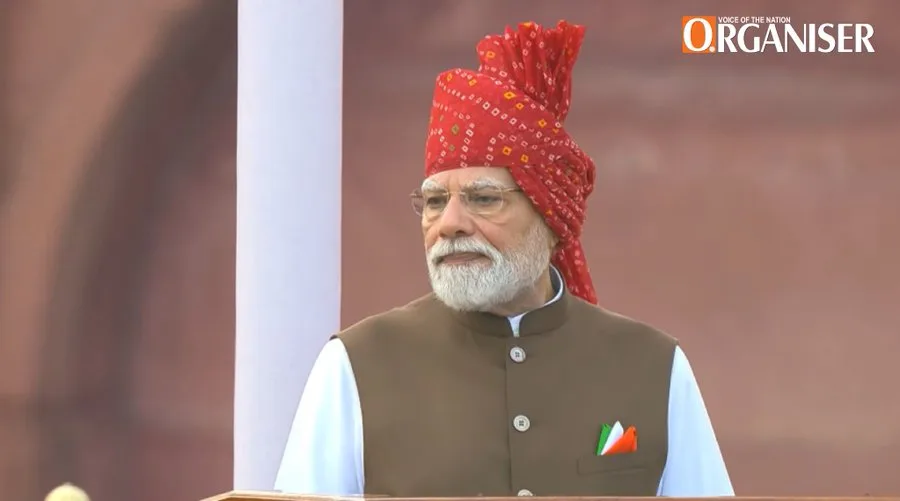
#80thIndependenceDay | Prime Minister Narendra Modi hoists the Tiranga at the Red Fort on the occasion of Bharat’s 80th Independence Day.
The flag hoisting is synchronised with a 21-Gun Salute by the 1721 Field Battery (Ceremonial), using indigenous 105mm Light Field Guns. The… pic.twitter.com/jxATzBogb6
— Organiser Weekly (@eOrganiser) August 15, 2026
For India, investments in hydrogen technology are part of a broader effort to develop new energy sources and reduce dependence on conventional fossil fuels.
The Prime Minister used the hydrogen train as an example of India’s move towards new fuel technologies and the development of indigenous technological capabilities.
100 percent railway electrification
Railway electrification was another area highlighted during the address.
Modi contrasted the pace of railway electrification in the past with the progress achieved over the last decade.
He said only around 30 per cent of India’s railway network had been electrified between 1925 and 2014, describing it as 30 per cent achieved over roughly 90 years.
According to the Prime Minister, India has now achieved 100 per cent railway electrification over the past decade.
Railway electrification has implications beyond transportation. It reduces dependence on diesel-powered locomotives and allows the railway network to increasingly use electricity generated from a broader energy mix.
The development therefore fits into the government’s larger narrative around energy efficiency, infrastructure modernisation and reduced dependence on imported fuels.
Opening up India’s coastline for exploration
Modi also raised the issue of domestic resource exploration.
He said that 99 per cent of India’s coastline had earlier been classified as a “no-go area” for exploration.
According to him, the government has now opened up these areas for exploration.
The Prime Minister criticised the earlier approach as reflecting a “poverty of thought”, arguing that India needs to explore its own natural resources to strengthen its resource security.
The focus on domestic exploration ties back to the larger theme of the speech — reducing dependence on external sources by making better use of India’s own resources and technological capabilities.
For an economy with rapidly rising energy and industrial requirements, exploration can potentially play an important role in identifying additional domestic resources.
Atmanirbhar Bharat as a broader economic strategy
Taken together, the various announcements and statistics cited by Modi point towards a broader interpretation of Atmanirbhar Bharat.
The Prime Minister’s self-reliance message was not limited to consumer products. Instead, the focus was on strategic sectors where dependence on foreign suppliers could have wider economic or security implications.
Semiconductors represent technological capability. Critical minerals represent resource security. Nuclear and solar energy represent power security. Hydrogen represents future fuel technology. Railway electrification represents infrastructure and energy efficiency, while domestic exploration represents resource availability.
The common thread is reducing vulnerabilities in critical supply chains.
Modi also reiterated the importance of Swadeshi products, saying Indians were increasingly supporting locally made goods. The push for domestic consumption is intended to complement manufacturing expansion by creating demand for Indian products.
The government has increasingly sought to position India as both a major manufacturing destination and a producer capable of meeting a larger share of its own strategic requirements.
The larger 2047 vision
The emphasis on semiconductors, minerals and energy also needs to be viewed against the government’s Viksit Bharat 2047 vision.
India’s development ambitions will require considerably greater energy availability, technological capacity, manufacturing strength and infrastructure.
The challenge is therefore not simply increasing production but creating domestic ecosystems around strategic sectors.
The semiconductor push requires skilled manpower, supply chains and advanced manufacturing infrastructure. Critical minerals require exploration, processing and international partnerships. Energy security requires a diversified generation mix and modern transmission and distribution infrastructure.
The government is attempting to address these areas simultaneously.
Modi’s Independence Day address therefore presented self-reliance not merely as an economic slogan but as a strategy for building resilience across sectors that will determine India’s future growth.
A shift from dependence to strategic capability
The central message from the Red Fort was that India’s development journey cannot depend indefinitely on external suppliers for technologies, minerals and energy.
The Prime Minister’s emphasis on semiconductors, critical minerals, nuclear power, solar energy, hydrogen, gas infrastructure and domestic exploration reflected an attempt to connect multiple policy priorities under one larger objective, strategic self-reliance.
As India moves towards 2047, the ability to manufacture critical technologies, secure essential raw materials and meet growing energy demand will increasingly influence both economic competitiveness and national security.
The 80th Independence Day address thus placed these sectors at the centre of India’s next phase of development, with the government seeking to move from being primarily a large market and consumer economy towards becoming a stronger producer of the technologies, resources and energy systems needed for its own future.