
India, often described as a subcontinent for its vast geographical expanse and extraordinary cultural diversity, is home to one of the world’s richest linguistic landscapes. According to the People’s Linguistic Survey of India, more than 780 living languages are spoken across the country. The 2011 Census of India recorded 19,569 reported mother tongues, which were rationalized into 1,369 mother tongues and classified under 121 major languages, including the 22 languages recognized in the Eighth Schedule of the Constitution.
What makes this linguistic diversity particularly remarkable is that a substantial part of India’s intellectual and cultural heritage has been preserved not in written texts but through its vibrant oral tradition. For millennia, knowledge, memory, and cultural practices have been transmitted across generations through spoken word, sustaining a living tradition even in the absence of written scripts. This enduring continuity reflects the remarkable resilience and depth of the Indian knowledge tradition.
The Spoken Legacy of Knowledge
One of the defining features of the Indian intellectual tradition is that a substantial part of it has been transmitted orally across generations. While around 26–28 Indian languages possess distinct scripts and rich written literatures, many others have sustained vibrant literary traditions without extensive written documentation. More remarkably, the Indian knowledge system developed a unique mode of preserving even written knowledge through disciplined oral transmission from one generation to the next—a phenomenon rarely seen with such depth and continuity elsewhere in the world.
This highlights a fundamental insight of the Indian knowledge tradition: knowledge and literature are not confined to written texts alone; they can flourish equally through oral expression. A key principle of linguistics is that wherever people speak, forms of literature inevitably emerge. The medium of transmission may be written or oral, but the creative impulse remains the same. The distinction between an ordinary utterance and a literary one often lies in its context—when it is spoken, why it is spoken, and by whom. This inherent creativity of speech explains why literature continues to be constantly created and renewed through oral expression.
Orality is deeply embedded even within India’s script-based literary traditions, particularly in Sanskrit, the language in which a large part of the Indian knowledge corpus was composed. The same holds true for other classical and regional languages such as Prakrit, Kannada, Marathi, Bengali, Punjabi, and Gujarati. Expressed through the śruti–smaraṇa tradition of listening, memorisation, and recitation, orality constitutes one of the defining features of India’s intellectual heritage. In this sense, the Indian knowledge tradition is not merely textual; it is simultaneously oral, performative, and audiovisual—a tradition intended to be recited, chanted, sung, heard, and experienced. Evolving alongside Indian civilization, this dynamic mode of knowledge transmission flourished for centuries before the disruptions brought about by colonial rule.
This creative oral impulse is evident in the Mahābhārata, one of the foundational texts of the Indian literary tradition, and becomes even more tangible in the Rāmcharitmānas, composed in Awadhi several centuries ago. Although both works exist as written texts, their metrical structure makes them equally suited for recitation, chanting, and singing. More broadly, Indian intellectual culture has long communicated ideas through stories, songs, and dramatic performances, using narratives and exemplars to transmit ethical, philosophical, and social knowledge. The Mahābhārata and the Rāmāyaṇa, together with their hundreds of thousands of regional retellings, linguistic adaptations, and community-based performances, exemplify one of the world’s most vibrant oral narrative traditions. The literary wealth generated through this tradition far exceeds the combined scale of the Iliad and the Odyssey, underscoring the extraordinary richness and continuity of India’s oral heritage.
Oral Tradition: A Culture of Collective Participation
The relationship between literature and its audience in India has been profoundly shaped by this oral tradition. Unlike much of the script-based literary culture of the West, which is often individualistic and intended for solitary reading, Indian literary traditions are inherently participatory and communal. They are, at their core, collective cultural experiences in which the boundaries between performer and audience are deliberately blurred.
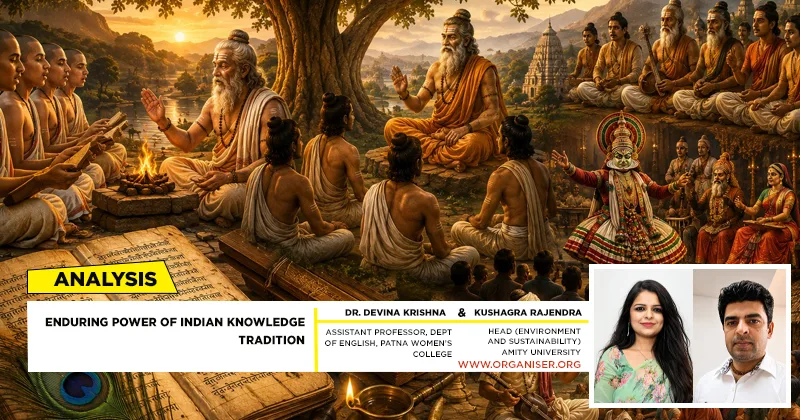
Oral and performative traditions invite active engagement rather than passive observation. Whether in the recitation of Vedic hymns, dramatic enactments of the Mahābhārata and the Rāmāyaṇa, Karnataka’s Yakshagana, Kerala’s Kathakali, the Ramlila of North India, or the traditions of satsang and kathā-vācana, the emphasis is on shared experience and collective participation. In Yakshagana, audiences do not merely watch the performance; they respond spontaneously to dialogues, cheer the heroes, and become part of the unfolding narrative. During a Ramlila, spectators grieve when Lakshmana falls unconscious and erupt in celebration at the defeat of Ravana. Such performances are dialogues rather than monologues, transforming literature into a shared emotional experience.
This participatory ethos is one of the defining strengths of the Indian knowledge tradition. Here, literature is not simply consumed—it is collectively experienced, interpreted, and continually renewed through public participation. Contemporary devotional singing groups and bhajan clubs demonstrate that this tradition remains vibrant, carrying the spirit of oral culture into modern social life. In this sense, India’s oral tradition represents a genuine democratisation of knowledge and literature, sustained by the community’s natural and active participation.
The extraordinary reach of India’s oral traditions necessitated the development of highly sophisticated techniques for memorizing and preserving vast bodies of knowledge. The Vedas, for instance, are not traditionally read but heard (śruti), reflecting a pedagogical system in which listening, memorization, and recitation form the foundation of learning. This tradition continues to the present day. Likewise, the Guru Granth Sahib, composed in poetic metres and arranged according to musical rāgas, is intended to be sung (bāṇī), allowing its teachings to be internalized through melody, rhythm, and collective recitation.
According to research published by India’s Ministry of Culture, Vedic chanting represents one of the world’s longest continuous oral traditions. Preserved for millennia through the guru–śiṣya (teacher–disciple) tradition, it has been transmitted orally with remarkable fidelity across generations. UNESCO recognizes that the significance of this tradition lies not only in the antiquity and richness of the Vedic corpus but also in the extraordinarily refined oral techniques that enabled generations of students and teachers to preserve these texts with exceptional accuracy, entirely independent of written manuscripts. It is this unique combination of historical continuity and sophisticated oral pedagogy that led UNESCO to inscribe Vedic chanting on the Representative List of the Intangible Cultural Heritage of Humanity.
The remarkable preservation of the Vedas has also drawn the attention of modern scholars. Despite being among the world’s oldest surviving texts, they have retained an extraordinary degree of textual integrity. The German philologist Friedrich Max Müller acknowledged this exceptional achievement, attributing it to the meticulous methods devised by Vedic seers. These included elaborate systems of recitation that safeguarded every syllable, accent, and intonation, ensuring the faithful transmission of the texts across thousands of years.
The Vedas: Sophisticated Techniques of Oral Preservation
The faithful preservation of the Vedas over several millennia remains one of the most extraordinary achievements in the history of human knowledge. To protect the texts from error, omission, or interpolation, Vedic scholars developed an exceptionally rigorous system of oral verification based on multiple modes of recitation. Three primary methods formed the foundation of this tradition: Saṃhitā-pāṭha, in which the text is recited continuously as a connected whole; Pada-pāṭha, where each word is pronounced separately to preserve its independent form; and Krama-pāṭha, in which words are recited in overlapping pairs. Beyond these were eight increasingly complex vikṛti-pāṭhas (modified recitation patterns), culminating in Ghana-pāṭha, one of the most sophisticated mnemonic systems ever devised. In these advanced methods, words are repeated in carefully structured forward and reverse sequences, creating multiple layers of internal verification. Even a minor omission or alteration would disrupt the entire recitational pattern, making errors immediately detectable.
Equally significant was the preservation of Vedic accent and intonation. The Vedic tradition recognizes that meaning depends not only on words but also on their precise tonal delivery. A change in accent can fundamentally alter the meaning of a mantra. This principle is illustrated by the well-known Purāṇic account of the sage Tvaṣṭṛ. Seeking the birth of a son destined to slay Indra, he is said to have mispronounced a crucial Vedic accent during the sacrificial ritual. As a consequence, the intended meaning was reversed, and the son born from the sacrifice—Vṛtrāsura—was ultimately slain by Indra instead. While the narrative is mythological, it powerfully underscores the traditional insistence on absolute precision in pronunciation and intonation.
Within the Indian intellectual tradition, the Vedas are regarded as svataḥ-pramāṇa—self-validating sources of knowledge. Much like the sun requires no external light to establish its presence, the authority of the Vedas has traditionally been understood to rest in their intrinsic validity rather than external verification. This conception has profoundly shaped the epistemological foundations of Indian philosophy, where the Vedas are revered not merely as ancient texts but as an authoritative and self-sustaining source of knowledge.
The predominance of orality profoundly shaped the form, structure, and style of Indian intellectual literature. In a culture where knowledge was preserved primarily in human memory rather than written repositories, scholars developed literary forms that maximized memorability. Instead of lengthy prose, complex ideas were often composed in verse, metre, and rhythm, making them easier to learn, retain, and transmit. Even the Amarakośa—one of the world’s earliest and most celebrated lexicons—was composed entirely in metrical verse so that students could memorize it through recitation.
To strengthen both memory and comprehension, Indian scholars evolved a range of sophisticated pedagogical techniques. The sūtra style condensed intricate philosophical and scientific ideas into remarkably concise aphorisms, much like mathematical formulae encapsulate complex principles. The principle of anuvṛtti linked successive statements so that each idea naturally reinforced the next, creating a coherent chain of recall. Equally important was the careful use of accent, rhythm, and melodic intonation, which served as powerful mnemonic cues, enabling both accurate memorization and deeper conceptual understanding. These methods produced an intellectual culture in which vast bodies of knowledge could be internalized with extraordinary precision. Rather than relying primarily on written reference, scholars cultivated disciplined habits of memorization, allowing them to engage fluently with extensive textual traditions. The preference for brevity also encouraged exceptional precision of expression, giving rise to concise yet conceptually rich works across disciplines ranging from grammar and philosophy to mathematics, astronomy, medicine, and logic. This distinctive synthesis of memory, concision, and intellectual rigor remains one of the defining achievements of the Indian knowledge tradition.
The Vyāsa Tradition: Renewing Knowledge Across Generations
One of the greatest strengths of the Indian knowledge tradition has been its remarkable continuity. Rather than remaining static, it has evolved through an unbroken process of preservation, interpretation, and renewal. As the eminent scholar Kapil Kapoor observes, the Indian intellectual tradition is inherently cumulative: each new work builds upon earlier knowledge, extending and reinterpreting it in response to changing contexts. Even during periods of political upheaval, when renowned libraries and centres of learning were destroyed, this knowledge tradition endured because it was sustained not merely in manuscripts but through the living guru–śiṣya (teacher–disciple) tradition. Embedded within this oral culture was an enduring mechanism for preserving, renewing, and transmitting knowledge across generations. Classical texts were continually reinterpreted through commentaries, translations, and fresh expositions, ensuring that they remained relevant to changing times.
Within this larger process emerged what may be described as the Vyāsa tradition—a continuing practice of collecting, reorganizing, and rearticulating knowledge in accordance with the needs of different historical periods. Indian tradition attributes the first great compilation of the Vedic corpus to Vyasa, who is therefore revered as Vedavyāsa. Subsequent generations likewise recognized the need to reinterpret and reorganize inherited knowledge in response to social and historical transformations. Traditional accounts speak of a succession of twenty-eight Vyāsas, each entrusted with preserving and renewing the intellectual inheritance of their age. While this belongs to the traditional understanding of Indian intellectual history, it illustrates an enduring civilizational ideal: knowledge must be continually reorganized and re-expressed without losing its essential continuity.This spirit of renewal is reflected across later Indian traditions as well. Guru Nanak, after extensive journeys across the Indian subcontinent and neighbouring regions, articulated a universal vision of ethical and spiritual life, later preserved in the Guru Granth Sahib. Equally important was the enduring kathā–pravacana (narrative exposition) tradition, through which philosophical and spiritual ideas were communicated in accessible forms. Saints and poets such as Kabir, Surdas, Guru Nanak, Namdev, Tukaram, and Tulsidas transformed profound philosophical insights into the language of everyday people through poetry, song, and public discourse.
As a result, despite centuries of political change, social upheaval, and the loss of numerous institutions of learning, India’s ancient knowledge did not remain confined to scholars, libraries, or centres of education. Instead, it became deeply embedded in collective memory, devotional practices, and everyday cultural life. It is this remarkable capacity to preserve continuity while embracing renewal that has enabled the Indian knowledge tradition to remain vibrant, relevant, and living across the centuries.
Bridging Scholarly and Folk Traditions
The oral mode of transmitting knowledge created a unique continuum between India’s classical intellectual traditions and its rich corpus of folk knowledge. Rather than remaining confined to learned circles, disciplines such as medicine, mathematics, agriculture, grammar, music, dance, and astronomy found expression in everyday social life. Traditional healing practices, indigenous medical practitioners, community-based water management systems, agricultural knowledge, seasonal festivals, and local games have all been sustained through generations of oral transmission, preserving practical wisdom alongside formal learning.
Equally significant is the reciprocal relationship between textual scholarship and lived tradition. Classical treatises often drew upon accumulated empirical knowledge from local communities, while many elements of folk practice were informed by concepts articulated in scholarly texts. Ayurveda offers a compelling example. Foundational ideas such as the pañca-mahābhūta (five great elements) and the tridoṣa theory (vāta, pitta, and kapha) are not confined to specialist discourse but continue to shape the vocabulary of household remedies and everyday health practices across India. This continuous exchange between scholarly and vernacular traditions ensured that even the most sophisticated theoretical knowledge remained closely connected to lived experience rather than becoming exclusively textual or academic.
To facilitate the preservation and transmission of complex ideas, ancient Indian scholars also evolved the concise sūtra style, condensing extensive bodies of knowledge into brief, memorable aphorisms that were both easy to memorize and intellectually rich. Together with the oral pedagogical tradition, this created an integrated framework in which theoretical inquiry and practical experience continually reinforced one another. The result was a multidimensional knowledge system that linked philosophy and spirituality with medicine, ecology, agriculture, mathematics, and other domains of everyday life. Today, the revitalization of the Indian Knowledge System seeks to recover this invaluable oral heritage—not as a relic of the past, but as a living intellectual resource. By integrating traditional knowledge with contemporary research, scientific inquiry, and education, it offers new possibilities for addressing present-day challenges through a dialogue between inherited wisdom and modern understanding.
Oral Tradition: Past, Present, and Future
In conclusion, India’s oral traditions are not relics of a distant past but the living foundation of its knowledge civilization. They have profoundly shaped the character of Indian literature, the methods through which knowledge has been preserved with remarkable fidelity, and the enduring relationship between scholarly learning and the wider community. The voices that have carried this knowledge across countless generations constitute one of India’s most distinctive civilizational assets—preserving the wisdom of the past while continuing to inform the present and inspire the future. The growing emphasis on Indian languages today reflects a renewed recognition of the linguistic diversity and oral foundations of this knowledge tradition. Sanskrit, together with the country’s regional and mother tongues, embodies centuries of accumulated learning in fields ranging from philosophy, mathematics, and medicine to ecology and everyday life. Strengthening these languages not only deepens intellectual engagement but also enables traditional knowledge to contribute meaningfully to contemporary scientific inquiry and sustainable solutions for the challenges of the twenty-first century.
The enduring vitality of India’s oral tradition lies in its unique ability to connect classical scholarship with lived experience. Preserved and transmitted through Sanskrit as well as the country’s many regional languages, this living heritage continues to bridge generations, communities, and systems of knowledge. Far more than a repository of cultural memory, it remains a dynamic intellectual resource—one that affirms India’s civilizational continuity while offering enduring insights for a rapidly changing world.