
Far fewer know that Keralam is also home to one of India’s oldest Christian communities — the St Thomas Christians or Syrian Christians — who trace their faith to the arrival of the Apostle Thomas in the first century. Within this ancient community, and also among other Christian groups in Kerala, bitter factional splits have repeatedly turned sacred spaces into battlegrounds.
The most enduring and bitter of these is the century-old division between the Malankara Orthodox and Jacobite Syrian factions. For more than a hundred years, disputes over church control, property, and authority have led to locked churches, police interventions, and physical clashes inside places of worship.
Malankara Orthodox and Jacobite Syrian factions’ clashes inside Church
A century-old feud between the Malankara Orthodox and Jacobite Syrian factions erupted again this week inside a Piramadom church near Muvattupuzha— a reminder that in Kerala, court verdicts settle paperwork, not disputes.
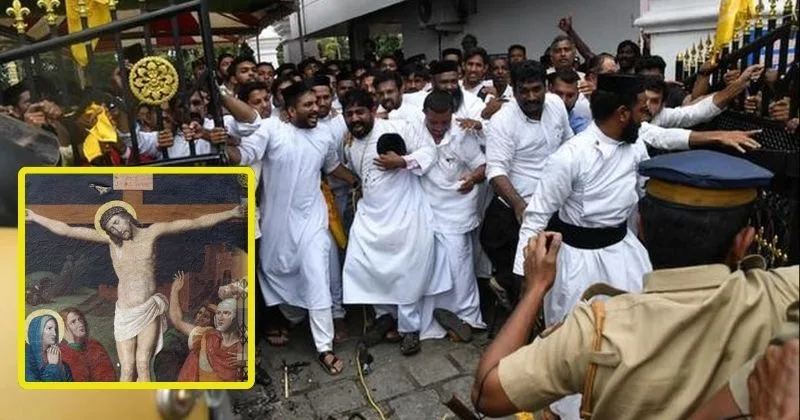
On Sunday morning, at the St John’s Bethlehem Syrian Church near Muvattupuzha in Piramadom, just as the Holy Qurbana had started, the sanctuary became a place of pushing, shouting and disorderly behaviour among the clergy. For about half an hour, priests from the Malankara Orthodox and Jacobite Syrian factions fought near the altar—that area which is supposed to be the most sacred in the church. Three people were injured, one of them being an Orthodox priest—only after the police from Ramamangalam had arrived did they take control of the church. The worshippers, who had come for the Sunday service, instead saw their clergy fighting over the right to stand at that altar.
What happened soon after Qurbana on Sunday
The direct cause of the situation was procedural. A number of Orthodox priests came to the church citing a order from the Muvattupuzha Sub Court which they claimed supported their faction’s claim to the church. The Jacobite priest and the members of the congregation who were already in possession of the building opposed this, referring to a ruling by the Munsiff Court which they said was in their favour. What then happened was more a physical conflict than a theological one.
Although the police at first took no action, a case was subsequently filed within a few days against twenty-two people on charges such as wrongful restraint, abuse and causing hurt, as reported locally. The Ernakulam district administration, under Collector G. Priyanka, arranged for talks between both sides at the Collectorate — this being the usual next stage in a dispute that Kerala has been seeing, in one church or another, for well over a century.
When Church Votes Matter More: LDF-UDF Governments Shy Away From Enforcing Supreme Court Verdict
Piramadom was the oldest and most enduring division within Kerala’s Christian community—that of the 1912 schism which divided the Malankara Syrian Church into two groups, one of which owes allegiance to an autocephalous Catholicos based in India (the Orthodox faction) and the other which still recognises the spiritual authority of the Syriac Orthodox Patriarch of Antioch (the Jacobite faction).
Although their doctrines differ only slightly in theory, in reality the conflict has always been over more tangible issues: who has the right to administer the parish, who controls its finances, and who is allowed to stand at the altar on a Sunday morning. What is remarkable in this dispute is the extent to which it has already been decided upon.
The Supreme Court has dealt with the issue on several occasions—first in 1958, then in 1995 and definitively in 2017—each time confirming the binding nature of the 1934 Malankara Church Constitution and, in effect, supporting the Orthodox administration of the parish churches.
In December 2024 the Court went a step further by ordering the transfer of a particular group of churches that are in dispute, including St John’s Bethlehem at Piramadom, together with St Mary’s at Odakkali, St Thomas at Mazhuvannoor and other churches in the Ernakulam and Palakkad districts of Keralam.
The fact that a church mentioned in a Supreme Court order to hand over the churches was still eight months later the scene of clergy arguing about who had the right to possession tells us more about the state’s desire to enforce the law than it does about the law’s ambiguity.
When appearing before a Division Bench of the Kerala High Court in relation to the administration of those six churches, Chief Secretary Biswanath Sinha told the court that the state government, under Chief Minister V. D. Satheesan, was pursuing a negotiated solution rather than carrying out enforcement by force. For the Orthodox side — whose Metropolitan, Dr Yuhanon Mar Dioscoros, after the Piramadom clash stated that a favourable court decision had already been reached and that “justice must be implemented” — the state’s choice of negotiation over enforcement appears to be yet another instance of delay.
This preference is not a new one and does not apply only to one party or one government; successive administrations — both those of the Left Democratic Front and the United Democratic Front — have opted for mediation instead of enforcement in the dispute between the Orthodox and Jacobite communities, a trend which, due to the electoral influence of Kerala’s Syrian Christian community, who are concentrated in exactly the central Travancore constituencies where these churches are located.
In other words, locking up a disputed church and having the police posted outside it has on numerous occasions turned out to be a more politically safe course than handing over the keys to the side which the Supreme Court has ruled owns them.
Syro-Malabar’s Five-Year Liturgical Rift: A Dispute!
A different and entirely separate dispute within the church provides a useful contrast in terms of how a religious disagreement can be settled. In the Syro-Malabar Church — an Eastern-rite Catholic Church in full communion with Rome and therefore distinct from both the Orthodox and Jacobite groups — the Archdiocese of Ernakulam-Angamaly was in open rebellion for most of five years over a liturgical instruction.
In 2021 the Syro-Malabar Synod ordered a single method of celebrating the Holy Qurbana, requiring the priests to face the altar when saying the Eucharistic prayer, thus departing from the archdiocese’s longstanding custom of facing the congregation.
The Ernakulam-Angamaly archdiocese, which is the largest and most influential in the Church, refused to comply. The resistance led to its own fair share of unpleasant incidents: the one-year closure of St Mary’s Basilica in Ernakulam, official circulars being set on fire, administrators being forced out of their parish offices, and threats of canonical sanctions and excommunication being made against the defiant priests. Pope Francis personally asked for obedience, including by means of a recorded video message, and in 2023 Rome sent a papal delegate, Archbishop Cyril Vasil, to help bring about a peaceful resolution.
The disagreement ultimately came to an end—not by means of a court ruling but as a result of negotiations within the Church. Following the election of a new Major Archbishop, Raphael Thattil, in January 2024, discussions were restarted with the priests who had been protesting under Archbishop Joseph Pamplany. On 19 June 2025, over three hundred priests arrived at an agreement with the Church hierarchy: the uniform-mode Mass would be celebrated at least once on each Sunday and on holy days, while the traditional Mass facing the congregation would continue to be held for the rest of the week; administrators would have the parish priests removed; and any pending police complaints and canonical proceedings against the protesting clergy would be dropped.
The new rules came into force on 3 July 2025, which was the feast day of St Thomas the Apostle. Since Rome had been satisfied that the crisis was over, it terminated the papal delegate’s mandate the following week.
When placed side by side, the two conflicts raise an unpleasant conclusion. The dispute over liturgy in the Syro-Malabar Church—truly a matter concerning sacred rites and internal authority—was settled within about four years as a result of negotiations after the Church’s own leadership had decided that reaching a resolution was more important than adhering to doctrine imposed from above.
In contrast, the Orthodox–Jacobite dispute, which involved questions of property and administrative control and had already been given a final decision by a Supreme Court, has remained unresolved more than a hundred years after the schism and nearly ten years after the highest court had issued its apparently final ruling. The reason for the difference is not the law but rather the willingness of the institutions responsible for enforcing it—a state government which is accountable to the voters in the very areas where these churches are located—to carry out their duty.
The cost of that reluctance can be seen in situations such as the one that occurred at Piramadom on Sunday, when older worshippers were pushed aside close to the altar, the priests fought over a technicality in a court room, and the congregation found itself embarrassed within its own church. This week district officials will seat the two sides down at the Collectorate, as they have done following numerous previous incidents, in order to arrange further discussions. Unless a state government at some point along the way decides that a Supreme Court order is intended to be carried out rather than merely managed, Piramadom will not be the last church in Kerala where Sunday Mass ends in a fight rather than a blessing.