Saudi-Pakistan-Turkey pact faces question over Islamic divide
August 30, 2026
  • Read Ecopy
  • Circulation
  • Advertise
  • Careers
  • About Us
  • Contact Us
Android AppiPhone AppArattai
Organiser
  • ‌
  • Bharat
    • Assam
    • Bihar
    • Chhattisgarh
    • Jharkhand
    • Maharashtra
    • View All States
  • World
    • Asia
    • Europe
    • North America
    • South America
    • Africa
    • Australia
  • Editorial
  • International
  • Opinion
  • RSS @ 100
  • More
    • Op Sindoor
    • Analysis
    • Sports
    • Defence
    • Politics
    • Business
    • Economy
    • Culture
    • Special Report
    • Sci & Tech
    • Entertainment
    • G20
    • Azadi Ka Amrit Mahotsav
    • Vocal4Local
    • Web Stories
    • Education
    • Employment
    • Books
    • Interviews
    • Travel
    • Law
    • Health
    • Obituary
  • Subscribe
    • Subscribe Print Edition
    • Subscribe Ecopy
    • Read Ecopy
  • ‌
  • Bharat
    • Assam
    • Bihar
    • Chhattisgarh
    • Jharkhand
    • Maharashtra
    • View All States
  • World
    • Asia
    • Europe
    • North America
    • South America
    • Africa
    • Australia
  • Editorial
  • International
  • Opinion
  • RSS @ 100
  • More
    • Op Sindoor
    • Analysis
    • Sports
    • Defence
    • Politics
    • Business
    • Economy
    • Culture
    • Special Report
    • Sci & Tech
    • Entertainment
    • G20
    • Azadi Ka Amrit Mahotsav
    • Vocal4Local
    • Web Stories
    • Education
    • Employment
    • Books
    • Interviews
    • Travel
    • Law
    • Health
    • Obituary
  • Subscribe
    • Subscribe Print Edition
    • Subscribe Ecopy
    • Read Ecopy
Organiser
  • Home
  • Bharat
  • World
  • Operation Sindoor
  • Editorial
  • Analysis
  • Opinion
  • Culture
  • Defence
  • International Edition
  • RSS @ 100
  • Magazine
  • Read Ecopy
Home World

Islamic NATO or Sunni Bloc? Saudi-Pakistan-Turkey pact faces question over Islam and sectarian divide

The Saudi-Pakistan-Turkey defence pact, dubbed an “Islamic NATO”, is drawing criticism as a Sunni bloc aimed at countering Iran rather than promoting genuine pan-Islamic unity

Dr Vishnu AravindDr Vishnu Aravind
Aug 10, 2026, 07:00 pm IST
inWorld, West Asia, Analysis, Asia, International Edition
Follow on Google News
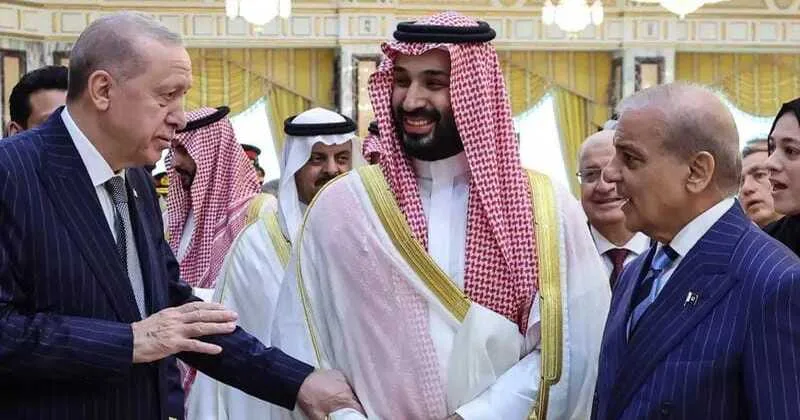
Turkey’s President Recep Tayyip Erdogan, Saudi Crown Prince Mohammed bin Salman, and Pakistan Prime Minister Shehbaz Sharif

Turkey’s President Recep Tayyip Erdogan, Saudi Crown Prince Mohammed bin Salman, and Pakistan Prime Minister Shehbaz Sharif

Facebook
Twitter
WhatsAppTelegramEmail

New Delhi: The recently signed Mecca Joint Defense Agreement linking Saudi Arabia, Pakistan, and Turkey has been touted by its architects as a milestone for pan-Islamic collective security. However, regional analysts and political figures across the West Asia and South Asia are increasingly questioning the validity of the pact. Rather than representing a unified, trans-regional “Islamic NATO,” critics argue that the accord is little more than a sectarian-tinged Sunni bloc directed against Shia Iran, further entrenching the deep-seated divisions that prevent any genuine solidarity across the Islamic world.

Sectarian alignments masked as collective security

While officials in Riyadh, Islamabad, and Ankara insist the trilateral arrangement is intended purely for “collective deterrence” and regional stability, the geopolitical realities on the ground suggest a far more partisan objective. By bringing together the West Asia’s richest Sunni monarchy, South Asia’s terror Sunni power, and NATO’s Sunni military force, the treaty effectively draws a tight security perimeter around Tehran.

Rather than transcending historic sectarian fractures, critics contend that the alliance formalizes them. Political commentators argue that calling the arrangement an “Islamic NATO” ignores the exclusion of major non-Sunni powers in the Muslim world, most notably Iran.

The narrative of a united Islamic defense front crumbles under the weight of historic theological and political rivalry, revealing a coalition driven by sectarian balancing and realpolitik rather than broad-based religious alignment.

Denunciations from Tehran to Islamabad

Reactions against the tri-nation pact were swift, highlighting how the pact deepens mistrust rather than fostering unity. Speaking out against the treaty, Ebrahim Rezaei, a member of the Iranian Parliament’s National Security and Foreign Policy Commission, sharply dismissed the strategic utility of the alignment for Riyadh. “The Saudis should know that a paper agreement with Turkey and Pakistan will not bring them security, just as years of one-sided ‘milking’ by the Americans did not bring them security,” Rezaei stated publicly, urging Riyadh to stop trying to “beg for security from others”.

Iran's FM Spox. Esmail Baghaei on the Mecca Agreement:

There is no reason for us to be concerned that this pact between the two neighboring countries of Türkiye and Pakistan, as well as Saudi Arabia—three countries with which we share deep religious, historical, and… pic.twitter.com/L0I6tJzb9b

— Clash Report (@clashreport) August 10, 2026

Criticism was not restricted to Tehran. Prominent diplomatic voices within the member nations themselves expressed deep skepticism regarding the pact’s substance. Husain Haqqani, former Pakistani Ambassador to the United States and a high-ranking diplomat, dismantled the concept of a grand military alliance, characterizing the deal as fundamentally flawed. “The Saudi-Turkiye-Pakistan Mutual Defence Agreement is more symbolic than substantive,” Haqqani noted. “A shared enemy is the first element of a mutual defence agreement and that is absent here. It might enhance intelligence sharing and joint munitions production, but it will not be the ‘Muslim NATO’ some people are talking about”.

Also Read: Trump Restricts Birthright Citizenship: US constitution & SC rulings vs President’s protectionism amid fierce backlash

Haqqani further stressed that the divergent national security priorities of Islamabad, Ankara, and Riyadh make a unified defense architecture virtually impossible, stating that “joint defense is generally against a common enemy. If there is no common enemy, then defensive cooperation may exist, but not joint defense.”

Strategic divergence and the illusion of unity

The fundamental flaw in viewing the tri-nation pact as an overarching military bloc lies in the starkly conflicting agendas of its signatories. Pakistan remains consumed by its border disputes with India and internal instability. Turkey’s defense policy remains bound to its commitments to Western partners in NATO and Saudi Arabia remains primarily focused on countering Iranian influence and protecting its critical infrastructure.

This absence of a shared global strategy illustrates why pan-Islamic security concepts consistently collapse into narrow self-interest. Rather than creating a stable, self-reliant defense network, the Mecca agreement highlights the structural instability of coalition-building along sectarian lines. As long as regional powers prioritize containment of their neighbors over genuine regional integration, the notion of a single, unified “Islamic NATO” will remain a geopolitical myth, replaced instead by fragile, transactional pacts that aggravate existing fault lines.


Topics: Shia-Sunni divideSaudi-Pakistan-Turkey Security PactIslamic NATOPakistanIranTurkeySaudi ArabiaWest Asia Conflict
Dr Vishnu Aravind
Dr Vishnu Aravind
Dr Vishnu Aravind is a researcher, political commentator and writer based in New Delhi, with a PhD from Jawaharlal Nehru University (JNU). His areas of interest include international politics, Indian foreign policy, electoral politics, election analysis, political developments, and cultural affairs. [Read more]
Share
Tweet
SendShareSend
✮ Subscribe Organiser YouTube Channel. ✮
✮ Join Organiser's WhatsApp channel for Nationalist views beyond the news. ✮
Previous News

India condemns attack on Embassy in Slovenia; MEA invokes Vienna Convention, affirms diplomatic premises as inviolable

Next News

Commonwealth Games 2026: Over to Amdavad

Related News

The demolition of Shri Guru Singh Sabha Gurdwara has intensified fears over the disappearance of Pakistan’s Sikh religious heritage

Pakistan demolishes 200-year-old Sikh Gurdwara in Quetta; Historic minority heritage land sold for commercial project!

Leftists Vs Rabindranath & Rakshabandhan: Red sickle strike of fraternity

US religious freedom panel, headed by a Pakistani, peddles lies about RSS ahead of Sarsanghachalak’s US visit

Maulana Abul Ala Maudidi (1903-1979)

85 Years of Jamaat-e-Islami in the Subcontinent: Maududi and His Organization

JeM headquarters rebuilt in Bahawalpur, Pakistan

Pakistan: Destroyed in Operation Sindoor, JeM base rebuilt in 15 months; Exposes Islamabad’s eternal terror nexus

AI Generated Image

West Asia: 20,000+ Pakistanis deported; Gulf countries flag illegal entry, drug trafficking & national security threat

Load More

Latest News

Students at the Gautam Buddha University, Greater Noida

Mann Ki Baat: PM Modi praises GBU’s mission ShakthiSAT, says dreams of daughters are now taking flight to space

Dutch TikTokker Angelo Bryson, known as Superhuman Unchained, at a pro-Palestine protest.

Dutch TikTokker recently converted to Islam livestreams stabbing three in Amsterdam; Watch video

From Kanchipuram to Kalamkari, India’s traditional textiles reflect its rich regional cultures and centuries-old craftsmanship

From Kanchipuram to Kalamkari: Exploring India’s rich traditional textiles and regional clothing heritage

Punjabi Influencer Abducted, Burnt Alive Near Morinda

Punjab Law and order crisis: Influencer Manjeet Kaur abducted, burnt alive after attack near Morinda

‘Dimagi Naxals’ romanticising Mao, Stalin and Pol Pot

The Swadeshi movement turned Indian enterprise into a powerful force for economic self-reliance, national pride and the struggle for Swaraj

Building Economic Swaraj: How Indian enterprises fought foreign rule and reclaimed national pride

Prime Minsiter Narendra Modi and Uzbekistan President Shavkat Mirziyoyev

India-Uzbekistan Herald New Chapter: Uranium deal, 30-day visa-free entry to Indians & $5bn trade propel bilateral ties

The new FCRA rules seek to curb unchecked foreign funding, strengthen financial accountability, and protect Bharat’s national security

Stopping Unchecked Foreign Money: How new FCRA rules protect Bharat’s security and financial sovereignty

Keralam CM VD Satheeshan, DCC member Chembil Anil (Left to Right)

Keralam Congress infighting surfaces in CM VD Satheeshan’s vehicle blockade; DCC member Chembil Anil arrested, remanded

Indian Logistics Data Bank tracks ten crore containers, transforming freight visibility and strengthening the nation’s logistics network

From Lothal Dockyard to Ten Crore Containers: India’s Logistics Data Bank transforms EXIM freight tracking

Load More
  • Privacy
  • Terms
  • Cookie Policy
  • Refund and Cancellation
  • Delivery and Shipping

© Bharat Prakashan (Delhi) Limited.
Tech-enabled by Ananthapuri Technologies

  • Home
  • Search Organiser
  • Bharat
    • Assam
    • Bihar
    • Chhattisgarh
    • Jharkhand
    • Maharashtra
    • View All States
  • World
    • Asia
    • Africa
    • North America
    • South America
    • Europe
    • Australia
  • Editorial
  • Operation Sindoor
  • Opinion
  • Analysis
  • Defence
  • Culture
  • Sports
  • Business
  • RSS @ 100
  • Entertainment
  • More ..
    • Sci & Tech
    • Vocal4Local
    • Special Report
    • Education
    • Employment
    • Books
    • Interviews
    • Travel
    • Health
    • Politics
    • Law
    • Economy
    • Obituary
  • Subscribe Magazine
  • Read Ecopy
  • Advertise
  • Circulation
  • Careers
  • About Us
  • Contact Us
  • Policies & Terms
    • Privacy Policy
    • Cookie Policy
    • Refund and Cancellation
    • Terms of Use

© Bharat Prakashan (Delhi) Limited.
Tech-enabled by Ananthapuri Technologies