The US President Donald Trump and his dramatic executive orders with the stated vision of “Make America Great Again” is repeatedly a political juggernaut that resurfaces time and again and jeopardises the socio-political, constitutional, economic and legal landscape of the United States. From the tariff tussle to the “One Big Beautiful Bill” and from the rigorous deportation of illegal migrants to the crackdown on citizenship & H-1B visas, every executive order has distorted the legal & constitutional alignments of the US and has escalated a gridlock & face-off among the administrative pillars of the US.
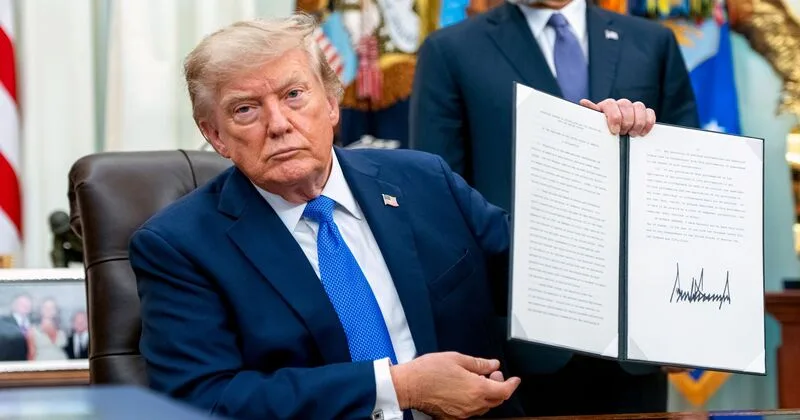
In the latest such political and legal skirmish, President Donald Trump has yet again imposed limits to birthright citizenship, despite previously facing setbacks in the Supreme Court. The executive order stamped amid severe backlash narrows down the scope of the 14th amendment of the US constitution, which empowers birthright citizenship. The two executive orders sealed on August 6, Thursday, takes a different path to limit birthright citizenship, than the White House’s previous attempts, which was apparently struck down by the US Supreme Court as “unconstitutional”.
The Trump administration argues that the latest restrictions imposed on birthright citizenship are not immune and mentioned under the 14th amendment of the US Constitution.
Latest executive order of Donald Trump; Who are excluded from birthright citizenship
- As per the latest orders, birthright citizenship will be restricted on “birth tourism” clauses. These are the people who travel to the United States exclusively and with the sole intention of giving birth in the American soil, so that the baby automatically attains the US citizenship
- The executive order also excludes birthright citizenship for the children of foreign government employees in the US. This includes, Ambassadors, Diplomats, Foreign Government Ministers, chargés d’affaires, counselors, secretaries and attachés of embassies and legations and members of the Delegation of the Commission of the European Communities, Employees of the UN & other international organisations
- Birthright citizenship will also be denied to the people who are categorised as “alien enemies”
Children of the parents who are tied to several terrorist organisations such as Antifa are also denied from birthright citizenship - The executive order is also entitled to affect the people born in the US territory, if Congress passes proposed legislation ending the automatic birthright citizenship
The White House further defended the executive order by claiming that the latest rules doesn’t violate the June 30 Supreme Court order, as it impacts those groups of citizens/people who fall outside the constitutional guarantee of birthright citizenship. Thus, the Trump administration has taken a deviation from its previous executive order, however, has aimed to impose restrictions on birthright citizenship.
The Trump administration has specifically cracked down on the practice of birth tourism, where people just travel to the US for baby delivery on American soil and claim US citizenship. “That practice of birth tourism is, as of the signing of this order, hereby banned. What that means is that no one in the world is anymore allowed to obtain a visa for this fraudulent purpose”, White House aide Stephen Miller said.
What is the 14th amendment? Why was it introduced in the US Constitution?
Birthright citizenship is enshrined in the 14th amendment of the US Constitution. It was introduced in 1868 to overturn the racist Dred Scott Supreme Court decision. This draconian and biased, inhuman ruling stated that the African Americans, whether they are free from slavery or enslaved, cannot ever be US citizens ever. However, post the US Civil War(1861 to 1865), which intended for complete abolition of slavery, the US Congress also aspired to liberate the slaved black Americans, by rendering complete citizenship and long due civil rights.
Thus, the 14th amendment was introduced to overturn the Dred Scott ruling and provide full scale citizenship for the newly freed enslaved Black Americans. The amendment aimed to permanently abolish the second-class hereditary caste of people.
Consequent Supreme Court rulings & legal backlash for Trump’s executive order
Post the 14th constitutional amendment, the US Supreme Court on many occasions has upheld birthright citizenship clauses.
United States vs Wong Kim Ark(1898)
In this landmark judgement, the US Supreme Court ruled that a child born in San Francisco to a Chinese citizen couple, who are legally residing in the United States, is a US citizen by birth. Thus, the court upheld the 14th constitution amendment and reiterated that anyone born on US soil is a citizen, irrespective of parents nationality or legal status. Children born on US soil for foreign national parents are the US citizens, the SC clarified.
Trump vs Barbara(2026)
In the latest ruling of June, 2026, the US Supreme Court struck down President Donald Trump’s previous executive order that curtailed the scope of birthright citizenship. In a 6-3 ruling, the verdict & Chief Justice John Roberts stated that the 14th Amendment covers nearly all persons born on U.S. territory. This was a pivotal legal backlash for Trump against his attempt to curtail the power of birthright citizenship.
Trump’s accusations
Meanwhile, President Trump described the court ruling as an “unfortunate decision”. “People are building businesses around it. That’s not the way it’s supposed to work. It’s a disgrace. They are buying their way in and we are not going to let it happen”, Trump exclaimed. “This was done for a different reason. This was done right after the civil war. This was for the babies of slaves and what’s happening now”, Trump further added.
The Supreme Court ruling struck down Trump’s previous executive order signed in 2025, on his first day in the President’s office during the second-term. SC reiterated that the Presidential order is unconstitutional and against the long-standing interpretations of the 14th amendment.
Trump faces severe criticism for the latest order
Similar to previous attempts, the latest executive order is also potential to encounter immediate legal challenges though the white House has aimed to bypass the June SC ruling and impose birthright citizenship ban on few groups rather than a blanket ban. Meanwhile, the latest executive order is facing intense criticism from the lawmakers, scholars and civil right advocacy groups for violating the constitutional right under the 14th amendment.
“The Supreme Court already decided this issue: Birthright citizenship is guaranteed by the Constitution”, said Cody Wofsy, Deputy Director of the American Civil Liberties Union’s Immigrants’ Rights Project. “No additional executive order can change the meaning of the Constitution. Any executive order that tries to rewrite birthright citizenship will meet the same fate as the last one”, Cody Wofsy further added.
Senator Alex Padilla, Democrat lawmaker from California posted on social media that Trump doesn’t understand the Constitution—but the 14th Amendment’s promise of birthright citizenship and equality speaks for itself. Similarly, Senator Ruben Gallego from Arizona wrote, “even our extremist Supreme Court ruled it’s not up for debate”.
César Cuauhtémoc García Hernández, a law professor at Ohio State University, questioned the grounds for banning citizenship for the children of those affiliated with terror outfits. “How is the federal government going to decide that a child is born to a member of a designated terrorist organization? These are not organizations that are sharing the membership lists if they even have them”, the Professor questioned.
The civil right groups also say that the latest executive order and a ban on birth tourism would give the immigration officers unhindered discretion to deny the visas for pregnant women, by doubting that they are here for birth tourism, without adequately verifying the real reason for visit. The activists slammed the executive order for not giving clear and explicit guidelines.
The latest dramatic executive order of Donald Trump is thus set to trigger massive political and legal debate, battle across the United States, as Trump’s protectionist directive doesn’t align with the legal and constitutional principles of the United States.