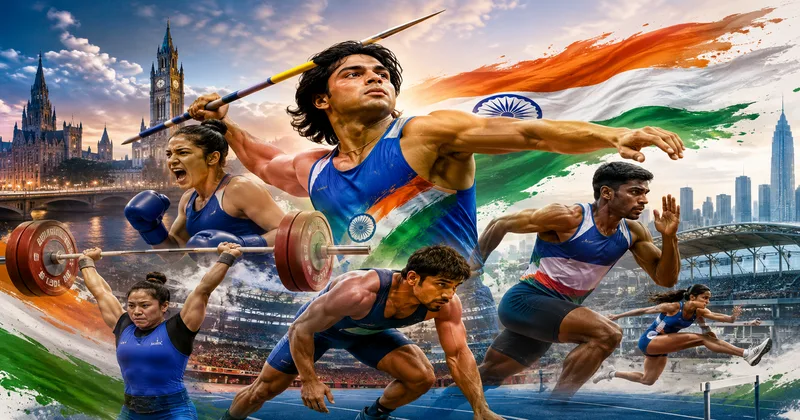
The Commonwealth Games (CWG) 2026, which began on July 23, 2026, came to a glittering close on August 2-3, 2026, at Glasgow, the capital city of Scotland (UK). The Indian contingent did its best under the circumstances and brought home 39 medals, including 13 gold, 17 silver and 9 bronze. The flag and baton of the CWG were handed over to the Indian officials at the end of the closing ceremony in recognition of the fact that the next CWG in 2030 would be held in India at Ahmedabad. The Indian Olympic Association President, P.T.Usha, Javelin Throw Champion, Neeraj Chopra and the Dy. Chief Minister of Gujarat, Harsh Sanghavi received the flag and the baton with the deserved honour and protocol of the Games.
This handover officially marked India taking charge to host the 2030 historic Centenary Commonwealth Games in Ahmedabad. The first such games were held in Hamilton, Canada, in 1930. Hosting the 2030 Games is expected to boost India’s global sporting profile, accelerate world-class sports infrastructure development, and showcase the country’s organisational capabilities on the international stage. It should also be seen particularly in the context of the preparations for the Asian Games to be held in September this year in Japan, followed by the Olympics to be held in the US in 2028.
India had sent a contingent of 191 members headed by Chief de Mission Rohit Rajpal and Deputy Chief de Mission Ravi Bengani. The contingent included 126 athletes (77 men and 49 women) and 51 team officials to participate in the games. Those who participated included 32 competitors (22 men and 10 women) in Athletics, 15 representatives each in Boxing & Judo and 12 competitors in weightlifting. There were only 10 sports disciplines plus the para sports this time, which surely impacted the results for India as well. Shooting, wrestling, archery, hockey, badminton and table tennis -the mainstay sports of India, which bring a lot of fortunes for it traditionally, were not included in the games this time.
Ever since the inception of CWG in 1930, India continued to participate in the games barring only three times, including the first one. It got the best results in the CWG 2010 when the games were organised in Delhi. It stood second in the medal tally with 101 total medals, including 38 gold, 27 silver and 36 bronze. The second best performance by India was in CWG 2002 at Manchester when it won 30 gold, 22 silver, 17 bronze with a total of 69 medals. The performance this time at Glasgow with a tally of 39 medals was also satisfactory and encouraging. It secured 5th place on the overall medal table of the games and the first place among the Asian countries in the CWG 2026.
This time, the boxers from India exhibited great class and character and made history by entering the final 10 events of the discipline. They won seven finals and also got 7 gold medals and 3 silver medals. This is India’s best-ever boxing performance. The gold finishers for India included Jasmine Lamboria, Preeti Pawar, Sakshi Chaudhary, Priya Ghanghas, Arundhati Chaudhary, Sachin Siwach and Ankush Panghal. The champion weightlifter Mirabai Chanu secured gold in the 48kg women’s category. In this way, she was able to successfully achieve a historic third consecutive CWG title.
Sharmila Dhankar won gold in the women’s shot-put F57, leading the record-making campaign for Indian para-athletes. Dilip Gavit won a historic gold in the men’s 100m T47 event with a game record time of 10.71 seconds. This is the men’s first-ever para-athletic gold at the CWG. Mohammed Basil got silver in the same category, thus giving India a 1-2 finish in the finals. While Soman Rana won gold in the men’s shot-put F57 para-athlete event, Shubham Juyal got a silver medal in the same event. Shilpa Shyla secured a bronze medal in the women’s shot-put F57 para-athlete event following a successful appeal.
Gulveer Singh created a new history and became the first Indian track and field athlete to win two individual medals at a single CWG (silver in 10,000m and bronze in 5,000m). The ace champion Neeraj Chopra, alongside debutant Yash Vir Singh, won silver and bronze respectively in the Javelin throw. Asmita Dey and Harsh Singh clinched the first-ever gold in the Judo competition, marking India’s strong entry into the elite club of the sportsmen and women of the discipline.
These remarkable achievements of India at an international platform are a reflection of the sports policy of India coupled with the infrastructure development at a grassroots level. Training methodology, investment in the sports sector and the grooming of sportsmen and women at a tender age are the basics for the development of sports in the modern context. Then there are centres for sportsmen and women in a number of states in India where special arrangements have been made to groom the budding talent under national and international experts of various games and sports.
A number of the athletes revealed that they were fully supported by their state governments and also the big institutions in the country. Great international players like Virat Kohli have also sponsored some key athletes who have shown exemplary results. The scenario in India has drastically changed and improved in the context of the athletes taking part in international competitions like CWG, Asian Games, Olympics and other important competitions held intermittently. Big companies and other organisations have been coming forward to help and support the deserving talent in the country.
The CWG overall medal table highlights the most successful nations in the history of the competition. Australia continues to lead the all-time standings with an incredible 2,773 medals, followed by England and Canada, while India proudly holds fourth place with 602 medals. The rankings reflect decades of excellence across multiple sports and generations of world-class athletes.
Keeping in view the next CWG 2030, the Government of India, immediately after the announcement of the Centenary CWG 2030 being held in India, took a number of major initiatives to take India to developing modern infrastructure in this regard. The Gujarat government has allocated Rs 1,331 crore to transform Ahmedabad into an Olympic-ready city. The investment is intended to strengthen India’s bid to host the 2036 Olympic Games as well. The project focuses on developing world-class sports infrastructure in India in the coming four years.
The Asian Games are also about to start in Aichi Prefecture and Nagoya, Japan, from 19 September to October 4 this year. In the previous edition of the games in 2022 at Hangzhou, China, India for the first time crossed the 100-medal mark. The performance marked India’s highest-ever medal haul in the history of Asian Games with 28 gold, 38 silver and 41 bronze totalling 107 medals. India finished fourth on the overall medal table after China, Japan and Korea. With the kind of encouraging results from Glasgow, the Indian Olympic Association, Ministry of Sports, Sports Authority of India and the respective sports institutions in various states should surely be thinking big in regard to the Asian Games 2026. There will be 43 sports spanning 469 medal events in the 2026 Asian Games in Japan; therefore, the preparations are also supposed to be of the same nature and the required standard.
The Olympics 2028 at Los Angeles is a little far away issue, but thinking and planning have begun in this regard at various levels. India’s records at the Olympics, except in hockey, aren’t so great, but over the last two decades, some important strides have been taken, and those have given good results as well. There are some big names who have brought laurels for the country and themselves in the Olympics. Some of them are as follows.
Major Dhyan Chand and Balbir Singh Sr. of Hockey are among the extraordinary Indian Olympic champions recognised globally. Besides them, who made a mark in their respective sports with Olympic medals for the last three decades include Lendre Peas, Karnam Malleswari, Rajyavardhan Singh Rathore, Abhinav Bindra, Vijendra Singh, Sushil Kumar, MC Mary Kom, Vijay Kumar, Saina Nehwal, Gagan Narang, Yogeshwar Dutt, Neeraj Chopra, PV Sindhu, Sakshi Malik, Mirabai Chanu, Shreejesh, Harmanpreet Singh, Ravi Kumar Dahiya, Lovlina Borgohain, Bajrang Punia, Manu Bhaker, Sarabjot Singh, Swapnil Kusale and Aman Sahrawat. India has, to date, in its Olympic history won 41 medals comprising 10 gold, 10 silver and 21 bronze.
The results of the recently held CWG, Asian Games and the different international sporting and athletic events in favour of India beckon Indian sports, sportsmen and women and the government to focus on the Olympic Games and their standards. Much needs to be done in this context regardless of the previous results. The present generations need to take inspiration from our civilizational roots which had sports as an essential element of its greatness and grandeur all along.
The modern sports and competitions demand great planning, high thinking, ultra-modern technical know-how, high-value infrastructural facilities & logistics, consistent practice and competitions on different geographic pitches. This has been well acknowledged by the Union Sports Minister Dr Mansukh Mandaviya. He has further reinforced these preparations on the ground, noting that multi-sport continental events serve as prime platforms for podium finishes rather than mere exposure tours. In this connection, Prime Minister Narendra Modi also expressed full confidence that Indian athletes will significantly surpass their previous records at the upcoming Asian Games in Aichi-Nagoya, Japan, emphasising that the government will fully support the preparations on the ground. Hope to see bewildering results forthcoming in order to usher joy, pride, enthusiasm and happiness all around.