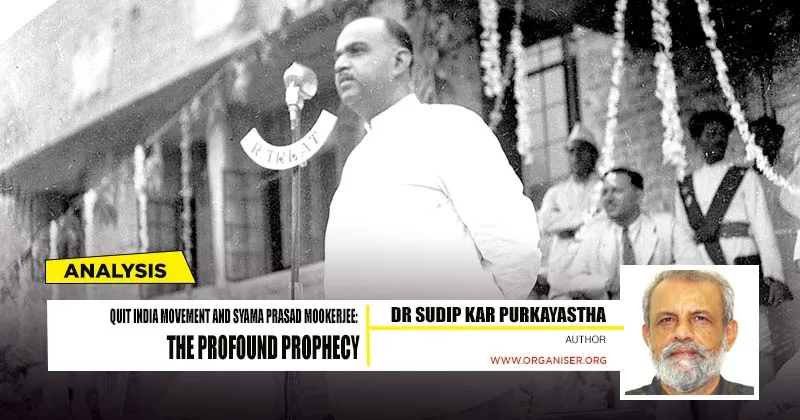
Syama Prasad Mookerjee was a statesman, patriot, administrator, and public leader of exceptional integrity. Unable to match his greatness, small minds have made a recurring and mischievous allegation that he was sympathetic to British rule because he did not support the Quit India Movement of 1942. Such claims deceitfully ignore the intricate political complexities of the period, particularly the fragile conditions prevailing in Bengal, and mislead the public by exploiting their deep emotional connections to the 1942 struggle. A fair and objective historical assessment must expose the mischief.
The Quit India Movement held a noble objective: the immediate termination of British rule in India. However, the timing of the movement raised significant questions. Since the outbreak of the Second World War in 1939, the Congress party had drastically altered its position regarding the forms of movement against the British. Earlier, in 1939, Mahatma Gandhi had rejected the insistent demand of mass civil disobedience by Subhas Chandra Bose, a disagreement that contributed to forcing Bose to resign from the party presidency. The likelihood of success then was far greater at that time, Britain having been under tremendous pressure in the face of German aggression. That strategic opportunity was let go.
In June 1940, the Mahatma wrote in Harijan that “We do not seek our independence out of Britain’s ruin..”. In two years, there was a paradigm shift. In a 180-degree shift during the AICC session on August 8, 1942, he delivered an electrifying speech demanding immediate freedom, stating, ” I, therefore, want freedom immediately, this very night, before dawn, if it can be had. Freedom cannot now wait for the realisation of communal unity..”. This tearing hurry in a tense wartime environment startled many. However, a careful reading of the Congress Working Committee (CWC) resolution of July 1942 gave an impression that the party had lost confidence in Britain’s ability to defend India against an impending Japanese invasion. Consequently, it demanded that the civil government be passed to Indians forthwith while accepting the continued presence of a strong allied army.
The geopolitical landscape of 1942 needs to be scanned to better understand the Congress’ concerns.
Between December 1941 and March 1942, the Japanese military experienced a dream victory run from the Philippines to Burma, defeating Anglo-American forces and capturing tens of thousands of prisoners of war.
By March 1942, the Japanese navy had ousted the British from the Andaman and Nicobar Islands and began bombarding some coastal Indian cities. The Japanese army was simultaneously breathing down the Indo-Burmese border adjoining Assam.
Additionally, there was an emerging possibility of an armed liberation struggle led by the Indian Independence League (IIL) and the Indian National Army (INA) with Japanese assistance reaching Indian borders.
Emigrant Indians organised a conference in Bangkok in June 1942, extending an invitation to Subhas Chandra Bose to take over the leadership of the IIL and INA. A discussion on any possible connection between the above concerns and the CWC resolution of July 1942 is not contemplated in this article and left to the conclusion of the reader. However, it needs to be mentioned that several parties, organisations, and eminent leaders did not share the Congress’ concerns for a variety of reasons. Most of them disagreed with the movement’s timing amid the war situation. Amongst them were Akali Dal (Tara Singh), Depressed Classes organisations, the Communist Party of India, the Hindu Mahasabha, and native princes besides the Muslim League, the prime adversary of the Congress. C. Rajagopalachari, one of the nation’s finest intellects and a confidant of the Mahatma, pointed out the impracticality of the British acceding to the demand during the war. In a letter dated July 18, 1942, he warned that forming a provisional national Government without an agreement between the Congress and the Muslim League would be impossible. He further cautioned that a civilian Government functioning alongside a powerful military would necessarily lead to a military takeover and imply the reinstallation of the British Government in a much worse form. The unbridgeable gulf between the two major parties kept coming to full public view through intermittent warnings from Jinnah against the Congress. On July 3, 1942, just on the eve of the CWC session, in a press interview he insinuated that the Congress was aiming to establish a “Hindu Raj” under the aegis of British bayonets.
Unprecedented Repression
In Bengal, Syama Prasad Mookerjee carried the heavy burden of public expectation to redeem the province from the evils of communal governance. It was just six months ago that Syama Prasad and Sarat Chandra Bose had succeeded in pushing the Muslim League out of power. They detached Fazlul Huq from the League and established a new secular government under the Progressive Coalition in December 1941, with Huq as its head. Serving as the Finance Minister and a key architect of the ministry, Syama Prasad Mookerjee, together with Huq, helped secure the confidence of the majority of both Hindus and Muslims for the first time since 1937. If this experiment succeeded in Bengal with the largest Muslim population, it was bound to change the course of politics in the country for the better.
However, the success of this popular Ministry attracted intense jealousy from the League and vindictive opposition from Sir John Herbert, the British Governor of Bengal. Well before the Quit India call, the governor began acting in extra-constitutional ways, misusing the wartime situation to adopt a scorched earth policy in parts of Bengal, which drove up food grain prices. The governor’s goal was to resume a reign of ‘divide and rule’ and build grounds for ousting the popular ministry, while the League was keen to regain power and pursue its goal of Pakistan.
As Syama Prasad Mookerjee had apprehended, the unfolding of the Quit India Movement in August 1942 provided the governor with the perfect opportunity to unleash a reign of terror. Midnapore became a particular target of unprecedented repression.
With top Congress leaders swiftly imprisoned and removed far from the ground, Mookerjee came to the rescue of the people. He fiercely questioned the governor and condemned the extra-constitutional atrocities unleashed by permanent officials. In February 1943, Mookerjee played the central role in passing a resolution in the legislative assembly to form an independent committee to investigate police, military, and local government atrocities. This move was a constitutional slap on the high-handed British governor, who had commanded these agencies by misusing his wartime discretionary powers.
Syama Prasad’s stance on the Quit India movement and Indian freedom was authentically documented in his August 12, 1942, letter to Viceroy Lord Linlithgow. He stressed that for the sake of winning the global war and mobilising India’s resources and public opinion, India required an immediate free political status. He argued that merely declaring India would attain freedom after the war would not suffice.
Syama Prasad unequivocally justified the Congress’s demand, terming it the demand of the whole of India, but he had concerns about its potential impact on law and order. Addressing both the Congress movement and Government repression, he urged responsibility on both sides. He finally provided the viceroy with a set of ten tentative proposals to resolve the Indo-British deadlock, starting with the formal recognition of India’s freedom, and requested these be forwarded to the British government in London.
Tragic Aftermath
The subsequent actions of the British validated Mookerjee’s deepest apprehensions. The British repressed the movement with unprecedented brutality and leveraged the resulting instability to escalate food shortages in Bengal. The Governor unconstitutionally dismissed the Progressive Coalition ministry and brought the League back to power through the back door in April 1943. With the Congress leadership shut in prison for over three years, the League was unwittingly given an open field to communalise politics across the country and aggressively advance its partition agenda. In Bengal, with a complicit League ministry in place, the British escalated the food shortage into a full-scale famine and epidemic that claimed approximately 3.5 million lives.
Syama Prasad Mookerjee responded not by blaming the Congress for Bengal’s suffering, but by deploying exceptional organisational energy to mobilise relief and resources for the starving and displaced.
Syama Prasad Mookerjee’s stakes were both provincial and national. His apprehension of a chaos attendant to a mass upheaval was not born out of loyalty to the Raj, but from an informed, prudent assessment that administrative manipulation and British repression would severely hurt Bengal’s people. Furthermore, he understood that political disorder in Bengal would undermine one of the last viable experiments in Hindu-Muslim cooperation and strengthen the very forces that later made the Partition unavoidable.
To reduce Syama Prasad Mookerjee’s complex nationalist judgement to a slogan of British sympathy is historically shallow and perverse. He fiercely upheld the causes of Indian freedom and human dignity. He fundamentally opposed British high-handedness, resigned from office in protest, defended the victims of brutal state repression, and worked tirelessly during one of the most devastating famines in human history. His difference with Congress strategy in 1942 was a matter of profound political foresight, not an opposition to the movement per se, with the goal of which he completely concurred, not its method.