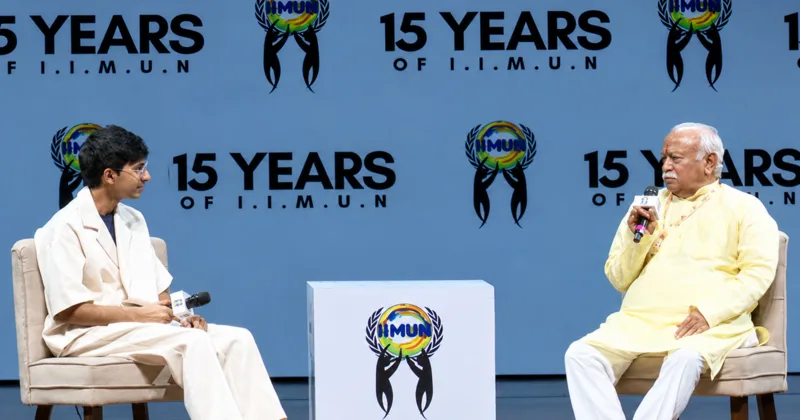
Mumbai: During the interactive session with nearly 2,000 Gen Z and Gen Alpha students at the India’s International Movement to Unite Nations (I.I.M.U.N.) 15th anniversary event on August 6, Rashtriya Swayamsevak Sangh (RSS) Sarsanghchalak Dr Mohan Bhagwat also responded to a question on India’s relations with neighbouring countries, particularly Pakistan and China, and whether people-to-people engagement should continue despite periods of conflict.
The interaction came in the context of I.I.M.U.N.’s emphasis on international dialogue and youth engagement, where participants sought Dr Bhagwat’s views on balancing national security with civil society engagement.
Question:
India shares borders with Pakistan and China, two neighbours with whom it has witnessed repeated military and diplomatic tensions. During such conflicts, many believe that all engagement with these countries should stop. In your view, should civilian-to-civilian and student-to-student relations with Pakistan and China continue despite political tensions, or should they be suspended? How should Bharat approach such relationships?
Dr Mohan Bhagwat:
“During times of conflict, we have to go with whatever our government does. But that should not sever the ties that already exist.
You have given two examples—Pakistan and China. The Chinese themselves say that there have been relations for 2,000 years. And Pakistan was Bharat not even 100 years ago. This should not be forgotten. These ties cannot be severed. They can be put on hold as long as the conflict continues. But what is the solution? Bharat’s solution. The Bharatiya solution is not conquering or obliterating others. It is to create a harmonious and assimilating process. That requires values.
So conflicts may temporarily halt these relationships, but they cannot remain halted forever. They should not. After the conflict is resolved, we have to pick up the thread from where we left it. We have to continue. Permanent enmity and permanent hatred are not the solution. When there is a problem, we have to deal with it, and there is a proper way to deal with it. We have to follow that path. But that is temporary. It belongs to politics. It is not that the people of Pakistan are, from the bottom of their hearts, enemies of Indians. That is not true. Indians are not like that.
But states, politics and international borders also exist. That is a fact. So during conflict, we stand with our own side. But we know that one day the conflict has to end and eventually there has to be unity. Humanity is one”.
Question:
As of today, should civil society maintain relations with students and ordinary members of civil society in Pakistan and China? Should we invite them? Should we continue dialogue with them—yes or no?
Dr Mohan Bhagwat:
“Not during times of conflict, I tell you. Conflict may be a military war or even terrorism. That is also a form of conflict. This terrorism is not only terrorism by radical groups. It is an entire philosophy. And there is a policy of ‘a thousand cuts.’ So it is a hidden one. We have to deal with it accordingly.