Pakistan’s Interior Minister Mohsin Naqvi has set the proverbial cat among the pigeons, politicians of the ruling party, Pakistan Muslim League-Nawaz. Prime Minister Shehbaz Sharif is a worried man these days as are others like Defence Minister Khwaja Asif and senior PML-N leader Rana Sanaullah, as also his elder brother Main Nawaz Sharif.
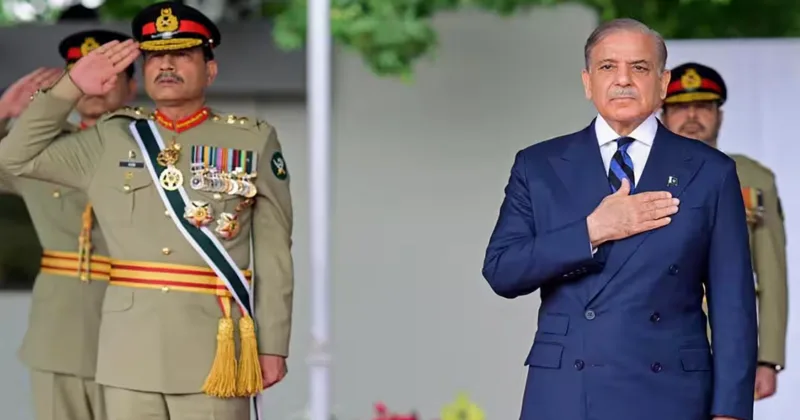
PM Sharif is seriously worried about the longevity of his government as most Pakistani analysts have said that Naqvi’s words are sinister. Omnious for PM Sharif as these are not his words but a message delivered on behalf of the Pakistan armed forces, reports in most Pakistani newspapers and portals have noted.
Incidentally, Naqvi is not someone whose words can be taken lightly for he is someone who is in Sharif government not because of his political heft. He is there, imposed on Sharif and enjoys the blessings of the Pakistan Army, specifically Chief of Defence Forces (CDF) Field Marshall Asim Munir.
Mohsin Naqvi no politician, military’s embedded mole
Naqvi is an independent Senator, a member of the Upper House of Pakistan, and elected because of the backing of two of the most powerful parties in political landscape there. PML-N and Pakistan Peoples Party (PPP) helmed by Bilawal Bhutto Zardari both ensured his smooth election to the Senate after being told by Munir to do so.
His remarks made some days ago that the governance has failed, besides saying that more provinces are needed in Pakistan are considered a strong message from the armed forces. These words meant the Army wants to break all four provinces, Punjab, Sindh, Khyber Pakhtunkhwa (KP) and Balochistan into smaller provinces.
If any doubts remained regarding Naqvi’s words of indictment, the endorsement by Inter Services Public Relations (ISPR) chief Lt Gen Ahmad Sharif Choudhryv removed them altogether. Choudhry said things needed to be fixed and a senior minister has already pointed out how they can be.
Breaking provinces into smaller administrative units
The provinces in Pakistan have been drawn along ethnic lines with Punjabis dominating Punjab numerically, Sindhis in Sindh, Pushtoons in KP and Baloch in Balochistan. Senior Pakistan Army leadership believes that this drawing of provincial boundaries along ethnic lines promotes sub-nationalism.
The armed forces firmly believe that ethnic sub-nationalism is responsible for rampant violence in Balochistan, KP and now becoming a headache for them in Pakistan Occupied Jammu Kashmir (POJK) too. They believe that breaking large provinces into smaller units will end this problem of sub-nationalism.
By obliterating borders drawn along ethnic lines, the senior leadership of the Army believes that all troubles will end. When the basic units drawn along ethnic lines are finished, what will the Pushtoons fight for in KP? Similarly, what will the armed Baloch fight for when Balochistan province ceases to exist? The same logic and argument has been pushed through Interior Minister Mohsin Naqvi by CDF Munir. Though indirectly.
Najam Sethi talks about challenge of sub nationalism
Senior journalist Najam Sethi, owner of the news organisation The Friday Times, has interpreted things in his inimitable style. In an interview on a television channel, Sethi said: “We have realised that the state (read Pakistan) is facing a lot of threats from sub-nationalism. In Balochistan, in KP and even Kashmir (read POJK).
“Our system cannot accommodate them. The problem with security versus welfare or security versus rights … there’s an issue. That’s why they believe there is only one way to sort out things … Asim Munir has realised that Pakistan is not able to accommodate Balochistan, KP or POJK.
“He has decided to crush Baloch, Pushtoon, Kashmir or Sindhi sub-nationalism by breaking the provinces. He has decided to make smaller units of them …which will be administrative units, not national units … Not ethnic units … So I think our security establishment has … this experiment of four or five units … because of misgovernance … People’s grievances are increasing.
Pakistan faces challenges of various ethnic groups
“And these grievances are translating into (and promoting) sub-nationalism … these are colliding with the state (read Pakistan ideology) … Our democratically elected politicians are not able to handle the problem … They are actually becoming a part of the problem … That is why we need to break up our system into smaller units so as to dilute sub-nationalism
“That I think is fair because at this time, as we speak today, we have problems in Balochistan … We have problems in KP … We have problems in Kashmir (read POJK).’’
Sethi, in clear words, has said it that Interior Minister Mohsin Naqvi was just articulating what the armed forces wanted. He was just being His Master’s Voice (HMV) when he talked of smaller units being the need of the hour.
Interestingly, Naqvi has questioned the legitimacy of the very system of hybrid governance in Pakistan. A system of which he is not only the most significant creation but also the biggest beneficiary, out and out a lackey of the military establishment. In this hybrid system, the military controls most levers of power with a civilian, in the present case PM Shehbaz Sharif, masquerading as head of the executive.
Pakistan Army a master of all it surveys
This is the model of governance in which the Pakistani Army wields power without responsibility and power without any accountability. When something good happens, which happens rather rarely in Pakistan, it can take all the credit. When things go wrong, as they are on most occasions, the Army easily washes off its hands saying the civilian government is to blame.
The first person in the civilian establishment to take on Naqvi was Defence Minister Khwaja Asif as he could not have been allowed to go unchallenged. He pointed out that Naqvi is all powerful as is evident from his behaviour as he attends very few, if any, cabinet meetings chaired by PM Sharif. Naqvi’s appearances in the Senate or on Treasury benches during parliamentary sittings are equally rare, or even more, Asif said.
Asif said Naqvi is happier attending functions related to the Pakistan Cricket Board (PCB) which he heads, and where he is not answerable to anyone. Definitely not to his cabinet colleagues or even the PM and it remains an area where Naqvi has an absolutely free hand. Asif then described the pathetic condition of the PCB with Naqvi leads with ordinary Pakistanis very unhappy with the way things are being run there.
Khwaja Asif, Rana Sanaullah tear into Interior Minister
The sloppy manner in which PCB affairs have been handled under Naqvi’s watch have led to the steep fall in Pakistan’s cricketing fortunes, Asif said. The Pakistan cricket team has been reshuffled ever so often with disastrous results, he added.
“Given the unhappiness of ordinary citizens about cricket in Pakistan, why doesn’t Naqvi Saheb make amendments there? Why doesn’t he change things for the better in cricket? Who or what is stopping Naqvi from making meaningful changes in cricket administration he heads?’’ Asif said at a press conference pointedly.
If a direct message was being conveyed from the Sharif family to Naqvi, and his masters, this was it. Plainly, with no room left for any uncertainty or mincing words either. A classic Khwaja Asif act delivered publicly to dare Naqvi and Co.
Next to roast Naqvi publicly was Special Assistant to Prime Minister (SAPM) Rana Sanaullah, another veteran of the ruling PML-N. Going a step further, Sanaullah remarked that Naqvi has reached the political level he has in 3.5 years. This munch rise in 3.5 years is possible for ordinary politicians in 35 years only, Sanaullah remarked.
Everybody among the journalists present at Rana Sanaullah’s press meeting understood the dig at Naqvi’s mentors clearly.
It is ironical that Naqvi has decided to go against the powerful Sharif family which controls PML-N. The powerful trio of Nawaz Sharif, PM Shehbaz Sharif and Nawaz’s daughter Maryam Nawaz. The fourth one of the Sharif family, Hamza Shehbaz, son of the present PM, not so visible these days, is the one who had propped up Naqvi in the political arena.
Hamza Shehbaz brought Naqvi into limelight
It was Hamza Shehbaz who had conferred on Naqvi the post of Caretaker Chief Minister of Punjab in January 2023, exactly 3.5 years ago, referred to in his statements repeatedly by Rana Sanaullah and others also nowadays. In the Pakistan Constitution, a Caretaker CM can be in place for only between 60 and in exceptional circumstances 90 days.
Naqvi pulled off the impossible with the blessings of his mentor, CDF Marshall Asim Munir, and a pliable judiciary, and demitted office only after nationwide elections in February 2024. This was truly unprecedented and established Naqvi’s credentials as the military’s man.
In an editorial in Dawn, its former editor Zahid Hussain wrote: Mohsin Naqvi is himself a product of a system whose legitimacy he is now questioing. His statement points to the unravelling of the hybrid arrangement.
He adds: The statement has also generated speculation about the Shehbaz Sharif government’s survival less than halfway through its term. Given the historically brief tenures of civilian governments, such uncertainty is deeply rooted. The interior minister’s remarks have jolted the ruling coalition, with some federal ministers questioning Naqvi’s own credentials. Yet while chastising him, they understand that he is not answerable even to the cabinet or the prime minister.
PML-N, PPP drifting apart during POJK polls
PM Shehbaz Sharif is also worried about the support of the PPP which the party had extended to his government after February 2024 elections. PPP’s non-participation in the government at Islamabad makes this a shaky government. Besides, the ongoing elections in Pakistan Occupied Jammu Kashmir (POJK) have embittered the relations between two parties as PPP boss Bilawal Bhutto Zardari has alleged large scale rigging.
For good measure, Bilawal has also said that Shehbaz Sharif should start counting his days as the country’s PM. Incidentally, Shehbaz is expected to carry forward the tradition of no PM in Pakistan ever completing his/her tenure till date.
Given the headwinds Shehbaz Sharif is facing now, it will be no surprise if he fails to remain PM till February 2029 when his five-year terms will end in the normal course of time.