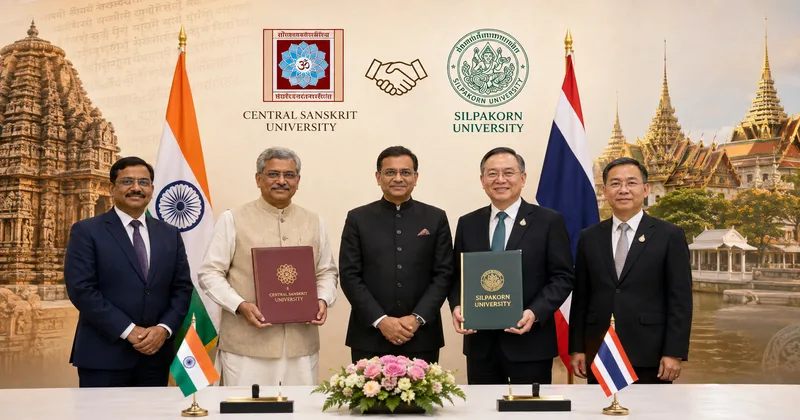
New Delhi: To boost international academic collaboration, Central Sanskrit University (CSU) has signed a Memorandum of Understanding (MoU) with Silpakorn University, Thailand, to strengthen academic cooperation and promote Sanskrit, the Indian Knowledge System (IKS), and India’s cultural heritage on the global stage. Under the agreement, the Sanskrit Studies Centre at Silpakorn University will be developed as the Foreign Study Centre of Central Sanskrit University. This will create an international platform for expanding Sanskrit education, encouraging cross-cultural research, and strengthening centuries-old academic and cultural ties between India and Thailand.
The MoU was witnessed by Puneet Agrawal, Ambassador of India to Thailand, and signed in the presence of Srinivasa Varkhedi and Tanasait Ngawhirunpat, along with senior academicians from both universities.
Central Sanskrit University has signed a landmark Memorandum of Understanding (MoU) with Silpakorn University, Thailand, marking a significant step in strengthening the centuries-old academic and cultural ties between India and Thailand.
As part of this collaboration, the… pic.twitter.com/VXx7JCwCRd
— CENTRAL SANSKRIT UNIVERSITY (@CentralSanskrit) August 3, 2026
Key Areas of Collaboration
The partnership will promote the academic excellence and international cooperation through several initiatives, including:
- Faculty and student exchange programmes
- Joint research projects and academic publications
- Collaborative teaching in Sanskrit, Pali, Hindi, and the Indian Knowledge System
- Digital preservation of Sanskrit manuscripts and development of e-learning resources
- Academic conferences, seminars, workshops, and cultural programmes
- Expansion of Sanskrit and Indic studies across Thailand and Southeast Asia
The partnership is part of Central Sanskrit University’s plan to take Sanskrit to a global audience. By opening study centres in other countries, the university wants to help more students and researchers learn Sanskrit and understand India’s ancient knowledge and culture. The initiative also follows the vision of the National Education Policy (NEP) 2020, which encourages the promotion of Indian languages, stronger ties with foreign universities, and better opportunities for learning and research.
Why Thailand?
Thailand shares deep historical and cultural links with Bharat. Sanskrit and Pali have significantly influenced the Thai language, Buddhist traditions, royal ceremonies, architecture, literature, and classical performing arts. Several Thai inscriptions and historical texts also contain Sanskrit vocabulary. Thus, this makes Thailand an important centre for Sanskrit and Buddhist studies outside India.
About Central Sanskrit University
Central Sanskrit University is a Central University under the Ministry of Education, Government of India. Established through the Central Sanskrit Universities Act, 2020, this University focuses on higher education, research, teacher training, manuscript preservation, and the global promotion of Sanskrit and the Indian Knowledge System through its campuses and affiliated institutions.
About Silpakorn University
Silpakorn University is one of Thailand’s leading public universities, established in 1943. Initially it was known for fine arts, but with time it evolved into a multidisciplinary institution. Now it offers programmes in humanities, archaeology, languages, education, science, engineering, and social sciences. Its Sanskrit Studies Centre has been actively engaged in research on Sanskrit, Pali, Buddhist studies, and India’s cultural connections with Southeast Asia.