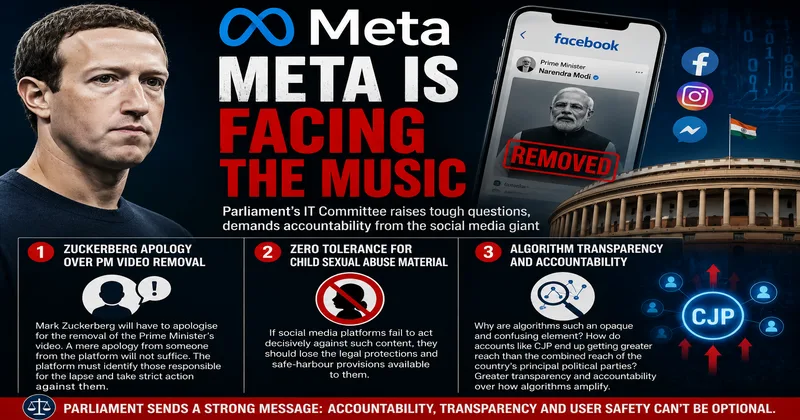
New Delhi: Meta is facing heightened scrutiny from Parliament’s IT Committee, with the social media giant coming under the spotlight over content moderation, child safety and the growing influence of opaque algorithms. The committee has raised questions that go beyond individual incidents, demanding greater accountability from platforms that wield enormous influence over India’s digital information ecosystem.
META IS FACING THE MUSIC
Three prominent issues taken up by the IT Committee in its meeting. According to government sources to @payalmehta100 :1- Mark Zuckerberg will have to apologise for the removal of the Prime Minister's video. A mere apology from someone from the platform…
— Rahul Shivshankar (@RShivshankar) August 4, 2026
According to government sources, three prominent issues dominated the committee’s concerns: the removal of a video featuring Prime Minister Narendra Modi, the need for zero tolerance towards child sexual abuse material, and greater transparency in the way social media algorithms determine what users see and how widely content is amplified.
Zuckerberg apology sought over PM’s video removal
One of the most significant issues before the committee concerns the removal of a video featuring Prime Minister Narendra Modi.
According to government sources, the committee believes that the matter warrants accountability at the highest level of Meta’s leadership. A routine apology from a representative of the platform would not be considered sufficient, with the committee reportedly insisting that Meta CEO Mark Zuckerberg should apologise for the lapse.
The issue, however, is not limited to an apology. The committee has also called for Meta to identify those responsible for the decision or failure that resulted in the removal and take strict action against them. The underlying concern is whether content moderation decisions involving prominent public figures are being taken through transparent and accountable processes, particularly when such decisions can have a direct impact on political communication and public discourse.
The demand reflects a broader question confronting social media platforms: when a major moderation error occurs, who is ultimately responsible, and what mechanisms exist to ensure that similar mistakes are not repeated?
Zero tolerance for child sexual abuse material
The second major concern is far more serious: the presence and circulation of child sexual abuse material (CSAM) and other forms of child exploitation content on social media platforms. The committee has stressed the need for zero tolerance towards such material, placing the responsibility firmly on technology companies to detect, remove and report unlawful content swiftly.
Social media platforms operate at a scale where billions of pieces of content can be uploaded, shared and reshared. However, the sheer volume of content cannot become an excuse for failing to act against material involving the sexual exploitation of children.
The committee’s position reportedly goes further by raising the possibility of removing legal protections and safe-harbour provisions from platforms that fail to take decisive action against such content. Safe-harbour protections are important to the functioning of internet platforms because they can protect intermediaries from being held directly liable for content generated by users, subject to applicable legal requirements. But such protections also come with responsibilities.
The debate therefore centres on a fundamental principle: platforms benefiting from legal protections must demonstrate that they are taking serious and effective steps to prevent their services from being exploited for criminal activity. The message from the committee is clear, child safety cannot be treated as merely another content-moderation challenge.
The algorithm question: Who decides what India sees?
Perhaps the most consequential issue raised by the committee concerns something that remains largely invisible to ordinary users: algorithms. Social media algorithms determine, to a significant extent, which posts appear on a user’s feed, which accounts receive greater visibility and which content is recommended, shared or amplified. Yet these systems often operate behind layers of technical complexity and corporate secrecy.
The IT Committee has questioned why algorithms remain such an opaque and confusing element of the social media ecosystem. The concern is not simply how algorithms function technically, but how their decisions can shape public conversations and political narratives. One question reportedly raised before the committee is particularly striking: how do accounts such as CJP end up receiving greater reach than the combined reach of the country’s principal political parties? The question goes to the heart of the debate over digital influence.
If an account with comparatively limited institutional or organisational strength can achieve extraordinary reach through algorithmic amplification, users deserve to understand why. Is the reach driven by genuine public interest and engagement, or are recommendation systems unintentionally creating disproportionate visibility for certain types of content? Greater transparency could help answer such questions.
From content moderation to platform accountability
The three concerns raised by the committee point towards a larger transformation in the debate around social media regulation. The issue is no longer simply whether platforms remove unlawful or objectionable posts. The bigger question is whether platforms can explain how their systems make decisions, who is responsible when those systems fail, and what consequences follow when companies do not adequately protect users.
The controversy over the Prime Minister’s video raises questions about accountability within content moderation systems. The issue of CSAM highlights the absolute necessity of protecting children from online exploitation. And the algorithm debate raises questions about whether platforms should be required to provide greater insight into the mechanisms that determine digital reach and visibility. Together, they underline the growing importance of transparency and responsibility in India’s digital ecosystem.
Why algorithmic transparency matters
Algorithms are not merely technical tools. They influence what millions of people read, watch, discuss and ultimately believe deserves attention. A platform may not explicitly endorse a particular piece of content, but its recommendation system can determine whether that content reaches hundreds of people or millions. That makes algorithmic accountability increasingly important.
Greater transparency does not necessarily mean forcing companies to publicly disclose every line of proprietary code. Instead, it can mean providing meaningful information about how recommendation and amplification systems work, what factors influence visibility, how political and sensitive content is treated, and what safeguards exist against manipulation. Independent audits, clearer explanations and stronger accountability mechanisms could also help establish whether platforms are applying their rules consistently.
Meta faces a larger accountability test
The issues raised by the IT Committee place Meta at the centre of a much wider debate about the responsibilities of global technology companies operating in India. The demand for accountability over the Prime Minister’s video is about responsibility at the top. The warning over child sexual abuse material is about the limits of platform responsibility and the protection of vulnerable users. The algorithm debate is about transparency and the enormous power technology companies exercise over digital visibility. Taken together, the committee’s concerns send a strong message: social media platforms cannot expect their responsibilities to remain hidden behind technology, corporate policies or complex algorithms.
As India’s digital public sphere continues to expand, platforms such as Meta are likely to face increasing demands to explain not only what they remove, but also what they amplify, how they make those decisions and who is accountable when they get them wrong. The central question is no longer whether social media platforms have influence. They clearly do. The question is whether that influence can be exercised with sufficient transparency, responsibility and accountability.