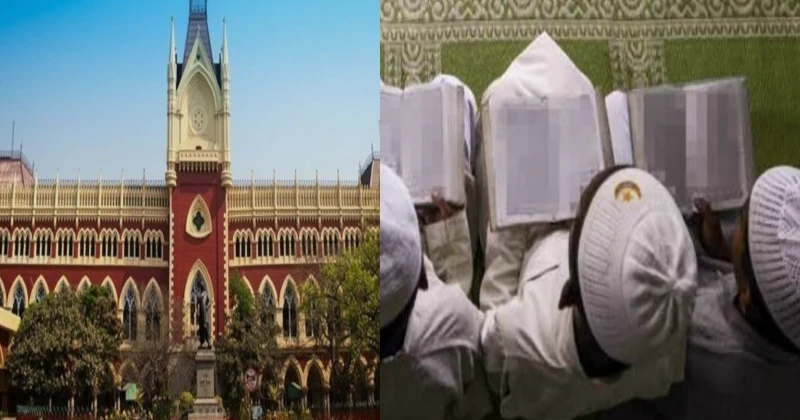
Kolkata: The Calcutta High Court made a strong oral observation that “heavens will not fall” if students in madrasas sing all six stanzas of Vande Mataram, reigniting the long-standing debate over the place of the national song in educational institutions and the balance between constitutional values and religious sensitivities.
The remarks came during the hearing of a Public Interest Litigation (PIL) challenging a West Bengal government notification that mandates the rendition of the complete Vande Mataram in madrasas. While the court did not pass any final order on the issue, its observations reflected a pointed questioning of objections raised against the national song.
A Division Bench comprising Acting Chief Justice Tapabrata Chakraborty and Justice Partha Sarathi Sen was hearing submissions made by Senior Advocate Bikash Ranjan Bhattacharya on behalf of the petitioners.
Responding to concerns that singing Vande Mataram could conflict with religious beliefs, the Acting Chief Justice made a pointed observation. “Heavens will not fall… today if I am asked to utter a quote that is not in my religion… what will happen? I will become a person not belonging to that religion?”
The Bench questioned whether merely reciting words outside one’s faith could be construed as an infringement of religious identity, suggesting that such concerns may be overstated. The Bench also referred to practices followed in Christian-run educational institutions, where students from diverse religious backgrounds routinely participate in prayers.
“There have been thousands of Christian schools where all students are asked to pray to the Lord. Then, do students belonging to a particular community ask why they are being asked to sing certain things which are in the Christian religion?” the court observed.
The judges further remarked that similar objections had surfaced in the past regarding prayers in Christian institutions but had not resulted in social upheaval.
“Christian schools pray to God. Take any institution, this issue was at a nascent stage when students belonging to a certain community questioned why the school should make them sing Christian songs… heavens will not fall,” the Bench said.
Appearing for the petitioners, Senior Advocate Bikash Ranjan Bhattacharya argued that while Vande Mataram enjoys the status of India’s national song, it does not occupy the same constitutional position as the National Anthem. He contended that compelling children studying in madrasas to sing the national song was legally untenable.
“The national anthem stands on a higher pedestal when compared to the national song,” he submitted, arguing that the government could not impose compulsory singing of Vande Mataram. The petition challenges the state government’s notification making the rendition of all six stanzas mandatory in madrasas, alleging that such a direction infringes upon constitutional freedoms.
The Bench also questioned whether the challenge was premature, noting that no coercive action had reportedly been taken against anyone for failing to comply with the circular. “You have brought it before us, as an activist. Has any impinging action been taken for strict implementation of this circular?” the Acting Chief Justice asked.
Responding to the query, the petitioners’ counsel stated, “They have not dared to enforce it yet.”
The Bench then observed that unless punitive action had actually been initiated, it would be difficult to conclude that the notification was being enforced in a mandatory manner. “Only if any punitive action is taken, can you contend that it was mandatory. Has anybody suffered yet?” the court asked.
Appearing for the State, Additional Solicitor General Dhiraj Kumar Trivedi requested the court to grant time to obtain instructions and file an affidavit detailing the government’s position.
He argued that the petitioners were seeking interim relief based merely on apprehensions rather than any actual violation or punitive action. Accordingly, he sought an adjournment to place the relevant facts before the court.
Senior Advocate Kalyan Bandopadhyay also addressed the Bench, highlighting the political sensitivity surrounding the issue. He submitted that the question of Vande Mataram had been extensively debated in Parliament.
“This Vande Mataram issue was debated in the Lok Sabha last year in July for 12 hours… it was a very contentious issue. Ultimately the Parliament could not take any resolution. I am not going to 1926 or 1936, it was in 2025. When no resolution could be passed in Parliament, this is how they are trying to enforce it,” he argued.
His submission suggested that the executive was attempting to implement, through administrative directions, an issue on which the legislature had not reached a consensus.