New Delhi: Questions over international media coverage of the ongoing unrest in Pakistan-occupied Jammu and Kashmir (PoJK) have intensified amid major global media houses have devoted far less attention to the region than to similar developments in India. The debate has gathered momentum following India’s call on July 31, 2026, for the international community to scrutinise Islamabad’s actions in the region after a violent crackdown on protesters left more than 40 civilians dead.
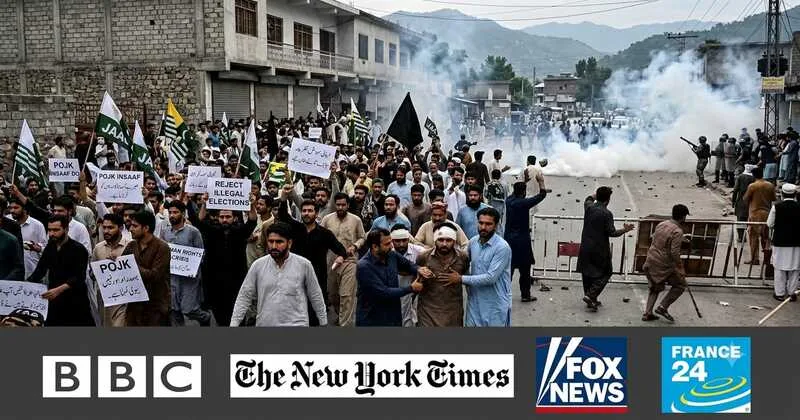
Critics argue that allegations of human rights abuses by Pakistani security forces have not received sustained attention from major Western media organisations despite the scale of the unrest. According to these critics, leading international broadcasters and publications, including the BBC, CNN, Fox News, Newyork Times and France 24, have not maintained consistent coverage of the crackdown, prompting accusations of selective reporting and double standards in the treatment of human rights issues across South Asia.
Similar criticism has also been directed at sections of the Pakistani media, with observers pointing out that reports on the violence and protests in PoJK have received limited domestic prominence despite mounting casualties and widespread public unrest.
Some analysts have further alleged that the international media’s surrendering to geopolitical considerations involving Pakistan and the United States has contributed to the absence of sustained international scrutiny of Pakistan’s security forces.
Growing unrest and deadly crackdown
The present wave of unrest in Pakistan-occupied Jammu and Kashmir has been driven by deepening economic distress, soaring inflation, rising electricity tariffs, administrative neglect, political discrimination and grievances among minority communities. Public anger intensified over recent months, leading thousands of people associated with groups such as the Joint Awami Action Committee (JAAC) to organise large-scale demonstrations across the region.
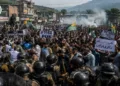
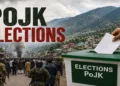
The protests escalated further during local-body elections beginning on July 27, 2026. Reports from the region indicate that Pakistani security forces launched an extensive crackdown on demonstrators, resulting in the deaths of around 40 civilians while many others sustained serious injuries. Local reports also referred to widespread internet shutdowns and communication blackouts during the security operations, making independent verification of events increasingly difficult.
Scenes from muzaffarbad, pojk
2 august, 2026
Normal people protest against pak army and administration.
Their had a vote but they reject it. pic.twitter.com/lM7zchZsCl— THE UNKNOWN MAN (@Theunk5555) August 2, 2026
The violence has been described by several observers as one of the most severe crackdowns witnessed in the region in recent years. Yet, despite the reported civilian toll and continuing protests, critics contend that the developments have failed to receive the same level of continuous front-page coverage or prime-time attention that similar incidents in Jammu and Kashmir often attract.
Debate over selective reporting
The disparity in international reporting has become a central point of debate. Critics argue that whenever unrest occurs in J&K, international correspondents rapidly converge on the region and global media extensively covers protests, security measures and political developments, frequently placing human rights issues at the centre of the narrative.
In contrast, they argue that the large-scale protests, deadly security operations and widespread public dissatisfaction in Pakistan-occupied Jammu and Kashmir have largely remained outside the sustained focus of international newsrooms. According to these observers, this imbalance reflects inconsistencies in how human rights concerns are prioritised depending on geography and political context.
Pakistan has spent 78 years calling PoJK "Azad Kashmir." 🇮🇳
The people of PoJK just corrected that in front of 80,000 people.
JAAC leader Sardar Aman Khan said it straight.
"Kashmir is not disputed territory. It is occupied territory. And it was never truly Azad."
India has… pic.twitter.com/oINquBUu4Q
— Military Observer (@TheMilObserverr) July 14, 2026
Several explanations have been offered by geopolitical analysts for this disparity. One argument is that many Western media organisations rely upon established geopolitical narratives that make developments in Jammu and Kashmir easier to integrate into broader international reporting, while the internal political and economic struggles in Pakistan-occupied territories receive comparatively limited attention.
Another factor frequently cited is the severe information restrictions imposed by Pakistani authorities during periods of unrest. Internet suspensions, media restrictions and limited access to volatile areas such as Mirpur and Rawalakot have significantly constrained the ability of independent international journalists to verify developments on the ground.
At the same time, several British Members of Parliament have continued to raise concerns regarding developments in Pakistan-occupied Jammu and Kashmir, urging greater international attention to the humanitarian situation despite what they describe as insufficient global media coverage.
The debate has also drawn comparisons with international reporting on demonstrations in India. Critics have pointed to extensive international coverage of protests organised by the Cockroach Janta Party (CJP) in New Delhi, arguing that comparable attention has not been devoted to the ongoing unrest in PoJK. According to these critics, the contrasting levels of coverage have reinforced perceptions of selective treatment in reporting human rights issues across the region.
India calls for international scrutiny
India formally raised the issue on July 31, 2026, when Ministry of External Affairs spokesperson Randhir Jaiswal strongly criticised Pakistan’s handling of the protests. Addressing a regular media briefing, Jaiswal stated that the Pakistani establishment continued to “unleash ruthless force” against peaceful civilians in Pakistan-occupied Jammu and Kashmir.
He said the crackdown had resulted in the tragic deaths of more than 40 civilians while many others had suffered serious injuries. Referring to remarks made by Pakistani leaders, Jaiswal said that Islamabad’s attitude towards the people of the region had become increasingly evident.
#WATCH | Delhi: On Pakistan-occupied Jammu and Kashmir (PoJK), MEA Spokesperson Randhir Jaiswal says, "… The Pakistani establishment continues to unleash ruthless force against peaceful civilians in Pakistan-occupied Jammu and Kashmir. This crackdown has resulted in the tragic… pic.twitter.com/rKTWWcjfNQ
— ANI (@ANI) July 31, 2026
According to him, Pakistan’s Defence Minister had described protesting civilians as enemies, while the Special Assistant to the Prime Minister on Political Affairs had openly acknowledged that the very “mujahideen” whom the Pakistani establishment had trained, armed and sent to bleed India had now turned their weapons against the Pakistani state itself.
Jaiswal also criticised the recently conducted local-body elections, describing the “so-called” electoral exercise as a humiliating rejection of the Pakistani establishment. He stated that citizens confronting what he termed a violent regime had appealed to international organisations to undertake an independent investigation into the unlawful killings.
Calling for greater international involvement, Jaiswal urged the global community to carefully examine Pakistan’s actions and hold Islamabad accountable for what he described as atrocities committed against peaceful demonstrators in the occupied territory.
NYT terminology row adds fresh dimension
The developments also triggered a diplomatic exchange involving The New York Times. India objected to the newspaper’s description of the territory as “Pakistani Kashmir” in a report published during the violence.
The report, headlined “Clashes Erupt in Pakistani Kashmir as Voting in Local Election Begins,” referred to the unrest during local-body elections in the region. Responding on July 29, 2026, the Indian Embassy in the United States criticised the terminology, describing the headline as “misleading and incorrect.”
In a statement posted on X, the embassy asserted that “There is no Pakistani Kashmir, only Pakistan-occupied Kashmir.” It further reiterated India’s long-standing position that the Union Territories of Jammu and Kashmir and Ladakh have been, are and will always remain an integral and inalienable part of India, while maintaining that Pakistan continues to illegally occupy parts of these territories and is using violence against the people living there.
The terminology dispute added another dimension to the broader debate over international reporting on the region, with Indian officials arguing that the language used by influential international media organisations carries significant political and diplomatic implications.
As the unrest continues, questions surrounding media coverage remain closely intertwined with concerns over human rights, political representation and accountability. While international organisations have voiced concern over the humanitarian situation and rights groups have called for restraint, critics maintain that the scale of the violence in Pakistan-occupied Jammu and Kashmir has yet to receive the sustained international attention they believe it warrants.
Simultaneously, India’s appeal for an independent investigation and greater global scrutiny has placed renewed focus on both the humanitarian crisis and the broader debate over consistency in international media reporting.