For nearly four decades, the Chinese Communist Party (CCP) justified its monopoly on political power through an unwritten social contract. Citizens were expected to surrender political participation, accept censorship, and refrain from challenging one-party rule. In return, the Party promised uninterrupted economic progress and steadily improving living standards. That bargain delivered a remarkable economic transformation after China opened itself to foreign trade, investment, technology and markets. Rising prosperity convinced millions that political freedom was an acceptable price for material advancement.
Today, however, that foundation is under unprecedented strain. China’s economy is no longer generating the rapid growth that once underpinned the CCP’s legitimacy. Property wealth has evaporated, youth unemployment remains stubbornly high, prices continue to fall, demographic decline is accelerating, and foreign capital is steadily leaving the country. Rather than addressing these structural weaknesses through political or economic liberalisation, President Xi Jinping is attempting to replace economic legitimacy with nationalist legitimacy.
Instead of promising greater prosperity, Beijing increasingly promises national rejuvenation, strategic rivalry with the United States and eventual absorption of Taiwan. The shift represents one of the most consequential political transformations in modern China, replacing performance-based legitimacy with an ideology centred on nationalism, patriotism and external confrontation.
The collapse of performance legitimacy
China’s extraordinary economic rise was never solely the product of central planning. Much of its growth followed the CCP’s decision to loosen state control over parts of the economy while opening China to Western investment, technology and export markets. Access to global capital transformed the country’s manufacturing base and raised living standards across society.
Throughout this period, however, political repression never disappeared. Critics continued to be imprisoned, dissent remained tightly controlled, and entire communities were subjected to persecution despite remaining outside organised political movements. Economic improvement helped sustain public acceptance despite these restrictions.
Among Chinese scholars, this arrangement became known as “performance legitimacy.” The CCP’s right to rule rested primarily on its ability to improve people’s lives. As long as citizens experienced rising incomes, better housing and expanding opportunities, demands for political participation remained relatively muted.
China’s economy is changing—and not in the way policymakers had hoped.
📉The property sector remains in a prolonged downturn, consumer spending is weak, the population is shrinking, and confidence has yet to recover. At the same time, exports and advanced manufacturing have… pic.twitter.com/9csaexxCzb
— China Update (@tonychinaupdate) June 27, 2026
That equation is now weakening. Economic growth has slowed sharply, while many of the gains accumulated during previous decades are being reversed. According to China’s National Bureau of Statistics, prices throughout the economy have been falling for much of the past three years. Bloomberg Economics described this as China’s longest period of deflation since the famine that followed Mao Zedong’s Great Leap Forward during the early 1960s.
Deflation creates a self-reinforcing cycle. Falling prices reduce company revenues, encouraging businesses to cut wages and jobs. Consumers postpone purchases in anticipation of even lower prices, further weakening demand. Meanwhile, debt burdens become heavier in real terms as incomes stagnate.
China’s property crisis has magnified these pressures. Bloomberg estimates that the collapse of the housing market has wiped out approximately US$18 trillion in household wealth. As property represented the primary savings vehicle for many Chinese families, declining housing values have severely damaged consumer confidence and spending.
Economic anxiety meets demographic decline
China’s labour market reflects these mounting pressures. Official figures placed youth unemployment at 16.3 per cent in April. However, the published statistics only include people aged 16 to 24 who are not students. Beijing adopted this narrower methodology in 2023 after the previous measurement reached a record 21.3 per cent, prompting authorities to suspend publication entirely for six months.
During that period, Peking University economist Zhang Dandan attracted national attention by estimating that actual youth unemployment could be as high as 46.5 per cent.
The country’s demographic outlook is equally troubling. Births declined by 17 per cent in 2025, falling to just 7.92 million, the lowest number recorded since official statistics began in 1949. Simultaneously, roughly 23 per cent of China’s population is now over the age of 60.
University of Wisconsin-Madison demographer Yi Fuxian observed that China registered approximately the same number of births in 2025 as it did in 1738, when the country’s population stood at around 150 million.
These figures reinforce fears that China is ageing before achieving the level of prosperity reached by advanced economies.
The consequences are increasingly visible among ordinary citizens. Residents report falling incomes, declining property values and growing financial insecurity. A woman in her fifties from Harbin described how the depreciation of the yuan had further undermined her confidence, adding that in contemporary China, simply remaining debt-free had become a mark of financial success.
The combination of shrinking household wealth, weak employment prospects and demographic decline has significantly reduced the CCP’s ability to rely solely on economic achievements for political legitimacy.
Nationalism replaces prosperity
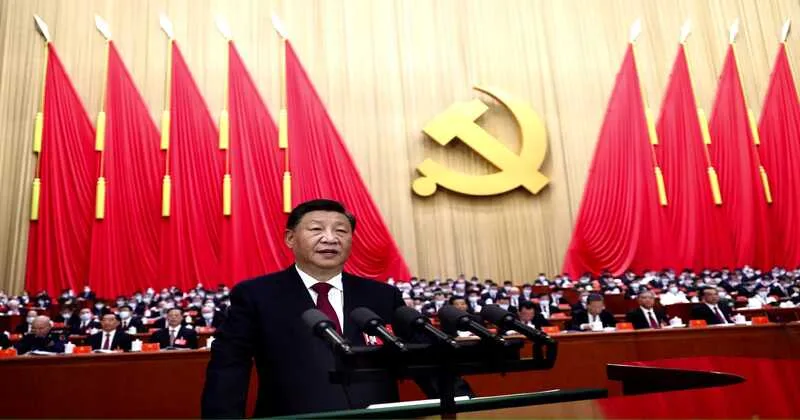
Facing declining economic performance, Xi Jinping’s government has consciously elevated nationalism as the new foundation of political legitimacy.
The Mercator Institute for China Studies (MERICS), based in Berlin, describes this as a strategic shift away from improving living standards towards patriotism, military preparedness and an increasingly anti-Western political narrative.
This ideological transformation did not begin under Xi. Following the violent suppression of the 1989 Tiananmen Square protests, former CCP General Secretary Jiang Zemin launched the Patriotic Education Campaign in 1991. As documented by China scholar Zheng Wang, school curricula were rewritten around the narrative of China’s “Century of Humiliation,” portraying the CCP as the force that rescued the nation from foreign domination. Under Xi, this historical narrative has become central to state legitimacy.
The government increasingly promotes national achievements such as aircraft carriers, space missions and military modernisation as symbols of national revival. These highly visible projects seek to reinforce public confidence despite worsening economic conditions.
#Breaking China removes six generals as lawmakers as Xi’s crackdown intensifies
Arrests Intensifies, first #Iraq now #China
China has removed six senior military officers from its top legislative body in a sign that president Xi Jinping’s anti-corruption drive is intensifying.… pic.twitter.com/1UQZD2lErn
— Jack Straw (@JackStr42679640) June 28, 2026
Some analysts argue that these displays project confidence while masking deeper insecurities. They contend that public expressions of patriotism increasingly reflect political caution rather than genuine enthusiasm, with loyalty becoming a form of collective risk management in an environment where dissent carries significant consequences.
The government has also encouraged economic nationalism through consumer behaviour. According to Bain & Company and Worldpanel, domestic brands accounted for 76 per cent of China’s consumer market in 2024, compared with 66 per cent in 2012. Beijing has actively supported this trend by promoting national champions under the “guochao” or “national wave” movement.
Foreign companies have suffered accordingly. Nike, once regarded as a status symbol among urban Chinese consumers, has recorded six consecutive quarters of declining sales in China as domestic brands such as Anta and Li-Ning expanded their market share.
Some of this shift reflects genuine improvements in product quality. However, purchasing foreign brands has also become politically sensitive. Nationalist boycotts have targeted companies including H&M, Nike and Dolce & Gabbana, making domestic purchases the safer social choice.
Private choices reveal public contradictions
Despite official nationalist rhetoric, many wealthy Chinese continue making decisions that suggest limited confidence in China’s long-term trajectory.
Observers describe a striking contradiction between public political loyalty and private personal choices. While many individuals publicly endorse resistance to Western influence, privately they seek access to Western universities, legal systems, property markets and financial institutions.
Chen Pokong, a political commentator now based in the United States who spent years imprisoned for participating in the 1989 democracy movement, summarises this contradiction bluntly: public rhetoric celebrates patriotism, but personal decisions reveal different priorities. He notes the contrast between sparsely attended visa queues outside Russian and North Korean embassies and significantly larger crowds seeking visas for the United States, Japan and Australia. According to Chen, even officials who publicly criticise Western countries frequently relocate their wealth and family members abroad.
Many people expressed hopes either to emigrate themselves or send their children overseas. Many identified Europe and other developed democracies as preferred destinations for themselves and future generations. They also described extensive online censorship and constant surveillance that discourages open political discussion.
Capital flight and international distrust
Foreign investors have increasingly mirrored the caution shown by many Chinese households. According to U.S. State Department figures, China’s net foreign direct investment fell from a peak of US$344 billion in 2021 to approximately US$4.5 billion in 2024, the lowest level since 1991.
Several factors contributed to this collapse. Beijing expanded its anti-espionage legislation, conducted raids on foreign consulting firms and prevented certain foreign executives from leaving the country, significantly increasing business uncertainty.
The World Bank reported that during 2025, capital outflows exceeded even China’s record trade surplus. Meanwhile, 73 per cent of European companies surveyed by the European Union Chamber of Commerce stated in 2025 that operating conditions in China had become more difficult over the previous year.
Against this backdrop, Beijing’s insistence that China has reached strategic parity with the United States serves an important domestic political purpose.
This messaging received considerable attention during U.S. President Donald Trump’s May visit to Beijing, the first by a sitting American president in nearly a decade. During the highly choreographed three-day visit, Trump toured the Temple of Heaven and later remarked in an interview with Fox News that China and the United States were “the two great countries,” referring to them collectively as the “G2.”
For Xi, such symbolism carries greater significance domestically than internationally. International recognition from the world’s leading power helps reinforce the narrative that his leadership has elevated China to equal global status despite worsening domestic conditions and continuing military purges. Some analysts argue that Beijing increasingly seeks international acknowledgement primarily to reinforce domestic political legitimacy rather than foreign policy objectives.
Taiwan: The centrepiece of Xi’s political gamble
Beyond claims of equality with the United States, Xi’s revised political bargain increasingly centres upon Taiwan. Unlike previous Chinese leaders, Xi has directly connected Taiwan’s absorption with the CCP’s broader project of national rejuvenation.
In a 2019 speech, he declared that reunification formed an essential component of national rejuvenation, arguing that the issue should not be postponed indefinitely and insisting that unification remained inevitable.
According to Beijing’s own account of a later telephone conversation with Donald Trump, Xi went further by describing Taiwan’s return to China as part of the post-Second World War international order.
Whether Beijing could successfully achieve such an objective remains uncertain.
Analysts argue that Xi’s highly centralised political system increasingly filters out dissenting assessments before they reach senior leadership. As political conformity becomes mandatory, optimistic reports may replace honest military evaluations, increasing the risk of strategic miscalculation.
Simultaneously, Xi has conducted sweeping purges within the People’s Liberation Army (PLA). According to the Centre for Strategic and International Studies (CSIS), more than 100 senior PLA officers have either disappeared from public view or been removed since 2022, many of whom Xi himself had previously promoted.
Of the six generals appointed to the Central Military Commission in 2022, only one reportedly remains in office. The most recent dismissals included Vice Chairman Zhang Youxia and Joint Staff Chief Liu Zhenli in January.
Analysts argue that these repeated purges have produced fear rather than confidence within the armed forces. The PLA’s own internal assessment as one of “fake combat capability,” pointing to missile exercises around Taiwan where projectiles reportedly failed to hit intended targets and noting the absence of public support from military commands following recent dismissals.
Critics question whether soldiers would willingly sacrifice themselves in a conflict lacking broad public legitimacy, particularly against what they describe as superior American military capabilities. Meanwhile, China’s long-term structural challenges continue to intensify. Economic stagnation, declining births, population ageing and weakening investor confidence suggest that the country’s strategic position may deteriorate over the coming decade. Some analysts, therefore, warn that a leadership confronting narrowing opportunities may become more willing to undertake external risks.
This assessment places the period between roughly 2027 and the early 2030s as the window of greatest strategic danger, when China’s military modernisation could peak even as economic and demographic decline accelerates.
Xi Jinping has increasingly tied his political future to promises of national greatness, strategic equality with the United States and eventual control of Taiwan. As the economic foundations of CCP legitimacy weaken, nationalism has become not merely an ideological preference but an instrument of political survival. Whether that strategy can indefinitely compensate for slowing growth, demographic decline, and mounting domestic anxiety remains one of the defining geopolitical questions of the coming decade.