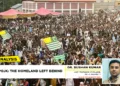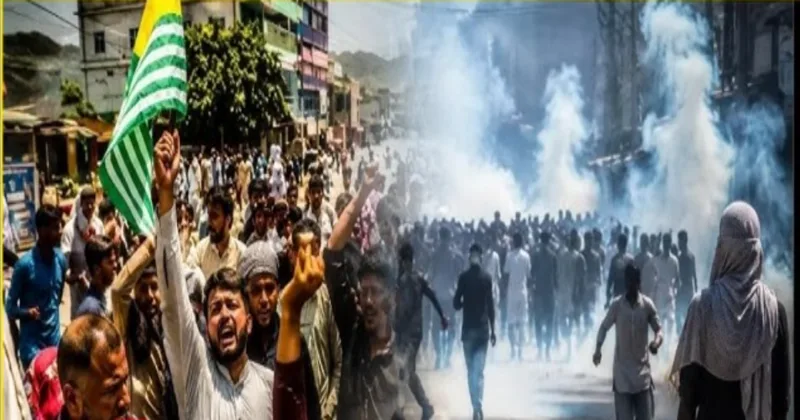
Over 100 people have died in Pakistan-occupied Jammu Kashmir (PoJK) since June 5 when trouble started big time following the death of a Jammu Kashmir Joint Awami Action Committee (JAAC) supporter in Rawalakot. At least 40 died on Monday and at least 200 were injured, many of them seriously, when Pakistan security forces fired at demonstrators gathered outside Rawalakot. These protesters were trying to March to Muzaffarabad, the capital of PoJK, a march that they had originally planned for June 9.
By all available indications, it seems the JAAC enjoys widespread support among the people of PoJK but it has been kept out of the electoral arena by the Federal government of Pakistan by declaring it a terrorist organisation on June 6. That day, by the orders and whims of the authorities, JAAC leaders all became persona non grata. Why? Simply because they refused to kowtow to the dictats of the Pakistan government and challenged its writ.
Mark it, the JAAC leaders and supporters were all declared terrorists officially so that any and every one of them could be shot at will by the Pakistani forces. And once this condition of being banned and proscribed had been fulfilled, the next step was to see to it that no JAAC supporter could enter the Legislative Assembly of PoJK. Soon thereafter, the Pakistan Federal government announced that elections for entire PoJK will be held on July 27.
The declaration of holding elections one one day was later amended and a three-phase polling schedule was announced. It was then decided that in the first phase, on July 27, elections will be held in Mirpur division which comprises three districts of Mirpur, Kotli and Bhimber. In the second phase, elections will be held on August 2 in Muzaffarabad division which includes Muzaffarabad, Hattian and Neelam Valley districts. In the third and last round, elections will be held on August 10 in Poonch division in Poonch, Haveli, bagh and Sudhnoti districts.
What are the reasons for large scale violence in PoJK which has roots in the unhappiness of the people on a host of issues. At one time, the JAAC had agitated all over PoJK and mobilised lakhs of people on economic and political issues and prepared a 38-point charter of demands. Of these demands, the most explosive and persistent demand was the abolition of 12 refugee seats in the 53-member assembly of the POJK region. Despite most of other demands having been met, the JAAC has refused to let go of the demand for abolition of these seats.
Division of seats into different categories
In the 53-member assembly that exists in the PoJK, direct elections are held for only 45 seats with eight seats being filled by the government through nominations. That means out of 53 seats, the government of the party that rules at the Federal level starts with an opening account of eight (53-45). Needless to say that any party having 27 out of 53, more than half the seats, is entitled to form the government.
With eight seats already in the pocket, even before the electoral process has started for the 53 member assembly, the ruling party at Islamabad only needs 19 more seats to form its government in PoJK.
The Pakistan Muslim League-N, the party of Pakistan Prime Minister Shehbaz Sharif, has already won nine out of 13 seats in the first round of elections held on July 27. That means it theoretically has 17 seats, of which eight candidates it will nominate and nine it has won. With 17 seats already with the PML-N for all practical purposes, it is only 10 more seats they need now.
That means it only needs 10 seats in next two rounds of elections to be held on August 2 and August 10. In these two rounds, 33 seats are stake and scoring 10 should not pose any problems to PML-N, it seems.
12 refugee seats: A dirty political tool to control PoJK
What are refugee seats? Why is JAAC unwilling to do any compromise on them? This needs to be explained and understood clearly as these 12 seats are the real source of annoyance of the residents of PoJK. The refugee seats are given to people living outside PoJK and are, on paper, scattered all over Pakistan. What is special about these refugees and why they must get seats in PoJK assembly? According to official narratives, these refugees are very special as they had moved to Pakistan from Jammu & Kashmir in India. Since they originally came from J&K, they needed to be accommodated politically in PoJK also, the Pakistani narrative goes.
The JAAC opposes these seats on several grounds, the very first of which is that these refugees and their descendants, have never ever lived in PoJK for the last almost eight decades. It says that why should the people who are not residents given any representation in the assembly?
Manipulation by ruling party at Islamabad
These 12 constituencies are located in Rawalpindi, Lahore and elsewhere in Pakistan. Further division of these seats has been done on the basis of from where the forefathers of these so-called voters belonged. People from the Jammu region (refugees) have been given six seats while the people from the Kashmir have also been given six seats.
The voting for these 12 seats is done in a manner that there is widespread manipulation and rampant rigging. In a very opaque manner, the voting is held and generally the ruling party at the Federal capital Islamabad wins a majority of them. Out of 12 seats reserved for refugees, it has often happened in the past that 10 or even more have gone to the ruling party in Islamabad.
Besides, the assembly members of the PoJK, particularly these 12 refugee representatives, are real floaters who decide the fate of successive governments at Muzaffarabad. They easily cross over to any party which seems more promising to them in the attainment of their personal agendas and give them more privileges.
At present, Prime Minister Shehbaz Sharif is from PML-N and it can be safely assumed that his party will get most of these seats. The problem, for now, is that the Pakistan Peoples’ Party (PPP) headed by Bilawal Bhutto Zardari is supporting PML-N from outside and this is an inconvenience the latter has to deal with. Otherwise, if PML-N had an absolute majority in the National Assembly, it could have easily got all the refugee seats.
For the sake of argument, we can say that the PML-N may be deterred by the prospects of PPP creating a ruckus on rigging on these seats, just as it had created about first round of polling in the Mirpur division. To placate the PPP, in such a scenario, it can split these 12 seats equally with the party. In that case, each party gets six seats.
By doing so, the number of seats for the PML-N can go up to 23, just four short of the majority mark with 33 seats yet to go to polls. In such a scenario, we can safely assume that the incoming government of POJK will be one headed by a PML-N member.
JAAC anger aimed at disenfranchisement of locals
As explained in the paragraphs above, the people of PoJK are totally disenfranchised in this manner. Their votes do not carry any weightage in the farcical elections that are held. With 20 seats which can be easily manipulated by the ruling party in Islamabad, managing a majority of 27 in the 53 member assembly is a very easy task.
This manipulation has continued for several decades and principal beneficiaries were either PML-N and PPP. Till Imran Khan became Prime Minister in Islamabad after his party, the Pakistan Tehreek Insaf (PTI) won the elections to the National Assembly in 2018. As had happened in the past, PTI also formed government in PoJK once Imran became Pakistan’s PM. In conformity with past trends of ruling party in Islamabad invariably winning PoJK elections too.
Incidentally, the last elections to PoJK were held in 2021 when Imran’s PTI was in power in Islamabad. And lo behold. As expected, and destined, PTI won the PoJK elections and its government was formed.
Later, once he was ousted from power in a parliamentary vote in 2022, and later in February 2024 in massive rigging, both the PML-N and PPP went into overdrive to topple PTI government in PoJK. PPP succeeded. Presently, the PPP of Bilawal Bhutto Zardari rules PoJK.
It all seems set for a change again, with PML-N of Sharif brothers about to emerge victorious in PoJK polls with the best chances of heading the government there. This likely victory of PML-N, part due to electoral wins but substantially likely to fall in place due to nominations on eight seats and manipulation of 12 refugee seats is the most sore point with the JAAC.
Incidentally, this shameless manipulation of governments in PoJK is something likely to be repeated in the next 10 days too. In 2017, when the last census was held in PoJK, its population was around 44 lakhs spread in 10 districts. It is safe to assume that it has crossed 50 lakh in the last 10 years. The farce of PoJK elections will disenfranchise these 50 lakh voters who want a say in the way they are governed.