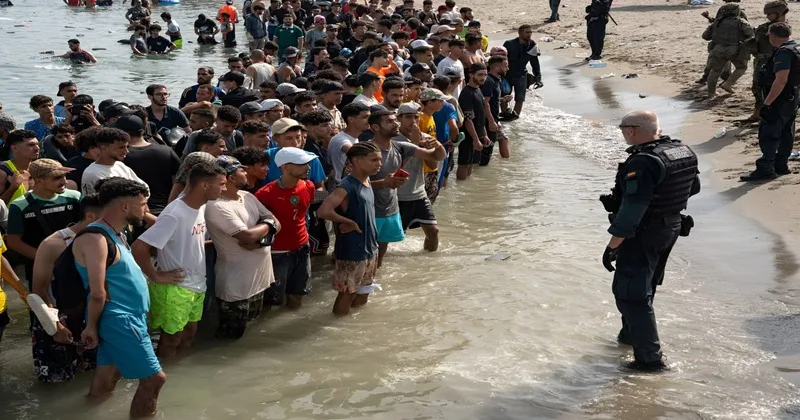
New Delhi: Spain’s left-coalition government, led by Prime Minister Pedro Sanchez of the Socialist Workers’ Party, is facing intense public scrutiny and fierce political backlash as a fresh wave of illegal migration overwhelms the North African enclave of Ceuta. Currently facing multiple corruption investigations, the radical leftist administration is under heavy fire for its border policies, which critics argue have set out to swamp the nation with Muslim mass illegal migration.
While the government’s approach has previously won praise from mainstream media outlets and Pope Leo, who continues to speak about the “kindness” and moral merits of maintaining an open-door immigration policy while remaining safe behind the high walls and Swiss Guard protection of the Vatican, the situation on the ground has rapidly deteriorated into chaos.
Migrants are swarming to Spanish shores in record numbers following a landmark judicial ruling by Spain’s Supreme Court. The magistrate’s ruling determined that foreign nationals attempting to enter the autonomous territories of Ceuta and Melilla by sea cannot be summarily sent back home or returned to Morocco. Instead, the court established that irregular arrivals can only be lawfully arrested or turned back if established physical border barriers, such as land fences, are breached.
This judicial decree triggered an immediate and massive surge in crossings. News outlets quickly reported on the developing crisis, with headline reports from The Straits Times noting that thousands of migrants crossed into Ceuta on foot according to EFE, while Euractiv highlighted how the Spanish enclave became instantly overwhelmed by migrants arriving by sea.
Muslim migrants came in vast numbers, pushing reception capacity well beyond its limits. The mass arrival on the shores of Ceuta has reached a critical tipping point, forcing local authorities to issue stern warnings of an impending state of collapse. Prior to the latest surge, over 1,500 migrants had arrived at the city’s shores in just a single week. For an enclave with a total population of just 84,000 residents, the local reception services were completely overwhelmed.
On one Wednesday alone, more than 800 people attempted to swim to Ceuta across a treacherous stretch of water spanning a few kilometres, a dangerous journey that has tragically cost many their lives. In a high-profile radio interview with Onda Cero on Thursday, Ceuta Mayor Juan Jesús Vivas described the sheer proportion of the influx, likening the local devastation to a scenario where “one million people were entering Spain irregularly.”
Judicial rulings, overwhelmed borders, and escalating border security deployments
The physical situation at the border broke down entirely on July 30. Spain’s Guardia Civil police reported that hundreds of migrants broke through border fences into the North African enclave after completely overwhelming law enforcement officers positioned at the city’s breakwater. Extensively circulated video footage captured dramatic scenes of illegal migrants swimming over from the Moroccan side using inflatable inner tubes and improvised flotation devices, while others forcibly broke through a gate in the perimeter fence and ran directly into the city streets.
The chaotic scene was deeply reminiscent of the infamous border crossing in May 2021, when approximately 10,000 people from Morocco and sub-Saharan Africa entered the enclave in a matter of days. In response to the growing disaster, Mayor Juan Jesus Vivas urgently pressed the national government in Madrid to declare a formal state of emergency over the swarm of Muslim illegal migrants arriving from Morocco.
However, the ruling open-borders regime maintains that there is no official emergency. The Interior Ministry told Euractiv that it “is not possible” to declare a national state of emergency, reasoning that Spanish statutory law does not legally classify migration flows as a risk under the National Civil Protection System. Critics argue that the government views this national emergency not as a security crisis, but as a political opportunity to advance its ideological agenda.
The INVASION of Spain is unfolding right before our eyes 🇪🇸🚨
Prime Minister Pedro Sanchez's government policies are actively encouraging massive waves of migration from Africa into Spain.
The Spanish territory of Ceuta – an enclave bordering Morocco near the Strait of… pic.twitter.com/w8i0JR04yR
— Predictivemoney (@Predictivemoney) July 30, 2026
The progressive coalition is failing miserably at securing its national borders and protecting its citizens. In Ceuta, everyday life has ground to a halt; local shops are now shuttered as over 30,000 Muslim illegal migrants from Morocco attempt to storm the Spanish border. To regain control, military units have been deployed to reinforce police. The military sent 60 troops to support 200 specialised police officers already stationed at the border, while authorities simultaneously sought to secure Spain’s second North African enclave, Melilla.
State television station TVE reported that between 2,000 and 3,000 people had crossed into Ceuta on Thursday alone. Just across the border in the Moroccan town of Fnideq, Moroccan security forces aimed high-pressure water cannons at crowds of migrants late Thursday night in an attempt to deter them from making the crossing, according to eyewitnesses. Despite these deterrents, migrants successfully breached the perimeter. Speaking to Reuters in Ceuta on Thursday afternoon, migrant Jadid Zacaria, his hair and shirt still wet from the ocean water, described the crossing by stating, “It was very tough. The police tried to stop us. But our will and determination allowed us to come here.” As they stepped onto Spanish soil through the breached gates, some migrants enthusiastically shouted, “Long live Spain!”
Violence spills into Melilla and the amnesty controversy deepens
The border instability was not confined to Ceuta. In Melilla, Spain’s second autonomous city in northern Africa, video footage released by local news outlets and human rights organisations depicted violent clashes late Thursday at the Beni Ansar border point, the single open land crossing between Morocco and Melilla for the past six years. Omar Naji, representing the Moroccan Association for Human Rights, confirmed that at least three vehicles were set ablaze during the chaotic altercations, with multiple injuries reported among both the surging migrants and the defending security forces.
Political commentators note that such anarchy is the predictable outcome of leftist governance, driven by systemic laxity in enforcing the rule of law. Rather than safeguarding national security, a critical duty given that Spain currently leads the European Union in the number of suspected jihadis, the radical left government continues to leverage border anarchy for political gain.
BREAKING:
Moroccan media reports that over 30,000 Moroccans are currently invading Ceuta
On the eve of Throne Day, Moroccan King Mohammed VI pardoned 1,788 prisoners. In May, he pardoned 1,376 prisoners, including terrorists.
They are now entering Spain with no controls
🇪🇸🇲🇦 pic.twitter.com/WzKlFN6zrf
— Visegrád 24 (@visegrad24) July 30, 2026
This posture was underscored last month when The Telegraph reported that up to one million migrants were expected to apply for Spain’s sweeping mass amnesty program. The socialist government had originally estimated that only half a million undocumented migrants would claim legal status. According to The Telegraph, Prime Minister Pedro Sanchez strongly championed the controversial amnesty plot, publicly arguing that “integrating paperless migrants was just and made economic sense.”
Opponents contend that such reasoning only makes economic sense if the true goal is to collapse the country from within and dismantle its democratic character. This strategy of exploiting native populations comes at a grave cost to public safety and social cohesion.
The ambition of Sanchez’s amnesty scheme caught international attention, drawing public criticism from prominent conservative leaders including Florida Governor Ron DeSantis.
Opponents emphasise that only the Spanish people themselves can save their country from impending catastrophe amid a total breakdown of the rule of law and spiralling jihadi security threats. The persistent re-election of leftist candidates is attributed in part to media indoctrination, candidate deceptiveness, and public ignorance.
Although Spain remains a predominantly Catholic nation, pastoral calls for unconditional kindness from church figures like the Pope are increasingly viewed by critics as advocating a suicidal open-door policy.
Political fallout and the unfolding national civil protection struggle
As the border crisis worsens, the rift between Madrid’s central government and local North African officials has widened into an unbridgeable divide. Mayor Juan Jesus Vivas continues to insist that the central government’s refusal to recognise a national state of emergency ignores the reality on the ground, where municipal infrastructure, public health, and basic reception services have collapsed. Local law enforcement and border agents state that without physical containment structures extending into the sea, the recent Supreme Court ruling leaves them virtually powerless to stop sea-bound arrivals from setting foot on Spanish soil.
The combination of judicial rulings restricting maritime returns, massive amnesty promises, and inadequate military enforcement has created a perfect storm along the North African border. With thousands of migrants continuously attempting the hazardous sea passage or charging perimeter gates, Spain stands at a critical crossroads. As shuttered businesses line the streets of Ceuta and security forces clash with crowds in Melilla, public demands are growing for the Sanchez administration to abandon its open-border policies, restore strict rule of law, and protect the sovereign territory of the Spanish nation.