For a civilisation that has carried commerce in its bloodstream since the merchants of the Harappan ports and the shreni guilds of ancient Bharat, the language of money has never been foreign. What has been foreign, for far too long, is the language of modern banking itself. That anomaly moved a decisive step closer to correction on July 15, 2026, when the Digital India BHASHINI Division (DIBD), functioning under the Digital India Corporation of the Ministry of Electronics and Information Technology (MeitY), signed a Memorandum of Understanding with Punjab National Bank (PNB) at the bank’s Corporate Office in Dwarka, New Delhi.
The pact, executed under the BHASHINI for Seva/Sanchalan, A BHASHINI Sahayogi Program, will embed India’s indigenous multilingual AI stack across PNB’s digital banking ecosystem, allowing customers to transact, enquire and engage with one of the nation’s oldest public sector banks in the Indian language of their choice by voice as much as by text.
The MoU was signed by Amitabh Nag, Chief Executive Officer of DIBD and Atish Kumar Rout, Chief General Manager (Digital) of PNB’s Digital Banking Transformation Division, in the presence of M Paramasivam, Executive Director of the bank. Paramasivam framed the partnership as a demonstration of how Digital Public Infrastructure (DPI) can accelerate inclusive digital transformation across sectors, bridging language barriers so that digital banking becomes accessible and equitable for citizens across the country. It was articulated that the guiding conviction of the entire BHASHINI mission, language should never stand between a citizen and an essential financial service and described the collaboration as an advance towards a voice-first, multilingual banking system.
What the MoU actually delivers
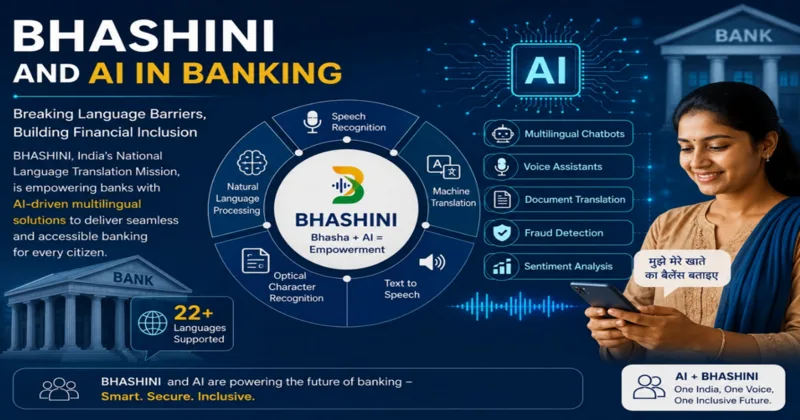
BHASHINI is AI-powered language technologies automatic speech recognition, text-to-text translation, text-to-speech and allied capabilities will be integrated into PNB digital platforms through the division’s suite of deployment tools, including BHASHINI Udyat, Mitra, AppMitra, Pravakta and the crowdsourced dataset initiative Bhashadaan. In practical terms, a farmer in Bundelkhand checking his Kisan Credit Card limit, a weaver in Bhadohi tracking a loan instalment or an elderly pensioner in Gorakhpur verifying her monthly credit will be able to do so by simply speaking to the bank’s app in Hindi, Bhojpuri-inflected Hindi, Tamil, Bengali or any supported Indian language without wrestling with English menus designed, frankly for a different India.
The scale of the platform being plugged into PNB is formidable. BHASHINI, operating through the National Hub for Language Technology, already powers more than 800 government websites and has clocked over eight billion AI inferences. It is the same sovereign language stack that the Reserve Bank of India embraced on February 23, 2026, when RBI and DIBD signed their own MoU to co-develop ‘Banking BHASHINI’ a domain-specific language model trained on banking terminology and regulatory frameworks, designed to serve all 22 languages of the Eighth Schedule. The PNB agreement is arriving months later is not an isolated gesture but the operational rollout of a considered national architecture, the regulator builds the linguistic foundation, and the public sector banks carry it to the last customer.
Why language is the last mile of financial inclusion
India’s financial inclusion story over the past decade has been genuinely historic, crores of Jan Dhan accounts, the UPI revolution that the world now studies, Direct Benefit Transfers that plugged leakages which once devoured welfare budgets. The 2011 Census recorded over 120 languages and more than 19,500 mother tongues across Bharat, while only a small fraction of the population is comfortable transacting in English. An account that exists but cannot be confidently operated is inclusion on paper not in spirit. When a customer cannot read a One-Time Password warning, cannot comprehend a loan agreement, or hesitates to use mobile banking because every button speaks an alien tongue, the digital divide simply reappears in linguistic disguise.
This is where artificial intelligence changes the arithmetic of banking altogether. Traditional localisation hiring translators, printing multilingual pamphlets, staffing regional call centres scales linearly and expensively. AI-driven language technology scales exponentially and cheaply once a speech-recognition and translation model is trained, serving the ten-millionth customer costs virtually nothing more than serving the first. Voice-first interfaces go further still, dissolving the literacy barrier itself. A citizen who has never typed a sentence in her life can speak to her bank and the bank can speak back in her language and idiom. That is Antyodaya in action, the rise of the last person, engineered into the very interface of finance.
The Global Mirror: What America’s AI banking experience teaches
To understand where AI-enabled banking can go, it is instructive to glance at the United States, where the technology has matured over nearly a decade in a single language. Bank of America launched its virtual assistant Erica in 2018, by 2025 it had crossed three billion client interactions, served nearly 50 million users and was handling tens of millions of conversations every month. The bank reported that roughly 98 per cent of users find the information they need through the assistant, with an average interaction lasting under a minute—resolution speeds no human call centre can match at that scale. In 2025, Bank of America directed around four billion dollars of its thirteen billion dollar technology budget specifically towards AI, while peers such as JPMorgan Chase and Morgan Stanley deployed generative AI tools across their workforces to augment employee productivity.
The American experience establishes three truths that India can now leapfrog upon. First, customers embrace AI banking when it is accurate and fast trust follows utility. Second, AI assistants do not merely answer queries, they proactively surface insights, flag unusual transactions and nudge better financial behaviour, effectively giving every account holder a personal banker. Third, the productivity dividend is enormous Bank of America’s leadership has estimated that its assistant performs work equivalent to thousands of employees, freeing human staff for complex, high-empathy tasks. But here lies Bharat’s distinctive opportunity America built this sophistication for one language and a largely literate, banked population. India is building it for 22 scheduled languages and hundreds of dialects, for the newly banked and the never-typed, on sovereign infrastructure owned by the nation rather than rented from Big Tech. Where the West optimised convenience, Bharat is engineering inclusion.
The expanding role of AI in inclusive banking
The BHASHINI–PNB integration is the visible tip of a much deeper transformation in what AI can do for the unbanked and underbanked. Multilingual conversational banking is the entry point but behind it stand at least four further frontiers. In credit assessment, AI models can evaluate borrowers who lack formal credit histories by reading alternative signals, opening institutional lending to street vendors and micro-entrepreneurs whom the old paperwork-driven system could never see. In fraud protection, machine learning watches transaction patterns in real time, shielding precisely those first-generation digital users who are most vulnerable to cyber deceit and warning them in their own language, which is often the difference between a heeded alert and an ignored one. In grievance redressal, AI triage can ensure that a complaint filed in Maithili receives the same speed of resolution as one filed in English. And in financial literacy, voice-based AI can explain compound interest, insurance and pension schemes conversationally, turning every smartphone into a patient teacher.
For public sector banks in particular, this technology realigns them with their founding purpose. PNB was established in 1894 in Lahore as a swadeshi enterprise a bank of Indians, by Indians, for Indians, at a time when colonial banks would not look at the native trader. That the same institution, 132 years later, is wiring an indigenous AI language stack into its systems so that no Indian is turned away by the accident of tongue, is a continuity of purpose that deserves notice. Aatmanirbharta was never merely about manufacturing, it is equally about owning the invisible infrastructure the models, the datasets, the voice of the machine through which a billion citizens will conduct their economic lives.
Challenges remain and honesty demands the Speech recognition for low-resource languages and dialect-heavy speech still trails the polish achieved for English. Banking terminology must be rendered accurately, for a mistranslated loan clause is worse than an untranslated one and data privacy frameworks must keep pace as voice data flows through financial systems. The Bhashadaan initiative, which crowdsources linguistic datasets from citizens, is the right civilisational answer to the first problem Bharat’s languages being taught to machines by Bharat’s own people. The RBI supported Banking BHASHINI model addresses the second. The third will demand continued regulatory vigilance.
For two centuries, an Indian walking into a formal financial institution was expected to leave his language at the door. The BHASHINI–PNB MoU following the RBI partnership and preceding one may reasonably expect, similar integrations across the public banking system inverts that expectation permanently. The bank will now learn the customer’s language, not the other way around. In a nation where language is not only communication but identity, memory and civilisation itself, that inversion is not a software update. It is a restoration.