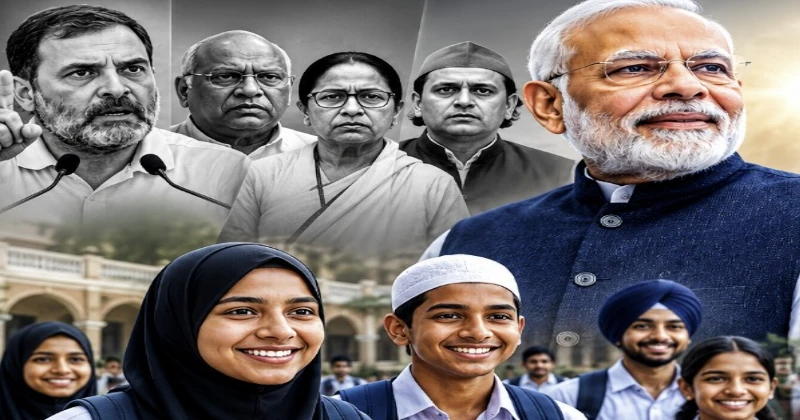
New Delhi: For years, the Opposition has repeatedly alleged that India’s minorities have been marginalised under the Narendra Modi government, portraying the NDA’s governance model as exclusionary and discriminatory. However, official data tabled in Parliament has now dealt a significant blow to that narrative.
Figures presented by the Centre in the Lok Sabha reveal that minority participation in India’s education system has consistently increased across every stage of schooling over the last five academic years, with enrolment reaching its highest level during the Modi government’s tenure. The data not only contradicts the charge that minorities have been denied opportunities under the NDA but also lends empirical support to Prime Minister Narendra Modi’s oft-repeated governance mantra of “Sabka Saath, Sabka Vikas, Sabka Vishwas, Sabka Prayas.”
DATA FACT CHECKS LEFT-LUTYENS DIVISIVE NARRATIVE
PM MODI IS "SABKE SAATH".
NDA TABLES DATA IN SANSAD SHOWING BIG SPIKE IN MINORITY SCHOOL INCLUSION.
The NDA has responded to the ecosystem's charge that minorities have been neglected under the NDA by citing official data that… pic.twitter.com/5t3UDFKVAF— Rahul Shivshankar (@RShivshankar) July 30, 2026
The latest figures come at a politically crucial time when Opposition parties continue to accuse the BJP-led government of discriminating against minority communities. Yet, the numbers presented before Parliament tell an entirely different story one of rising educational inclusion rather than systematic exclusion.
In a written reply to a starred question in the Lok Sabha, Union Minority Affairs Minister Kiren Rijiju presented official data compiled through the Unified District Information System for Education Plus (UDISE+) and the All India Survey on Higher Education (AISHE).
The data shows that the proportion of students belonging to India’s six notified minority communities Muslims, Christians, Sikhs, Buddhists, Jains and Parsis has steadily increased across every stage of school education between 2021-22 and 2025-26.
According to the figures:
- Primary education: Minority enrolment increased from 18.8 per cent in 2021-22 to 21.8 per cent in 2025-26.
- Upper primary: The share rose from 17.8 per cent to 19.6 per cent .
- Secondary education: Minority participation increased from 16.4 per cent to 18.7 per cent .
- Higher secondary: Enrolment climbed from 15.1 per cent to 17.1 per cent .
These are the highest recorded proportions during the five-year period.
Far from supporting the allegation that minorities are being pushed out of mainstream education, the government’s own data suggests that more students from minority communities are entering and remaining within India’s formal education system. The trend extends well beyond school education.
According to AISHE data placed before Parliament, Muslim enrolment in higher educational institutions increased from 21.08 lakh students in 2021-22 to 22.53 lakh students in 2023-24. Similarly, enrolment from the other five notified minority communities Christians, Sikhs, Buddhists, Jains and Parsis rose from 9.05 lakh to 10.80 lakh over the same period.
The latest AISHE survey recorded more than 4.5 crore students enrolled in higher education across the country, including over 22.5 lakh Muslim students and nearly 10.8 lakh students belonging to the remaining notified minority communities.
Female participation has also remained substantial, with more than 11.65 lakh Muslim women and over 5.71 lakh women from other minority communities enrolled in higher education.
The numbers reinforce the government’s claim that educational access among minority communities has expanded rather than contracted. The figures are politically significant because they challenge one of the Opposition’s most persistent narratives against the Modi government.
Since 2014, Opposition parties have repeatedly accused the BJP of creating an atmosphere of insecurity among minorities and denying them equal opportunities in education and welfare. International forums and advocacy groups have also echoed similar allegations, often portraying India’s minorities as victims of institutional exclusion.
However, the official enrolment data presented in Parliament paints a sharply different picture. If minority communities were being systematically denied educational opportunities, such sustained increases across every stage of schooling would be difficult to explain.
Instead, the data indicates that minority participation in formal education has continued to grow steadily under the NDA government. While enrolment figures alone cannot capture every aspect of social development, they remain one of the most important indicators of access to educational opportunities.
Responding in Parliament, Minority Affairs Minister Kiren Rijiju said the Modi government continues to implement welfare programmes for all sections of society, with special emphasis on economically weaker and socially disadvantaged groups, including minorities.
The Ministry of Minority Affairs, he said, administers scholarship schemes specifically aimed at promoting the educational and socio-economic empowerment of the country’s six notified minority communities.
Apart from scholarships, the government has also expanded educational infrastructure in minority-concentrated areas through the construction of hostels, residential schools, degree colleges and community facilities.
According to the government, these interventions have contributed to improving educational participation among minority communities.
Unlike previous approaches that were frequently criticised as vote-bank politics centred around selective appeasement, the NDA has maintained that welfare benefits should be delivered on the basis of need rather than religious identity.
The latest parliamentary figures are likely to be cited by the BJP as evidence that inclusive development can be achieved without religion-specific political mobilisation. The Centre also clarified certain limitations of the available data.
School education statistics are maintained through UDISE+, which records minority enrolment as a combined category covering all six notified minority communities. Religion-wise enrolment figures are therefore not available at the school level.
Similarly, dropout rates are maintained only at the aggregate level and are not broken down community-wise or religion-wise. Separate dropout data is also not maintained for the higher secondary stage.
For higher education, however, AISHE records separate enrolment figures for Muslim students while grouping Christians, Sikhs, Buddhists, Jains and Parsis under a combined “Other Minority Community” category. These clarifications underline that while community-specific school-level data is unavailable, the overall trend remains clear minority participation has increased consistently across the education system.
The latest parliamentary data also echoes PM Modi’s observations made in 2024 while referring to a report by the Economic Advisory Council to the Prime Minister (EAC-PM). Responding to the long-standing narrative that minorities were unsafe or suppressed in India, Modi had argued that facts did not support such claims.
Citing the EAC-PM report, he pointed out that between 1950 and 2015 the share of the Hindu population declined by nearly eight percentage points, while several minority communities registered growth in their population shares.
“The perception that has been created is proving to be a mistake. The wrong narrative is being exposed,” the PM had remarked.
He reiterated that his government’s guiding principle remained “Sabka Saath, Sabka Vikas, Sabka Vishwas, Sabka Prayas,” insisting that governance must be free from discrimination based on caste, religion or gender.