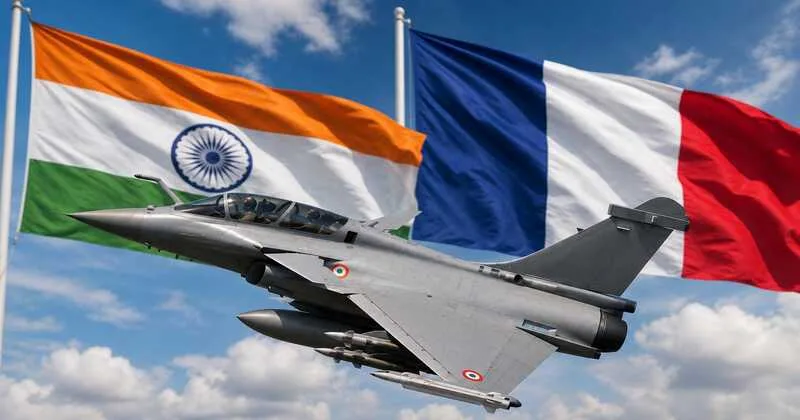
New Delhi: India’s proposed acquisition of 114 Rafale fighter aircraft under the Multi-Role Fighter Aircraft (MRFA) programme is increasingly being viewed as a strategic industrial initiative that could transform the country into Dassault Aviation’s second global production hub for the Rafale.
Beyond meeting the Indian Air Force’s long-term operational requirements, the proposed manufacturing ecosystem is expected to support future export orders across Asia, West Asia and Africa, significantly expanding India’s role in the global aerospace industry.
If the programme proceeds as envisaged, the project would mark one of the most significant milestones in India’s defence manufacturing journey. The initiative is expected to position the country not only as a major producer of one of the world’s most successful 4.5-generation fighter aircraft but also as an important export and supply-chain partner within Dassault Aviation’s worldwide production network.
India’s expanding role in global Rafale manufacturing
Dassault Aviation’s existing final assembly line at Merignac, France, is currently engaged in fulfilling a growing list of domestic and international orders. In recent years, the Rafale has secured major export contracts from the United Arab Emirates, Egypt, Indonesia, Greece, Croatia and Serbia, while France continues to induct additional aircraft into its own armed forces.
Industry observers believe that if India moves ahead with the procurement of 114 additional Rafales while Dassault continues to honour its existing international commitments, relying solely on the French production line would pose considerable industrial and manufacturing challenges. Establishing a second production ecosystem has therefore emerged as an important requirement, not only for India’s acquisition programme but also for Dassault’s long-term global export strategy.
A major step towards this objective was taken in 2025, when Dassault Aviation signed production transfer agreements with Tata Advanced Systems Limited (TASL) to establish manufacturing facilities in Hyderabad for complete Rafale fuselage sections. The facilities are expected to manufacture complete fuselage assemblies that will become part of Dassault’s worldwide production system rather than serving only India’s domestic requirements.
Once operational, these Indian-built fuselage sections could be supplied to final assembly lines producing aircraft for both Indian and international customers. The approach indicates that Dassault is developing an integrated manufacturing ecosystem in India capable of supporting global production instead of creating a standalone assembly line dedicated exclusively to Indian orders.
#WATCH | Nice, France: At 'Bharat Innovates' inauguration event, PM Narendra Modi says, "During his visit to India, President Macron had said that for the solutions to challenges of this century, India and France will have to step forward together. I can proudly say today that… pic.twitter.com/ZFLXWYV8oR
— ANI (@ANI) June 14, 2026
Under the proposed phased manufacturing model, the initial batch of aircraft is expected to be built in France to enable relatively faster induction into Indian Air Force service while production infrastructure is simultaneously developed in India. As domestic manufacturing capabilities mature, a growing proportion of the remaining aircraft could be assembled within India with progressively higher indigenous content.
The gradual transition would allow Indian industry to steadily assume greater manufacturing responsibility while avoiding delivery delays. Over time, local production is expected to move beyond final assembly to include sophisticated structural manufacturing, systems integration and wider participation across the aerospace supply chain.
Export potential and indigenous capability boost
After the Indian Air Force’s primary requirements are fulfilled, the production infrastructure established under the MRFA programme is expected to remain available for future export orders. A second major Rafale production centre would substantially increase overall annual manufacturing capacity while reducing pressure on Dassault’s facilities in France. It would also provide greater flexibility in executing export contracts and responding to increasing international demand for advanced combat aircraft.
India’s strategic geographic location further strengthens the proposal. Positioned between Europe, Southeast Asia, the Middle East and Africa—regions that continue to emerge as important markets for advanced fighter aircraft—India could offer shorter logistics chains, improved industrial cooperation and more efficient long-term maintenance and support arrangements for prospective customers.
The programme is also expected to deepen the involvement of Indian industry in global aerospace manufacturing. Companies including Tata Advanced Systems, Bharat Electronics Limited (BEL), Bharat Dynamics Limited (BDL), Larsen & Toubro (L&T), Dynamatic Technologies, along with numerous micro, small and medium enterprises (MSMEs), have steadily expanded their participation in international aerospace production over the past several years.
Their integration into Rafale manufacturing would strengthen India’s position within global aerospace value chains while opening opportunities for exporting high-value aerospace components in addition to complete aircraft assemblies.
Beyond immediate industrial gains, large-scale participation in fighter aircraft production is expected to enhance expertise in advanced composites, precision machining, aerospace-quality manufacturing, systems integration and supply-chain management.
These technological capabilities are considered directly relevant to India’s indigenous fighter development programmes, including the Tejas Mk2 and the Advanced Medium Combat Aircraft (AMCA), potentially accelerating future domestic aerospace development.
Despite the significant industrial potential, India’s emergence as an export hub for the Rafale will ultimately depend on the final commercial framework agreed between Dassault Aviation, the Government of India and the selected Indian industrial partners.
Any export of Rafale aircraft manufactured in India would continue to require compliance with French export policies as well as applicable international regulations governing defence sales.
Even if aircraft are assembled in India, prospective international buyers would continue to negotiate purchases directly with Dassault Aviation and the French government, since the Rafale remains a French-designed combat aircraft. Nevertheless, the proposed MRFA programme has the potential to establish India as a critical pillar of Dassault’s global manufacturing strategy while simultaneously strengthening the country’s long-term aerospace and defence industrial capabilities.