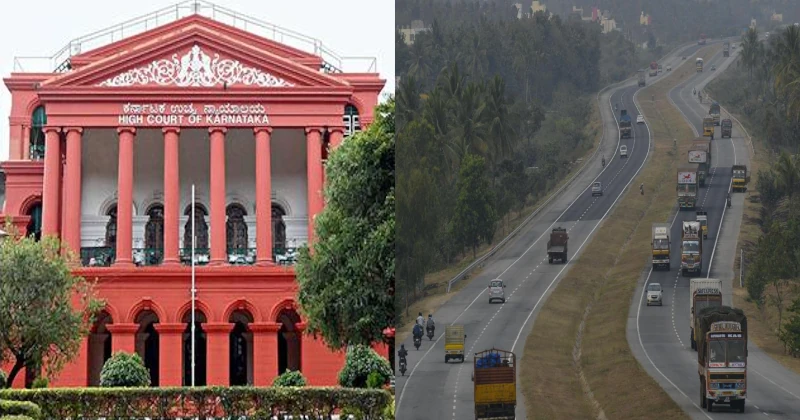
Bengaluru: In a landmark verdict with far-reaching implications for the long-pending Bengaluru-Mysuru Infrastructure Corridor (BMIC) project, the Karnataka High Court has upheld an earlier order setting aside the acquisition of several acres of land for the controversial expressway project. The court also made scathing observations, describing the BMIC project as appearing to be “one of the biggest scams in the State of Karnataka” and calling for an independent investigation and forensic audit into its implementation.
A Division Bench comprising Justice D.K. Singh and Justice T.M. Nadaf dismissed 92 appeals filed by Nandi Infrastructure Corridor Enterprises (NICE), the Karnataka Industrial Areas Development Board (KIADB) and others challenging the July 4, 2025 order of a single judge, which had quashed the acquisition of land notified for the project.
The Bench endorsed the findings of the single judge, who had ruled that the land acquisition process had remained incomplete for over two decades, depriving farmers of their agricultural lands and livelihood without payment of compensation.
In strongly worded remarks, the High Court observed that the BMIC project appeared to have allowed private interests to flourish at the cost of public interest, environmental protection and constitutional principles.
“It appears that this BMIC project may be one of the biggest scams in the State of Karnataka. It demonstrates how the State, as trustee of natural resources on behalf of citizens, has allowed private interests to prosper in violation of constitutional mandates, environmental safeguards and public interest,” the Bench observed.
The court noted that despite the passage of nearly 25 years since the project was conceived, its promised objectives had largely remained unfulfilled while substantial private gains had allegedly been made.
The judges said the project had “done nothing except benefit its proponents in an astronomical manner” while farmers lost their lands and livelihoods and the public interest suffered.
Observing that the case warranted deeper scrutiny, the Bench recommended that the entire project be subjected to an independent investigation by a panel of experts along with a forensic audit of financial transactions. It said such an exercise was necessary to examine allegations of fraud and other acts of commission and omission connected with the implementation of the project.
However, the court also expressed scepticism over whether such an inquiry would actually be undertaken.
“We have serious doubts whether such an exercise will ever be initiated because the State itself appears to have acted as an accomplice by permitting illegal diversion of land, capitalisation of public assets, destruction of lakes, collection of huge tolls in violation of the Framework Agreement and allowing the project proponents to retain a massive land bank without compensating landowners,” the Bench remarked.
The High Court further observed that the facts placed before it indicated that the project had failed to deliver on its original promises. “There is little to show from this project except that generations of farmers have been deprived of their lands and livelihoods without receiving due compensation,” the court noted.
The Bench pointed out that NICE had constructed only around five kilometres of the proposed expressway over the past 25 to 26 years despite retaining control over a land bank exceeding 20,000 acres.
According to the court, valuable land and assets had allegedly been alienated and commercially exploited in violation of both the Framework Agreement governing the project and earlier directions of the Supreme Court.
During the proceedings, NICE argued that delays in executing the project were caused by the State Government’s failure to provide the extent of land promised under the Framework Agreement. The company maintained that this was the primary reason for the non-completion of the expressway and associated infrastructure.
The Division Bench, however, rejected this contention, describing it as factually incorrect. The judges referred to an affidavit filed by the State Government in contempt proceedings, which disclosed that 554 acres of excess land had in fact been handed over to NICE beyond what was originally envisaged.
The court also questioned the State Government’s continued support for the project despite its prolonged delay.
“We fail to understand why the State has not reviewed or cancelled the project when NICE has failed to fulfil its core objectives, including construction of a 111-kilometre expressway, development of five townships and creation of employment and economic growth,” the Bench observed.
NICE had also argued that repeated legal challenges by landowners would adversely affect large public infrastructure projects and discourage investment.
Rejecting this submission, the High Court held that the grievances raised by landowners were not based on minor procedural delays but on a prolonged denial of their rights.
“The delay in this case is not for a few months or a few years. It has extended over more than two decades, during which affected landowners have been deprived of their property and livelihood,” the court observed.