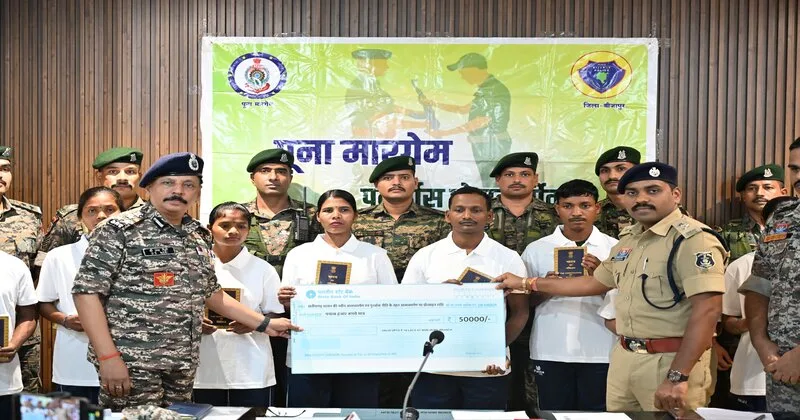
Jagdalpur: In a significant development in the ongoing efforts to curb Maoism, eight Maoists carrying a combined reward of Rs 49 lakh surrendered before security forces in Chhattisgarh’s Bijapur district on Wednesday. The surrender is being seen as a major breakthrough, particularly as it comes after the state government’s declaration on March 31 that Chhattisgarh had been freed from Maoism.
Eight Maoists Lay Down Arms in Bijapur
According to Bijapur Superintendent of Police Umesh Prasad Gupta, the surrendered cadres, including five women, appeared before senior officials of the district police and the Central Reserve Police Force (CRPF). The individuals had been active for several years in neighbouring Jharkhand and were associated with the banned CPI (Maoist).
Maoist Surrender in Bijapur, Chattisgarh
Today 8 hardcore Naxalites active in Jharkhand & carrying a cash reward of 49 lakh surrendered in Bijapur in presence of Sh BS Negi, DIG Ops Bijapur, Sh Umesh Prasad Gupta, SP Bijapur & Officers of 209 CoBRA & Chattisgarh Police @209_CoBRA pic.twitter.com/vuoOfTesWV— DIG OPS BIJAPUR, CRPF (@DIGOPSBJPR) July 29, 2026
Among those who surrendered were Ashwin alias Lachhu (30), Ranga alias Sohan (30), and Doba Madvi alias Rahat (25), who were functioning as divisional committee members and each carried a reward of Rs 8 lakh. Phagni Poyam alias Rajni (28), Suraj Munni Champiya (25), Hidme Kadti alias Rita (27), and Budhri Kunjam alias Anusha (25) were working as area committee members and carried rewards of Rs 5 lakh each. Another cadre, Salmi Champiya alias Jilani (20), who was a party member, also had a reward of Rs 5 lakh on her head.
The surrendered Maoists are residents of Bijapur, Narayanpur, and Sukma districts, highlighting the continued presence of cross-border Maoist activity in the Bastar region and adjoining areas of Jharkhand.
Factors Leading to the Surrender
Officials stated that the cadres were influenced by the Chhattisgarh government’s Naxalite Surrender and Rehabilitation Policy and ongoing welfare and development initiatives in tribal regions. According to SP Gupta, the individuals expressed growing disillusionment with the Maoist movement and cited several reasons for abandoning the insurgency.
They pointed to the increasing dominance and operational effectiveness of security forces in Maoist-affected areas, as well as the weakening organisational structure of the banned outfit. The surrendered cadres also mentioned dissatisfaction with the group’s violent and anti-people ideology and acknowledged the success stories of former Maoists who had reintegrated into society through rehabilitation programmes. Rapid development in remote tribal regions further contributed to their decision to return to the mainstream.
Rehabilitation and Reintegration Measures
Under the state’s surrender and rehabilitation policy, the former Maoists will be provided financial assistance, skill development training, housing facilities, educational support, and employment opportunities. Officials said these measures are aimed at ensuring that surrendered cadres can lead a dignified and self-reliant life.
Authorities also credited the coordinated efforts of Jharkhand Police, the CRPF, and Bijapur Police, along with sustained confidence-building measures among local populations, for creating an environment conducive to such surrenders. The administration believes that continued outreach and rehabilitation initiatives will encourage more Maoists to abandon violence.
IED Blasts Injure Two Villagers
Even as the surrender marked a positive development, the persistent threat of improvised explosive devices (IEDs) planted by Maoists continues to pose serious risks to civilians. On Wednesday, two villagers were injured in separate incidents in Bijapur district after stepping on pressure IEDs in forest areas.
According to Additional Superintendent of Police Chandrakant Govarna, both incidents occurred in remote forest regions where explosives had been planted earlier by Maoists. The first incident took place near the Neelam Sarai waterfall in the Chintagufa police station area of Sukma district. A group of seven to eight youths and children from Karigundam village were heading towards the waterfall when a 13-year-old boy, identified as Sodhi Deva, accidentally stepped on a pressure IED around 1.5 kilometres before reaching the site. The explosion injured the heel of his right foot.
The injured boy was immediately taken to the Usur Community Health Centre, where he received initial treatment before being referred to the district hospital. Police officials confirmed that his condition is stable.
The second incident occurred near Nambi village, where two villagers had gone to graze cattle near a stream. During the activity, 15-year-old Vinod Kattam stepped on a pressure IED concealed in the forest, sustaining injuries to his right foot. Authorities have urged residents to remain vigilant and avoid venturing into forested and sensitive areas without proper caution.
Recovery of Tiffin IEDs in Kanker
In a separate anti-Naxal operation, security forces achieved a major success in Kanker district by recovering four tiffin IEDs from forested terrain. Superintendent of Police Nikhil Rakhecha stated that the explosives were discovered during a joint search operation conducted by the District Reserve Guard (DRG) and the Bomb Disposal Squad (BDS).
#WATCH | Chhattisgarh | A joint team of the DRG and BDS recovered four 'tiffin' IEDs during a search operation in the forest and hilly terrain between Kharkagaon and Nilegondi, within the jurisdiction of the Ambabeda police station in Kanker.
Among the recovered explosives, one… pic.twitter.com/foFQPqwPGb
— ANI (@ANI) July 29, 2026
The operation was carried out in the forest area between Khadkagaon and Nilegondi villages under the jurisdiction of Kotwali police station, near the Amabeda and Kanker police station boundaries. During the search, the team recovered one IED weighing five kilograms and three others weighing three kilograms each.
The Bomb Disposal Squad subsequently destroyed the explosives on-site through controlled detonation, ensuring maximum safety. Officials said that timely detection and disposal of the IEDs prevented a potential major incident and safeguarded both security personnel and civilians.
The operation was led by Assistant Sub-Inspector Shailendra Bhaskar of the DRG and Assistant Sub-Inspector Govardhan Korram of the BDS. Police officials stated that such joint operations will continue in Maoist-affected border areas to maintain law and order.
Maoist Memorial Demolished in Narayanpur
In Narayanpur district, security forces demolished a wooden memorial constructed by Maoists in Toyapara village under the Dhanora police station limits. The action was part of an ongoing area domination and search operation conducted by a joint team of Chhattisgarh Police and the 45th Battalion of the Indo-Tibetan Border Police (ITBP).
Narayanpur Superintendent of Police Sandeep Kumar Patel confirmed that the structure was discovered during a search operation on Wednesday. The forces thoroughly combed the area and also interacted with local villagers during the operation.
According to police, such memorials are often built by Maoists to commemorate their deceased cadres and to serve as tools of propaganda and psychological influence. These structures are used to instill fear among local populations and reinforce the presence of the insurgent group.
The demolition of the memorial is part of broader efforts to dismantle Maoist influence and restore confidence among residents in areas that were previously affected by insurgent activities.
Despite the official declaration of Narayanpur as Maoist-free, security forces continue to conduct intensive search operations in the region to prevent any resurgence of insurgent activity. Authorities have emphasized that sustained vigilance, intelligence gathering, and community engagement remain essential components of the strategy to maintain peace.
Police have appealed to the public to promptly report any information related to Maoist movements or suspicious activities. Officials have assured that the identity of informants will be kept strictly confidential.