
A family floater health insurance plan is often considered the smartest and most cost-effective way for a family to manage healthcare costs. It provides a single shared pool of funds for each covered family member. This pooling of the Sum Insured (SI) offers convenience and savings compared to individual plans. However, this shared pool carries a critical risk:
“What if one family member requires extensive medical care and drains the entire coverage amount?”
When a single claim exhausts the policy’s Sum Insured mid-year, the entire family is left financially vulnerable because coverage for all members ceases for the remainder of the policy period.
This article explains the immediate and serious consequences of sum insured exhaustion through a case study. Let us know the essential strategies to safeguard your family’s financial security.
What happens when one family member uses up the entire SI in a family floater health insurance plan? In a family floater health insurance plan, when one member uses up the entire Sum Insured (SI), the coverage for all other members ceases for the rest of that policy year, leaving the entire family vulnerable to significant out-of-pocket expenses.
The Mehra family faces an empty reservoir: family floater coverage is used up!
Here is the recent case of the Mehra family: Mr Rahul Mehra, his wife Anjali, and their son Ishaan, all of whom were covered under a Rs 5 lakh family floater health insurance plan. They felt secure knowing they had a shared pool of funds for emergencies.
Midway through the policy year, Rahul required an emergency surgery following an accident. The total hospital bill came to exactly Rs 5 lakhs. Since their sum insured was a shared pool, the insurance company paid the full amount, depleting the reservoir entirely.
Three months later, Ishaan developed a severe case of typhoid fever that required hospitalisation. The Mehras assumed their ‘family’ plan would still protect them, but they quickly discovered the reality of sum insured exhaustion.
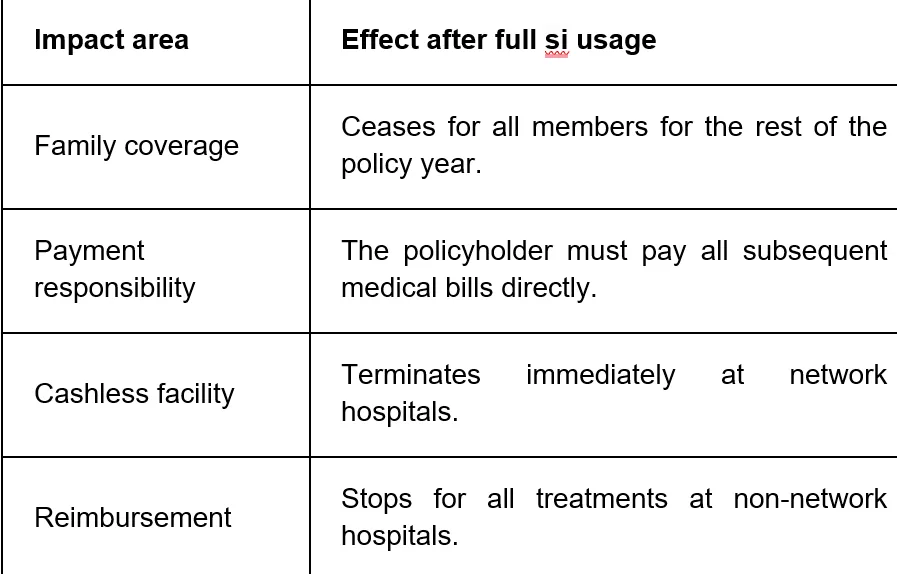
Here is a summary of the consequences faced by the Mehra family due to exhaustion of the sum insured:
.
The above consequences hint at a serious financial catastrophe for the Mehra family. Let us dive deep into the financial impact of sum insured exhaustion and how to avert it.
Immediate effects of sum insured exhaustion in a family floater plan
The Sum Insured in a family floater is a single, shared pool of funds available to all covered members. When one high claim depletes this pool, the following immediate consequences occur:
● Out-of-pocket expenses: Any subsequent medical expense incurred by any family member after the SI reaches zero must be paid directly by the policyholder. This includes doctors’ fees, hospital bills, follow-up care, and medication.
● Cessation of cashless facility: The cashless facility at network hospitals automatically stops. The insurer will cover only the remaining SI balance; the patient must settle the remaining balance on the bill.
● Reimbursement stops: For treatments received at non-network hospitals, all reimbursement payments from the insurer cease once the policy limit is reached.
One must opt for an adequate coverage amount to avoid such adverse consequences. However, if the sum insured is exhausted mid-policy year, one should adopt a master strategy to address the financial crisis.
What to do if the sum insured in a family floater health insurance plan gets exhausted?
When the sum insured in a family floater health insurance plan gets exhausted, you should treat the subsequent policy renewal as a critical opportunity to prevent recurrence. Here are five crucial policy renewal benefits that can enhance the scope of your coverage in the subsequent policy year:
●Increase SI at renewal: Request a significant increase in the Sum Insured during the renewal window. Note that the insurer may require a fresh medical check-up to approve a large increase in the SI, especially if the exhaustion was due to a new, serious condition.
● Check the restoration status: Immediately contact your insurer to confirm if your policy has a Restoration Benefit, when it activates, and whether it covers the illness that caused the exhaustion.
● Utilise super top-up: If you have a Super Top-Up plan, inform the hospital immediately about the benefit to avail the cashless benefit and ensure timely treatment.
● Wellness discounts: New-age health insurance plans offer significant premium discounts at policy renewal to encourage a healthy lifestyle. Fitness is tracked using digital devices such as smartwatches to count healthy days during the year, which determines the percentage discount on the renewal premium.
● Portability benefits: While renewing or porting a health insurance policy, you can even retain your credits for waiting periods already served in the previous policy. This ensures immediate coverage for pre-existing conditions. Besides, certain family health insurance plans also offer additional sum insured when porting a policy, for which a fresh waiting period applies.
Utilising these policy features can effectively safeguard your financial savings and ensure you receive prompt medical care.
To sum up
The Mehra family’s disappointing experience serves as a stark cautionary tale of the silent threat inherent in family floater health insurance plans: the sudden exhaustion of shared coverage. To prevent such a financial crisis, you must move beyond passive enrollment. Prioritise proactive security by verifying the specific triggers for your restoration benefits, securing a Super Top-Up plan as a secondary safety net for catastrophic events, and rigorously reviewing your Sum Insured at every renewal to keep pace with rising healthcare costs. Safeguarding your family requires a strategy that ensures your reservoir of care never runs dry.
(Disclaimer: The views expressed by the author are personal and not of the publication)