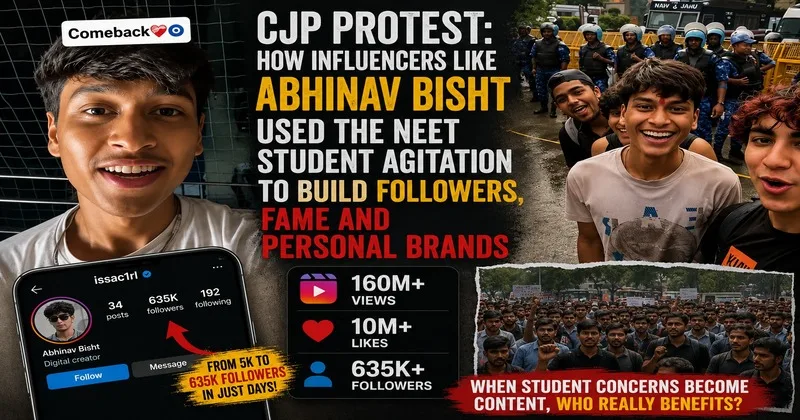
New Delhi: What began as a student-led agitation over the concerns of NEET aspirants gradually evolved into a social media opportunity for some influencers. Instead of keeping the spotlight on examination-related issues, they appeared to transform the protest into a steady stream of reels, reaction videos and provocative content targeting the Bharat Government while also amplifying a broader narrative against the country’s education system. Rather than focusing solely on specific reforms or the grievances of affected students, the messaging increasingly portrayed the system itself as fundamentally broken, fuelling outrage and sustaining online engagement.
As their digital reach grew, the protest site increasingly served not just as a platform for students to voice their concerns, but also as a stage for personal branding, audience expansion and potential commercial opportunities. What started as a movement centred on NEET aspirants appeared, in part, to evolve into a vehicle for influencer visibility and personal gain, with the protest itself becoming content for an ever-growing online audience.
Most of the people participated in CJP Protest for Likes, Views, Shares, Followers..
It was 100% for a personal gain and 0% for NEET Students.Abhinav Bisht gained 600K + followers on Instagram and got views in millions for his Chhapri reels mocking RAF got him money..
Dur… pic.twitter.com/3MudeJLY0b
— Sunaina Holey (@SunainaHoley) July 29, 2026
When the Protest Became Content
For students, a protest can mean academic uncertainty, years of preparation and anxiety about their future. For social-media creators, however, the same event can become an endless source of content. Confrontations, arguments, police action, slogans and dramatic moments can all be converted into short-form videos designed to attract maximum engagement. The more provocative the content, the greater its potential to go viral. This risks shifting the focus from the actual demands of NEET aspirants to the personalities documenting the agitation.
Abhinav Bisht and the Follower Surge
The case of social-media creator Abhinav Bisht illustrates how dramatically an influencer’s visibility can change during a viral protest. Reports stated that his Instagram following grew from around 5,000 to more than 635,000 during the period surrounding the CJP agitation, while his protest-related videos attracted millions of views.
One of his videos was reportedly viewed more than 160 million times. The extraordinary growth raises an obvious question: when an individual gains hundreds of thousands of followers and enormous visibility from content surrounding a student agitation, how much of the attention is ultimately benefiting the students and how much is building the creator’s own digital brand?
Millions of Views, But Where Are the Students?
The central irony is that an agitation supposedly centred on NEET aspirants can end up making the influencers more recognisable than the students themselves. Social-media audiences may remember the viral faces, jokes, confrontations and reels while knowing little about the actual demands of the aspirants. What exactly were students demanding? What reforms did they want? What were the academic consequences they were worried about? These questions require serious discussion, but detailed explanations rarely receive the same algorithmic attention as sensational or humorous content. When the creator becomes more visible than the cause, the purpose of activism itself comes under question.
The influencer economy is built around attention. Followers create an audience, views increase reach, and engagement strengthens a creator’s digital profile. A dramatic increase in followers can subsequently open doors to collaborations, sponsorships, appearances and other professional opportunities. This does not by itself prove that a particular creator monetised a specific protest video. However, it does demonstrate why viral visibility has value. A protest may last for days, but the audience acquired during those days can remain with the creator for years. The agitation therefore has the potential to provide a lasting personal benefit even after the original issue has disappeared from the news cycle.
When Personal Branding Overtakes Public Advocacy
There is a fundamental difference between using social media to amplify a cause and using a cause to amplify oneself. In genuine advocacy, the personality of the messenger should ultimately remain secondary to the issue being highlighted. But when reels increasingly centre on the influencer’s personality, reactions, confrontations and viral moments, the protest can begin to look like a personal branding exercise. The cause becomes the setting, while the influencer becomes the main character. That reversal is particularly problematic when the movement concerns students whose academic and professional futures are at stake.
The episode also reflects the growing influence of the creator economy among young people. Social media has made it possible for individuals to build careers almost entirely around their online personalities. A viral protest video can bring thousands of followers overnight, which can lead to another viral video and then an even larger audience. The cycle continues until participation in a public event itself becomes part of a creator’s identity. What may have started as protest coverage can consequently evolve into a long-term personal brand built around controversy, confrontation and political commentary.
There is nothing inherently wrong with influencers participating in public movements or using their platforms to highlight genuine grievances. The problem begins when the influencer’s personal growth becomes more visible than the progress made for the students. A student-centred agitation should leave behind greater awareness of examination concerns, meaningful public discussion and tangible attention to the aspirations of affected candidates. If the most visible outcome instead becomes a creator’s rapidly expanding follower base, then questions about the real beneficiaries of the agitation are bound to arise.
The distinction between public advocacy and personal gain becomes particularly important in the digital age. A creator can participate in a genuine cause while simultaneously benefiting from increased visibility, but the public should still examine whether the balance has shifted too far towards the individual’s interests. If millions of views, hundreds of thousands of new followers and heightened personal recognition become the most obvious outcomes for an influencer, the protest risks functioning as a branding opportunity. The students’ concerns may remain unresolved while the influencer’s digital career receives a major boost.
Who Really Benefited From the Agitation?
The CJP protest therefore raises a larger question about activism in the age of Instagram. Students may have entered the agitation hoping their concerns would receive attention, while influencers may have emerged with dramatically larger audiences and greater public recognition. The protest may have provided the raw material for viral content, but the resulting digital capital belongs primarily to the creators who accumulated it. This does not mean every influencer had selfish intentions, but the enormous personal visibility generated by such protests cannot simply be ignored.
A Protest Should Not Become a Personal Branding Exercise
Student movements deserve to be treated with seriousness because behind every examination controversy are young people who have invested years of their lives preparing for their future. Their concerns should not become merely background material for viral reels. Social media can certainly amplify their voices, but the spotlight should ultimately remain on the students and their demands. When the protest becomes more about followers, views, shares, personal fame and influencer identity than about the people whose future is at stake, a public cause risks being transformed into a private branding opportunity.
The CJP episode thus offers a broader lesson about protest politics in the digital era: in an economy where attention itself has value, public anger can become content, activism can become branding, and a student agitation can become a stepping stone for personal visibility. The most important question, therefore, is not how many views the protest generated, but what it actually delivered for the students at its centre.