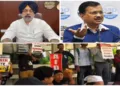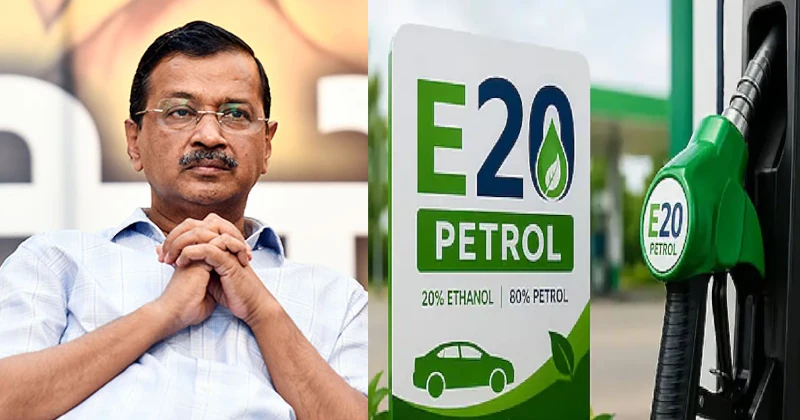
NEW DELHI: Aam Aadmi Party (AAP) chief Arvind Kejriwal has ignited a fresh controversy by claiming that automobile manufacturers privately believe the Centre’s E20 ethanol blending programme is “not desirable.” However, the country’s leading automobile companies have already said exactly the opposite on record, before the media, and backed by extensive engineering studies involving crores of vehicles.
The contradiction has placed Kejriwal’s assertions under intense scrutiny, with industry leaders publicly endorsing the E20 programme even as the former Delhi Chief Minister claims unnamed company officials have conveyed the opposite to him behind closed doors.
Arvind Kejriwal claims he has spoken to automobile manufacturers and that they believe E20 blending is “not desirable.”
The automobile industry itself says exactly the opposite.
Here are the facts, straight from the CEOs and senior executives who publicly addressed the media:… pic.twitter.com/x5XhLrKF5i
— Amit Malviya (@amitmalviya) July 29, 2026
In a post on X, Kejriwal announced that he had written to 29 automobile manufacturers asking whether petrol vehicles manufactured before 2023 could safely run on E20 fuel. He also claimed he had spoken to officials of automobile companies who allegedly told him that E20 blending was “not appropriate,” promising to reveal more details at a press conference.
But long before Kejriwal’s latest allegations, India’s biggest automobile manufacturers had already placed their position firmly in the public domain—and it leaves little room for ambiguity.
Maruti Suzuki: Data from 2.84 crore vehicles says otherwise
Perhaps the strongest rebuttal comes from India’s largest carmaker. Rahul Bharti, Senior Executive Officer at Maruti Suzuki, disclosed that the company analysed servicing data from 2.84 crore vehicles during FY 2025–26, including over 1.5 crore older vehicles that were never originally certified as E20-compatible.
The verdict was categorical.
According to Maruti Suzuki, there was no evidence of corrosion, abnormal wear and tear, or reduced component life attributable to E20 fuel. Rather than relying on assumptions or isolated complaints, the company based its conclusion on one of the largest real-world vehicle databases in the country.
Toyota: E20 was introduced only after rigorous scientific testing
Toyota Kirloskar Motor Country Head and Executive Vice President Vikram Gulati rejected the notion that E20 was rolled out without adequate preparation. He explained that the fuel underwent years of rigorous testing, including on older vehicles, before its introduction.
Describing ethanol as a clean, high-performance fuel, Gulati noted that it has been successfully used across several countries for decades, including in motorsport hardly the profile of a fuel considered “undesirable.”
Hero MotoCorp: Millions of two-wheelers show no additional damage
The country’s largest two-wheeler manufacturer also dismissed fears surrounding E20. Hero MotoCorp Chief Business Officer Ashutosh Varma stated that the company’s extensive service data covering millions of motorcycles revealed no increase in engine damage or vehicle failures linked to E20 fuel.
His remarks reinforced the industry’s broader position that real-world evidence simply does not support allegations that E20 harms vehicles.
Maruti Suzuki, Toyota and Hero MotoCorp are not alone. Representatives of Hyundai Motor India, Bajaj Auto and TVS Motor Company also publicly reaffirmed their confidence in the E20 programme during the same industry interaction.
Collectively, the country’s leading automobile manufacturers endorsed the fuel blend after years of testing and engineering validation.
The government’s E20 programme did not emerge overnight. It followed years of consultation involving the Society of Indian Automobile Manufacturers (SIAM), the Automotive Research Association of India (ARAI), automobile manufacturers, oil marketing companies, testing agencies and technical experts.
Engine calibration, fuel-system compatibility, emissions performance, durability and material behaviour were all evaluated before nationwide implementation.
The programme, therefore, rests on extensive scientific validation rather than political messaging. On one side are the public statements of CEOs and senior executives, backed by service records involving crores of vehicles, years of engineering research and exhaustive testing.