New Delhi: For seven decades after Independence, Indian agriculture chased a single goal: yield, at any cost. The Green Revolution fed a hungry nation, but it left behind silent, debt-depleted soils, poisoned water tables and farmers trapped in a cycle of rising input costs and falling returns. The National Mission on Natural Farming (NMNF), approved by the Union Cabinet on 25th November 2024 under the leadership of Prime Minister Narendra Modi, marks a civilisational correction to this trajectory. It is not a rejection of modern science but a synthesis of it with the traditional knowledge that sustained Bharat’s soil for millennia.
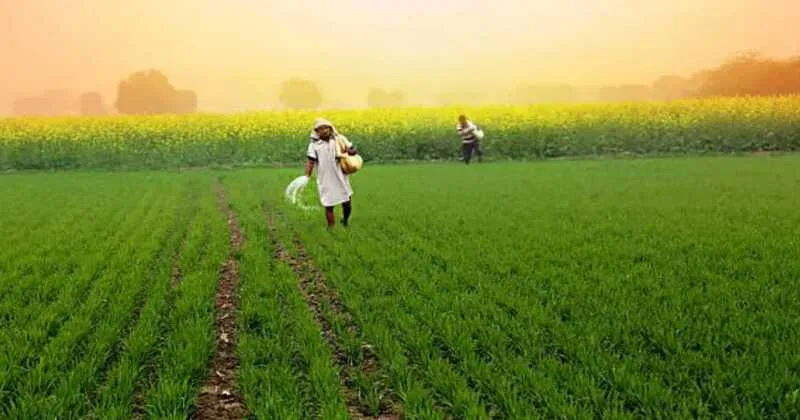
Natural farming as defined under the Mission is chemical-free agriculture built on livestock-integrated methods and diversified cropping systems rooted in indigenous practice. It recognises the interdependence of soil, water, the microbiome, plants, animals, climate and human wellbeing as a single living system, not a factory to be optimised with synthetic inputs. Implemented as a standalone Centrally Sponsored Scheme under the Ministry of Agriculture and Farmers Welfare, NMNF carries a total outlay of Rs 2,481 crore, with the Centre contributing Rs 1,584 crore and states Rs 897 crore till the period of the 15th Finance Commission. Its ambition is vast: reaching one crore farmers, forming 15,000 clusters in gram panchayats and bringing at least 7.5 lakh hectares under natural cultivation, with farmers receiving an incentive of Rs 4,000 per acre annually for two years to ease the transition.
Why India needed this correction
Indian fertiliser subsidy bill tells its own story of unsustainability. The Union government budgeted over Rs 1.67 lakh crore for fertiliser subsidy in 2025-26 alone, and this figure has swung as high as Rs 2.25 lakh crore in years of global price shocks, nearly 40 per cent of the country’s total subsidy spending, propping up a system that has quietly eroded the very soil it was meant to nourish. Despite these massive outlays, India still imports a significant share of its urea, and over 80 per cent of the natural gas used as feedstock for domestic fertiliser production is imported, leaving farm input security hostage to global price volatility and geopolitical disruptions such as those seen in West Asia. Decades of skewed, nitrogen-heavy fertilisation have degraded soil organic carbon, disturbed the natural nutrient balance and pushed farmers into a spiral where more chemicals are needed each season merely to sustain the same yield.
This is precisely the trap natural farming seeks to break. By restoring soil biology through local livestock integration, biomass mulching and traditional preparations. The Mission aims to cut farmers’ dependence on externally purchased inputs, lower cultivation costs and rebuild the resilience of Indian agriculture against an increasingly erratic climate, all while strengthening the Atmanirbhar Bharat vision of reducing reliance on imported chemical inputs.
There is also a public health dimension that rarely gets the attention it deserves. Decades of indiscriminate pesticide and fertiliser use in India’s chemical-intensive farming belts have been linked by researchers to contaminated groundwater and elevated pesticide residues in food grain, vegetables and even mother’s milk in some studied regions. The infamous “cancer train” running through Punjab’s Malwa belt, carrying patients from a heavily chemical-dependent agrarian region towards Bikaner for treatment that has for years stood as a grim symbol of what unchecked chemical intensification can do to a farming community’s own health. Natural farming, by removing synthetic pesticides and fertilisers from the food chain altogether, addresses this human cost directly rather than treating it as an unfortunate side effect of productivity.
The architecture of implementation
What distinguishes NMNF from earlier natural-farming efforts is the scale of its institutional backbone. The Mission has identified 527 Krishi Vigyan Kendras, 76 Agriculture Universities and 194 Local Natural Farming Institutes to anchor cluster-level implementation. Eighteen Centres of Natural Farming Institutes have been designated to train scientists drawn from these KVKs and State Agricultural Universities, along with state, district and block-level officials and Farmer Master Trainers. At the grassroots, Community Resource Persons popularly known as Krishi Sakhis, handhold farmers through the practical shift from chemical to natural methods. As of the latest figures, 33,257 such Krishi Sakhis and Community Resource Persons have already been trained across KVKs, Agricultural Universities and Local Natural Farming Institutions, forming the human infrastructure that will carry this Mission into the last mile of rural India. By July 2025, the Mission had already established over 1,100 model demonstration farms and engaged more than 800 training institutions, while working towards a target of 10,000 Bio-Input Resource Centres that will manufacture and supply natural inputs such as jeevamrit and beejamrit locally, ensuring farmers are not merely told to abandon chemical inputs but are given a functioning alternative supply chain from day one.
The results are already visible on the ground. Official data places 18,893 clusters formed and 20,92,657 farmers enrolled across the country, covering more than 10.32 lakh hectares under natural farming practices in 2024-25 and 2025-26. Rajasthan leads with over 2,380 clusters and 2.12 lakh farmers, while Madhya Pradesh, Maharashtra and Karnataka have each brought over 40,000 hectares under the fold. Uttar Pradesh alone has formed 1,857 clusters, enrolled 2,30,733 farmers and covered 83,166.9 hectares by placing it among the top three states nationally, a reflection of the state government’s aggressive convergence of NMNF with its own agricultural extension network. Andhra Pradesh, building on its earlier Zero Budget Natural Farming experience, tops the list with over 6.5 lakh farmers and 4.25 lakh hectares. Even smaller states and Union Territories, from Ladakh’s high-altitude farms to the island clusters of Andaman & Nicobar, have been drawn into the fold, underlining that the Mission’s scope is genuinely pan-Indian rather than confined to the traditional agricultural heartland alone.
A global reckoning with chemical agriculture
India’s pivot is not occurring in isolation; it mirrors a reckoning playing out across world agriculture. The UN Food and Agriculture Organisation estimates that nearly a third of the world’s ice-free land is moderately to highly degraded, with soil organic carbon stressed across both the Global North and Global South. The global economic cost of land degradation is estimated at $18-20 trillion annually by the UN Convention to Combat Desertification, a burden that falls disproportionately on developing nations already contending with climate volatility. Synthetic nitrogen fertiliser production and field use together generate over a billion tonnes of CO2-equivalent emissions a year, while agriculture as a whole accounts for the overwhelming majority of global nitrous oxide and ammonia emissions, pollutants with far greater warming potential than carbon dioxide.
The world has also seen the cost of getting this transition wrong. Sri Lanka’s abrupt, blanket ban on chemical fertiliser imports in 2021 imposed overnight without scientific groundwork, farmer training or alternative input systems triggered a collapse in rice and tea output and deepened the island nation’s economic crisis. That episode stands as a cautionary tale precisely because it validates, by contrast, the calibrated Indian model: NMNF does not ban chemical agriculture; it builds parallel scientific infrastructure, trains master trainers, certifies produce and creates market linkages before asking farmers to transition, cluster by cluster, over years rather than months.
This is the distinction that matters. As global food systems confront the twin pressures of climate change and diminishing soil fertility, the demand from the FAO Land Degradation Neutrality goals to the European Union’s Farm to Fork ambitions, which itself targets a 50 per cent cut in chemical pesticide use by the end of this decade, the demand is for models that reduce chemical dependence without compromising farmer livelihoods or national food security. Regenerative and organic movements in the United States, Europe and parts of Africa remain fragmented, market-driven and largely confined to niche, export-oriented produce. India, by contrast, with the largest network of Krishi Vigyan Kendras and agricultural universities in the developing world, is positioned to offer something different: a state-backed, science-validated, traditionally rooted model implemented at a scale no Western pilot programme has ever attempted.
Bharat’s traditional knowledge, validated by science
What the Modi government has effectively done through NMNF is give institutional and financial weight to knowledge systems that Indian farmers practised for generations before the Green Revolution’s chemical intensity took hold, but this time backed by KVK science, certification systems and a national branding architecture for chemical-free produce, so that traditional wisdom is no longer romanticised on the margins but mainstreamed into policy. With over one crore farmers targeted and a dedicated national brand for naturally grown produce already envisioned, the Mission positions India not merely as a participant in the global shift towards sustainable agriculture, but as a potential leader shaping how the developing world feeds itself without repeating the ecological mistakes of the twentieth century. For a nation whose civilisational memory has always understood soil as a living mother rather than an input to be exhausted, natural farming is less an innovation than a homecoming one now backed decisively by the full institutional muscle, scientific rigour and financial commitment of the Indian state.