New Delhi: A fresh diplomatic exchange between New Delhi and Beijing has once again brought the long-standing sovereignty dispute to the forefront, with India forcefully rejecting China’s interpretation of External Affairs Minister S Jaishankar’s remarks during his meeting with Chinese Foreign Minister Wang Yi.
The Ministry of External Affairs (MEA) has categorically asserted that it is India, not China, that has legitimate concerns on questions of sovereignty, citing Beijing’s continued illegal occupation of Indian territory in J&K and Ladakh since 1963, as well as Chinese infrastructure projects in the same territories . The clarification came after China released an official account of the ministerial meeting that suggested India had reaffirmed its respect for China’s sovereignty on matters concerning Taiwan and Tibet.
MEA rejects Chinese interpretation of Jaishankar’s remarks
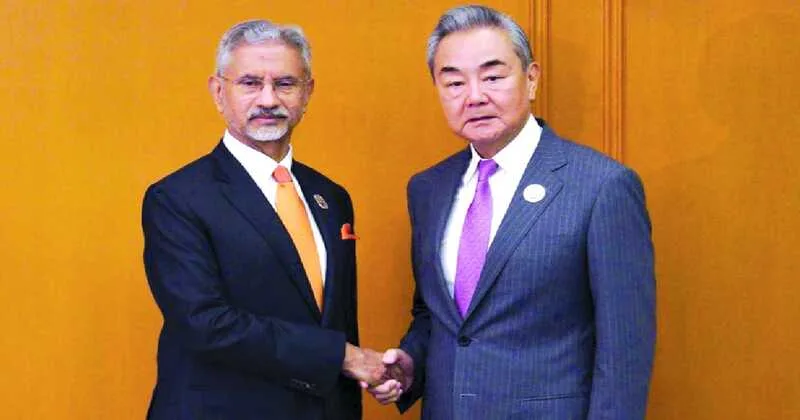
The latest friction emerged following the meeting between Jaishankar and Wang Yi held in Manila, the Philippines, on July 22, on the sidelines of the ASEAN and East Asia Foreign Ministers’ Meeting. Shortly after the talks, the Chinese Foreign Ministry, through the state-run news agency Xinhua, released a readout claiming that Jaishankar had conveyed that India’s positions on issues relating to Taiwan and Tibet remained unchanged and that India respected China’s sovereignty.
New Delhi has now publicly disputed that interpretation. During the weekly media briefing, MEA spokesperson Randhir Jaiswal clarified that Jaishankar’s remarks had been presented out of context. According to Jaiswal, the External Affairs Minister had instead emphasised that sovereignty concerns are matters that India itself must raise because it is India’s territorial integrity that continues to be violated.
#WATCH | Delhi | MEA Spokesperson Randhir Jaiswal says, "EAM said that when it comes to sovereignty issues, it is actually India that should be and is raising them. India does not violate China’s sovereignty in any manner and has been consistent. But China has been in illegal… pic.twitter.com/LN5FY1pUY5
— ANI (@ANI) July 24, 2026
Jaiswal stated that India has consistently respected China’s sovereignty and has never acted in a manner that infringes upon it. However, he stressed that the reverse cannot be said, pointing out that China has remained in illegal occupation of Indian territory in J&K and Ladakh since 1963. He further underlined that India’s legal rights over these territories have officially been acknowledged even by China, making Beijing’s claims on sovereignty contradictory. The MEA also reiterated its strong objection to Chinese infrastructure and connectivity projects in territories belonging to India in J&K, an apparent reference to projects passing through Pakistan-occupied Jammu & Kashmir.
Border peace remains India’s precondition for normal relations
The clarification has reinforced New Delhi’s consistent position that improvements in bilateral ties remain inseparable from stability along the disputed frontier. During his meeting with Wang Yi on July 22, Jaishankar reiterated that “peace and tranquility in the border areas is obviously the prerequisite for normal ties.” He noted that both countries had been engaging towards that objective since October 2024, adding that the process would continue to require sustained attention from both sides and that existing mechanisms dealing with border management must receive full support and encouragement.
The remarks referred directly to the India-China disengagement agreement reached in October 2024, which followed a prolonged four-year military standoff in eastern Ladakh. The disengagement process was completed in November 2024, marking a significant step in reducing tensions along the Line of Actual Control (LAC).
As part of that agreement, India and China finalised disengagement arrangements for Depsang and Demchok, the last two remaining friction points in eastern Ladakh. The understanding led to the withdrawal of troops from several contested locations along the LAC, ending one of the most prolonged phases of military confrontation between the two Asian neighbours.
Despite these developments, New Delhi has consistently maintained that the restoration of normal diplomatic, economic and broader bilateral engagement depends entirely on maintaining lasting peace and stability along the border. India’s position over the past six years has remained unchanged that bilateral relations cannot return to normal unless tranquillity is fully restored in the border regions.
Competing narratives reflect continuing strategic differences
Beyond the immediate disagreement over the diplomatic readout, the exchange has once again highlighted the wider strategic divergence between the two countries.
During the Manila meeting, Jaishankar acknowledged that India and China are two large, influential and neighbouring countries, making differences in national interests inevitable. Referring to the understanding reached by the leadership of both countries, he observed that differences should not become disputes, describing it as the responsibility of diplomacy to manage those differences constructively. His remarks reflected India’s long-standing approach first articulated after the 2017 BRICS Summit in Xiamen, where both sides agreed that disagreements should be managed without escalating into conflict.
EAM Jaishankar holds talks with Chinese FM Wang Yi in Manila, says ties gradually normalising
· External Affairs Minister S. Jaishankar held a wide-ranging discussion with Chinese Foreign Minister Wang Yi in Manila, Philippines, focusing on bilateral relations, border stability… pic.twitter.com/UO965Gq6Um
— IANS (@ians_india) July 22, 2026
China, however, projected a broader narrative centred on expanding cooperation. According to the Chinese Foreign Ministry’s readout carried by Xinhua, Wang Yi stated that Beijing was prepared to work with India to implement the important understandings reached by the leaders of the two countries. He called for maintaining close high-level exchanges and strengthening cooperation in sectors including economy and trade, media, people-to-people exchanges and cultural cooperation, while also advocating the proper handling of sensitive issues.
Wang, who is also a member of the Political Bureau of the Communist Party of China Central Committee, further stated that China and India should contribute positively to the advancement of multipolarity and greater democracy in international relations. According to the Chinese account, he also remarked that India had consistently pursued a positive and cooperative bilateral relationship with a forward-looking approach.
India’s subsequent clarification, however, underscored that New Delhi remains unwilling to allow broader narratives of cooperation to dilute its core concerns over territorial integrity. By publicly rejecting Beijing’s version of the July 22 discussions and reiterating China’s illegal occupation of Indian territory in J&K and Ladakh since 1963, along with objections to Chinese projects in Indian territory, the MEA has reaffirmed that sovereignty and border security remain the central benchmarks for the future direction of India-China relations.