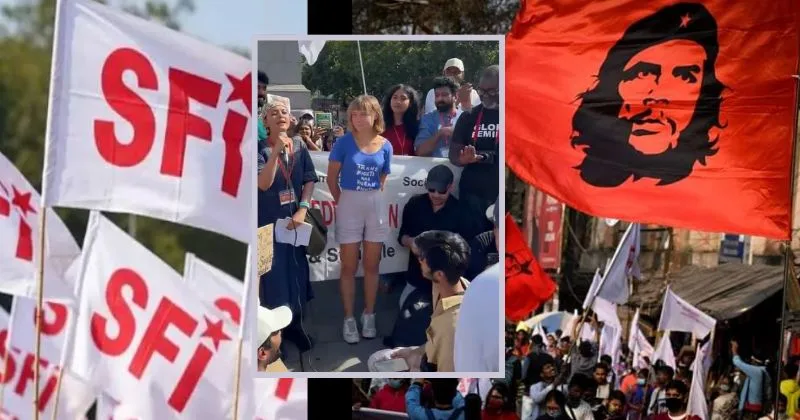
As the Cockroach Janta Party (CJP) called off its 36-day protest at Delhi’s Jantar Mantar following days of disruption and violence during the agitation, fresh questions are being raised over the movement’s international links and support network.
The spotlight has once again turned to Greta Thunberg—the so-called climate activist who came under scrutiny during the 2021 farmers’ protest over the controversial ‘toolkit. She publicly backed the CJP protest alongside the Students’ Federation of India (SFI) and is seen hurling allegations at Indian Government.
The victory celebration has however disclosed the complete tool kit of CJP and SFI against Indian government. On 26 July, Thunberg expressed solidarity with the CJP-led protest while speaking at an event organised by the UK chapter of the Students’ Federation of India (SFI) in London.
Addressing the gathering, Thunberg said the student protests in India had made people across the world “proud”. She said the agitation had shown what could be achieved when people united and resisted, describing the movement as an inspiration beyond India’s borders.
“They show the true meaning of people power. The Indian students’ struggle for justice and the broader struggle for democracy and liberation is also our struggle,” she said. Thunberg called upon supporters to “rise up in solidarity with India”.
SFI-UK’s victory gathering is in full swing at Trafalgar Square! We send our salutes to @GretaThunberg, who showed up in solidarity with the Indian student movement at the London protest today. The student movement has given global activists hope about the power of the people ✊ pic.twitter.com/nvtsYqEI2R
— Students' Federation of India – United Kingdom (@sfi_uk) July 26, 2026
The weekend event was presented by SFI UK as a celebration of the movement’s “victory”, with the organisation claiming that the protests had forced Union Education Minister Dharmendra Pradhan to resign. SFI UK also alleged that 21 students had lost their lives over the handling of the NEET issue and accused the police of using “brutal repression” against protesters.
However, the event made no mention of incidents of stone-pelting, heckling, or attacks on police and Railway Protection Force (RPF) personnel that were reported during the protests, allegedly carried out by individuals posing as student protesters.
The 2021 Toolkit Row: A Quick Recap
This wasn’t Thunberg’s first foray into Indian domestic protests. Back in 2021, during the massive farmers’ agitation against new agricultural laws, she amplified a “toolkit” document that outlined strategies for international coordination—hashtag campaigns, petitions, embassy protests, and digital strikes. The toolkit, shared widely after her tweet, sparked fierce controversy in India.
In February 2021, as tens of thousands of farmers camped on Delhi’s borders protesting new agricultural laws, Thunberg tweeted her solidarity with the movement and shared a “toolkit” — a document listing actions supporters abroad could take, from tagging international bodies like the UN and IMF to organising protests outside Indian missions and embassies.
Greta Thunberg’s controversial “toolkit” contained a detailed list of actions and social media strategies for supporting the farmers’ protest against the Narendra Modi government. The document drew widespread attention after it was made public, leading to scrutiny over its contents and the campaign surrounding the protests.
Critics argued that it revealed attempts to amplify unrest and influence events in India, prompting questions about the role of external actors in supporting and coordinating the agitation, including allegations of overseas backing and funding.
She deleted the tweet within hours, calling the document outdated, and posted a revised version.
The fallout was immediate and severe. The Indian government accused foreign celebrities, including Thunberg, Rihanna and Meena Harris, of running a coordinated campaign against the country’s interests. Delhi Police registered an FIR alleging the toolkit’s authors sought to spread “disaffection and ill-will” against the government, and investigators publicly linked the document to the pro-Khalistan Poetic Justice Foundation — though the FIR itself did not name Thunberg.
Days later, 22-year-old Bengaluru climate activist Disha Ravi was arrested in connection with the toolkit, triggering nationwide criticism of the crackdown. Thunberg did not back down, tweeting that she still stood with the farmers “no amount of hate, threats or violations of human rights” would change.
CJP, SFI – Same Playbook?
That CJP victory was celebrated an ocean away. On 26 July, SFI UK held a gathering at Trafalgar Square in London, describing it as a celebration of the movement’s win and reiterating claims — including the death toll of 21 students and allegations of “brutal repression” by police — without reference to the stone-pelting and attacks on police that preceded the crackdown.
Thunberg addressed the crowd, telling attendees the Indian students had made people across the world “proud” and calling the protests proof of the power of people coming together. She urged supporters to “rise up in solidarity with India.”
The London event was not a one-off. There were reports that SFI UK had been mobilising supporters across Britain since early June — running pre-announced, committee-led demonstrations in Leeds, Edinburgh and Manchester with fixed venues, posters and named speakers — well before the confrontation at Jantar Mantar on 20 July. SFI UK is the overseas wing of the Students’ Federation of India, the student arm of the CPI(M), and describes itself as having over 600 members and ten sub-committees in Britain.
Structural Resemblance between 2021 and 2026
An Indian domestic protest movement, an organised international solidarity campaign amplified through social media and diaspora networks, and Thunberg’s own voice lending global visibility to the cause — this time via a public appearance rather than a shared document.
Thunberg has now, for the second time in five years, placed herself at the centre of a protest narrative involving India — first through a hastily deleted tweet and toolkit, and now through a stage appearance in London celebrating a domestic Indian political outcome. It is a pattern — her involvement in campaigns linked to Indian political issues, even as India continues to project itself as a rising global power with growing economic and geopolitical influence.
A high-profile Western activist with a platform lends visibility to movements that align with certain ideological lines—anti-government reform in agriculture, then in education—while domestic political actors on the left coordinate the ground game.
The 2021 toolkit controversy turned the term “toolkit” into shorthand in Indian public discourse for alleged astroturfing and coordinated narrative-building. The episode exposed what they described as the “real face” of networked activism—campaigns that amplify India’s domestic challenges before international audiences even as efforts to address those issues continue within the country.