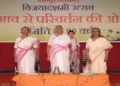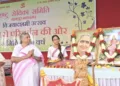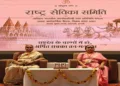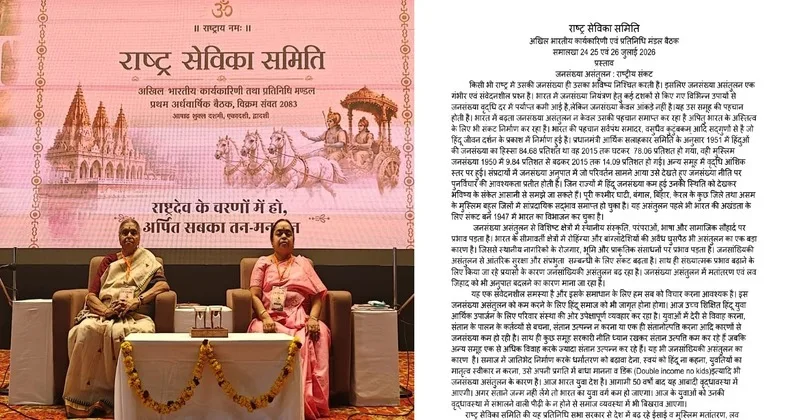
Samalkha (Haryana): The first half-yearly meeting of the Akhil Bharatiya Karyakarini and Pratinidhi Mandal of the Rashtra Sevika Samiti concluded today at Samalkha, Haryana. The meeting was attended by Vandaniya Pramukh Sanchalika Ma. Shanta Kumari Ji, Pramukh Karyavahika Sita Gayatri Ji, and 488 representatives from 40 Prants.
During the meeting, a resolution was passed on ‘Population Imbalance: A National Crisis’.
“The future of any nation is determined by its population. Therefore, demographic imbalance is a serious and sensitive issue. Although various measures undertaken over the past several decades for population control in Bharat have significantly reduced the population growth rate, population is not merely a matter of statistics; it is the identity of a society. The growing demographic imbalance in Bharat is not only eroding this identity but is also creating a threat to the very existence of the nation. Bharat’s identity is rooted in the noble ideals of Sarva Panth Samadar (equal respect for all faiths), Vasudhaiva Kutumbakam and other civilisational values that have evolved in the light of the Hindu worldview”, the resolution reads.
According to the Economic Advisory Council to the Prime Minister, the share of the Hindu population declined from 84.68 per cent in 1951 to 78.06 per cent in 2015, while the Muslim population increased from 9.84 per cent in 1951 to 14.09 per cent in 2015. The increase in other communities has been comparatively marginal. In view of the changing demographic proportions among different communities, there appears to be a need to revisit the country’s population policy. The condition of those States where the Hindu population has declined provides clear indications of future challenges. Communal harmony has already been disturbed in the entire Kashmir Valley, parts of West Bengal, Bihar, certain districts of Kerala and Muslim-majority districts of Assam. Such demographic imbalance had earlier endangered the unity and integrity of Bharat and culminated in the Partition of the country in 1947, it reads.
It further reads, “Demographic imbalance adversely affects the local culture, traditions, language and social harmony of specific regions. Illegal infiltration by Rohingyas and Bangladeshi nationals into the border areas of Bharat is also a major contributing factor. This has affected the employment opportunities, land and natural resources available to local citizens. Demographic imbalance also poses a serious challenge to internal security and national sovereignty. At the same time, organised efforts aimed at increasing numerical strength have further aggravated this imbalance. Religious conversions and Love Jihad are also being regarded as factors contributing to the change in demographic proportions”.
“This is a sensitive issue and demands serious reflection by society as a whole. To reduce demographic imbalance, the Hindu society must also awaken to its responsibilities. Today, many highly educated Hindu youth, in pursuit of economic advancement, are displaying an indifferent attitude towards the institution of the family. Delayed marriages, avoidance of responsibilities related to raising children, choosing not to have children or limiting themselves to only one child have all contributed to declining population growth”, it reads.
The resolution further reads that, “While some sections of society are consciously limiting childbirth in accordance with government policies, other sections are increasing their numbers through practices such as multiple marriages and larger families. This too is contributing to demographic imbalance. Creating caste divisions to encourage religious conversion, refusing to identify oneself as Hindu, young women declining to accept motherhood by considering it an obstacle to personal progress, and the growing trend of DINK (Double Income, No Kids) are also among the causes of demographic imbalance. Today, Bharat is a young nation. However, over the next fifty years, its population will gradually age. If fewer children are born, the country’s youthful population will decline significantly. The absence of a younger generation to support the present generation in its old age will also weaken the social order”.
Rashtra Sevika Samiti urges the Government to immediately enact and strictly enforce laws to curb the increasing incidents of Christian and Muslim religious conversions, Love Jihad and illegal infiltration in the country. It further calls for effective measures to secure the nation’s borders and prevent infiltration. Illegal entry of foreign nationals must be completely prohibited. Preventing such infiltration, identifying illegal entrants and deporting them are both the constitutional and moral responsibilities of every government.
The Hazarika Commission, appointed by the Hon’ble Supreme Court, has clearly observed that owing to illegal Bangladeshi infiltration into the North-Eastern region, the indigenous population may become a minority by 2047. The aggressive policies of jihadi elements against Hindus are rapidly aggravating demographic imbalance in these regions.
The Rashtra Sevika Samiti appeals to society to awaken to this challenge and make future generations aware of the impending demographic crisis. Society must encourage timely marriages, responsible parenthood and the fulfilment of social duties. Instead of caste- or community-based politics, efforts should be directed towards strengthening society through education, women’s empowerment and economic development across all communities. Recognising all the factors contributing to demographic imbalance, society must undertake lawful and constructive efforts to protect the nation from this grave crisis while fulfilling its social responsibilities.
Rashtra Sevika Samiti also expressed its deep concern over the causes and consequences of demographic imbalance in Bharat. It appeals to the Union Government and all State Governments to implement a Uniform National Population Policy applicable to all sections of society across the country.
The Akhil Bharatiya Karyakarini and Pratinidhi Mandal further urges the Government to implement the Uniform Civil Code throughout the country. It believes that such measures will help address the problems arising out of demographic imbalance and lead Bharat towards a brighter future.
Guiding the concluding session of the three-day meeting, Vandaniya Pramukh Sanchalika Ma. Shanta Kumari Ji said that the sacred land of Kurukshetra conveys the message of overcoming one’s inner conflicts and taking a firm resolve for the welfare of society with a steady mind. Drawing inspiration from this land, which signifies complete dedication for the establishment of Dharma, she said that all must take a firm resolve for the qualitative expansion of organisational work. At the same time, every Karyakarta must shape her personality and make herself worthy of the work entrusted to her. Having completed 90 years of its journey and moving towards its centenary, the Rashtra Sevika Samiti must continue to advance steadily and resolutely towards its cherished goal.