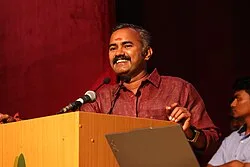
In a significant intervention at the United Nations Human Rights Council (UNHRC) in Geneva, BJP Tamil Nadu State Secretary Ashvathaman Allimuthu addressed issues relating to religious conversions, the preservation of ancient civilisations, and their connection to environmental sustainability.
According to those present, Allimuthu called for greater international attention to forced religious conversions, arguing that the disappearance of ancient civilisations has consequences that extend beyond culture and heritage. He maintained that preserving long-standing civilisations also contributes to ecological diversity and sustainable lifestyles.
Many described the address as one of the first instances in which the issue of religious conversions affecting ancient civilisations was presented before the UNHRC from this perspective.
Ashvathaman Allimuthu serves as the BJP Tamil Nadu State Secretary and is also associated with Project TamilAI, the Integral Humanism Foundation, Ashvathaman Associates, Ledge & Law, and DEFFO Tech.
Three Key Issues Raised
During his intervention, Allimuthu highlighted three major issues before the international forum.
First, he called for steps to curb what he described as forced religious conversions in regions that are home to some of the world’s oldest surviving civilisations.
Second, he argued that Hindu dharma should be understood not merely as a religion but as a living civilisation with an ancient cultural, philosophical and civilisational heritage.
Third, he linked the preservation of civilisational diversity with efforts to address global warming, saying environmental discussions should also consider cultural dimensions alongside scientific and policy approaches.
According to him, India’s civilizational traditions offer perspectives that deserve greater attention in global discussions on sustainability and environmental conservation.
Historic moment at the UNHRC in Geneva.
BJP State Secretary @asuvathaman raised three significant issues on the global stage:
1) Calling for an end to forced religious conversions to protect ancient civilizations.
2) Emphasizing that Hinduism is not merely a religion but a… pic.twitter.com/upZCFKA356
— Anshul Saxena (@AskAnshul) July 26, 2026
Linking Culture and Environment
Speaking at the forum, Allimuthu said that discussions on global warming are generally conducted from industrial and technological perspectives, while the cultural dimension often receives limited attention.
He argued that cultural diversity contributes to ecological balance because different civilisations encourage different lifestyles, traditions and patterns of consumption.
According to him, when multiple cultures continue to exist, they also preserve diverse ways of living, which can reduce pressure on natural resources and the environment.
He further said that ancient civilisations, particularly those that incorporate nature worship into their traditions, have historically contributed to environmental conservation.
Example from Tamil Nadu
To illustrate his argument, Allimuthu cited the Gedilam River in his native town of Panruti in Tamil Nadu.
He said local tradition holds that the river was created for the abhisheka (ritual bathing) of Lord Vishnu. Such beliefs, he argued, encourage communities to respect and preserve natural resources by associating them with sacred traditions.
According to him, these examples demonstrate how cultural practices can complement environmental protection.
Difference Between Civilisations and Religions
During his address, Allimuthu also argued that there is a distinction between civilisations and religions.
He said civilisations encompass a broader cultural framework, including traditions, philosophies, social practices and relationships with nature, whereas religions are centred primarily on systems of belief.
He further contended that civilisations with multiple traditions and forms of worship encourage diverse lifestyles and consumption patterns, which he believes can have positive environmental implications.
Call to Protect Ancient Civilisations
Referring to historical civilisations such as those of Egypt and Rome, Allimuthu said the world has witnessed the disappearance of several ancient civilisations over time.
He argued that protecting surviving civilisations, including India’s, should become a global priority.
Calling India one of the world’s oldest living civilisations, he urged the international community to consider measures to curb rapid religious conversions in regions where ancient civilisations continue to exist.
According to Allimuthu, preserving such civilisations is not solely a matter of cultural protection but also forms part of a broader effort towards environmental sustainability and addressing global warming.
His remarks sought to introduce a civilisational perspective into international discussions on human rights, cultural preservation and climate change at the UNHRC forum in Geneva.