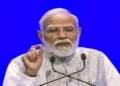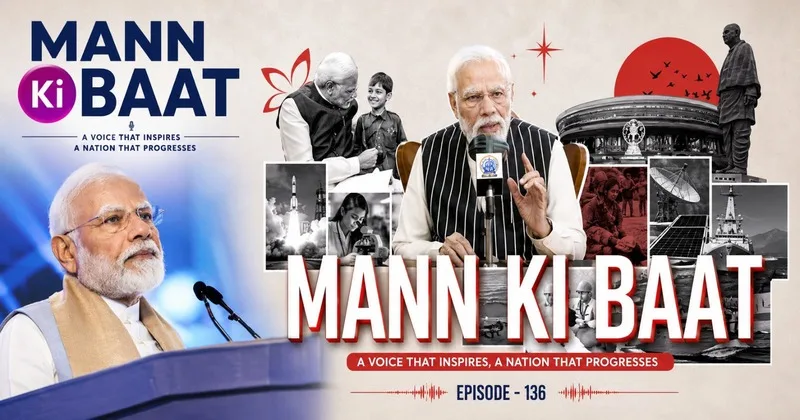
In the 136th edition of ‘Mann Ki Baat’ on July 26, Sunday, Prime Minister Narendra Modi began by commemorating Kargil Vijay Diwas. He stated, “Kargil Vijay Diwas is not merely a date; it is an immortal symbol of the indomitable courage and patriotism of India’s brave soldiers.” He noted that amidst the towering, snow-capped peaks of Kargil, Indian soldiers refused to accept defeat even in seemingly impossible circumstances. Despite harsh weather, treacherous terrain, and enemy strategies, the Indian Army scripted a history of victory. This triumph was a testament to the conviction that India can confront any challenge to safeguard its sovereignty and integrity.
Discussing various topics during this month’s #MannKiBaat… https://t.co/3JQbPB3eYb
— Narendra Modi (@narendramodi) July 26, 2026
The Prime Minister remarked that the courage witnessed on the Kargil battlefield is mirrored today in India’s scientific laboratories and defense establishments. While soldiers guard the nation at the borders, scientists and engineers are developing technologies that ensure future security. This is why India is advancing at an unprecedented pace towards self-reliance in the defense sector. Once dependent on foreign nations for defense equipment, India now independently develops modern warships, missiles, rockets and state-of-the-art defense systems. The Prime Minister also mentioned the ‘Shaurya Vijay Yatra’ organized for the occasion, which is being undertaken from the National War Memorial in New Delhi to the Kargil War Memorial in Dras.
Indigenous defense production becomes the hallmark of ‘New India’
Prime Minister Modi stated that India is consistently achieving new milestones in the field of defense technology. The induction of INS Mahendragiri into the Indian Navy stands as a powerful example of this. Designed and built entirely in India, this state-of-the-art warship incorporates over 75 percent indigenous content. It is not merely a vessel that boosts the Navy’s strength but also a living symbol of the ‘Atmanirbhar Bharat’ initiative.
India’s decisive leap in missile technology
In his address, the Prime Minister made special mention of the achievements in missile technology over recent months. He stated that the successful test of the Pinaka Long-Range Guided Rocket has elevated the Indian Army’s strike capability to new heights. Furthermore, the successful trial of the indigenous ‘Kusha’ air defense system signals that India is rapidly advancing into the league of select nations capable of developing modern air defense systems.
आज बांकीपुर विधानसभा के कदमकुआं मंडल स्थित बरनवाल भवन में कार्यकर्ताओं एवं आमजनों के साथ आदरणीय प्रधानमंत्री श्री @narendramodi जी के लोकप्रिय कार्यक्रम ‘मन की बात’ के 136वें संस्करण को सामूहिक रूप से सुना।
प्रधानमंत्री जी ने अपने प्रेरक विचारों के माध्यम से कारगिल विजय दिवस पर… pic.twitter.com/dIjOandIzT
— Nitin Nabin (@NitinNabin) July 26, 2026
India’s growing global influence in defense exports
Prime Minister Modi also highlighted the steadily increasing global confidence in Indian defense technology. Citing his recent foreign visits, he noted that significant international agreements have been reached regarding Indian systems such as the BrahMos and Astra missiles. This serves as proof that the Indian defense industry is establishing a strong presence in the global market. This is also garnering global recognition for the “Make in India” and “Atmanirbhar Bharat” initiatives.
A new model of self-reliance: Partnership between government, scientists and the private sector
The vision of India presented by the Prime Minister in his address is one where the government is not the sole driver of development. Scientific institutions, defense research organizations, private industries, startups and young innovators are all partners in this transformation. This is why India is making rapid strides not only in defense production but also in sectors such as space, artificial intelligence, cybersecurity, and high-tech manufacturing. Today, the country is confidently moving towards becoming a creator and exporter of cutting-edge technology, rather than merely an importer.
आदरणीय प्रधानमंत्री श्री @narendramodi जी के प्रेरणादायी 'मन की बात' कार्यक्रम के 136वें संस्करण का आज निवाड़ी जिले की पर्यटन एवं धार्मिक नगरी ओरछा में कंचना घाट पर स्थानीयजनों एवं जनप्रतिनिधियों के साथ श्रवण किया।
अपने उद्बोधन में प्रधानमंत्री जी ने 'कैच द रेन' अभियान को जन-जन… pic.twitter.com/kLdqw5kg8E
— Dr Mohan Yadav (@DrMohanYadav51) July 26, 2026
From Vikram-1 to science olympiads: India’s youth potential soars to new heights
In his ‘Mann Ki Baat’ address, Prime Minister Narendra Modi highlighted that the greatest strength of a developed India lies in its youth. The successful launch of ‘Vikram-1’ last week marked a new chapter in India’s space history. As the first rocket developed by India’s private sector, it demonstrated that the country’s young innovators are now achieving success in domains once considered the exclusive preserve of government institutions.
The Prime Minister remarked that these young scientists and engineers, through their skills, perseverance and innovation, have accomplished feats that seemed impossible just a few years ago. This expansion of private participation in the space sector signifies India’s growing innovation prowess and its self-reliant economy. The success also indicates that India is rapidly advancing towards playing a pivotal role in the future global space economy.
Indian students shine on the global stage
Highlighting the outstanding performance of Indian students in Science Olympiads, the Prime Minister described it as a source of pride for the entire nation. Indian students have showcased their talent to the world by achieving remarkable success in prestigious international competitions across subjects such as Physics, Chemistry, Biology and Mathematics. He noted that these achievements demonstrate India’s progress towards becoming a global hub for knowledge and research. The growing culture of Olympiads and hackathons in the country bears witness to this transformation. This new generation is poised to propel India to new heights in fields like science, defense, medicine, artificial intelligence and space research.
#Live :- ‘मन की बात' कार्यक्रम के 136वें संस्करण का सीधा प्रसारण…#MannKiBaathttps://t.co/EC4TBBkm0z
— Bhajanlal Sharma (@BhajanlalBjp) July 26, 2026
Water Conservation: The greatest national asset for the future
Referring to the ‘Catch the Rain’ campaign, the Prime Minister characterized water conservation as a movement driven by public participation. He articulated a simple principle: “Capture the rain where it falls.” He commended the construction of over four thousand ponds in Madhya Pradesh and lauded the ongoing water conservation drives in several states, including Andhra Pradesh and Chhattisgarh. His message was clear: every drop of water saved today constitutes a vital asset for the future. Amidst climate change and the escalating water crisis, the Prime Minister emphasized the need to strike a balance between development and the environment. His message was not limited to government schemes alone; it was also a call for every citizen to become a partner in water conservation.
Efforts to transform environmental conservation into a people’s movement
Highlighting the ‘Ek Ped Maa Ke Naam’ campaign, Prime Minister Modi stated that environmental conservation is not merely a government program but a social responsibility. He cited the planting of 3.5 lakh saplings within an hour in Ahmedabad and the planting of over 35 crore saplings in a single day in Uttar Pradesh as inspiring examples of public participation.
He also pointed to the return of the hornbill bird to the Gir region of Gujarat as a success story of conservation efforts. Furthermore, mentioning the innovative initiative in Sitamarhi, Bihar, to create benches from plastic waste, he noted that ‘Reduce, Reuse and Recycle’ is becoming a practical mantra for the nation. With the upcoming Ganeshotsav festival in mind, he once again urged people to install clay idols of Lord Ganesha instead of those made from Plaster of Paris or plastic. According to him, faith that aligns with nature is the true path to environmental conservation.
'Mann Ki Baat' with SHG members
Today, I listened to the 136th episode of 'Mann Ki Baat'
featuring Hon'ble Prime Minister Shri Narendra Modi ji,
alongside members of Self-Help Groups.
The message regarding the development of the nation
and society, as well as public welfare,… pic.twitter.com/LjujGMkj7a— Sumana Sarkar (@me_sumana4489) July 26, 2026
Local products, khadi and handicrafts gaining new recognition
The Prime Minister also accorded equal importance to the economic dimension of ‘Atmanirbhar Bharat’. He remarked that India’s local products and traditional handicrafts are now establishing an identity not just nationally, but globally. Citing efforts to revive Kashmir’s traditional ‘Wagu’ mats, herbal tea produced by women in Bijnor (Uttar Pradesh) and traditional musical instruments from Tripura, he noted that local innovation and traditional skills are infusing new energy into the rural economy.
In the context of National Handloom Day, the Prime Minister highlighted that Khadi sales have increased nearly six-fold over the past twelve years, reaching ₹8,000 crore. This transformation represents not only commercial success but also serves as a testament to the widespread social impact of the “Vocal for Local” campaign. Sports, Culture and Education: Parallel Forces in Nation-Building
While extending his best wishes to the Indian athletes participating in the Glasgow Commonwealth Games, the Prime Minister appealed to the nation to cheer them on. He made special mention of P.V. Sindhu’s victory at the Japan Open and the Indian women’s cricket team’s historic Test win. He also commended an innovative method used by a teacher from Kerala to teach Sanskrit to children through football. The Prime Minister’s message was clear: education becomes more effective when it incorporates innovation, culture and practicality.
Mann Ki Baat 136th Episode Live Broadcast https://t.co/gA06QZNtMm
— Manjinder Singh Sirsa (@mssirsa) July 26, 2026
From Dr. Kalam to ‘Har Ghar Tiranga’: The message of ‘nation first’
In the concluding part of his address, Prime Minister Modi called upon the nation to strengthen its resolve for nation-building, referencing the death anniversary of Bharat Ratna Dr. A.P.J. Abdul Kalam, Guru Purnima and the approaching Independence Day. He urged every citizen to participate enthusiastically in the ‘Har Ghar Tiranga’ campaign while honoring the sacrifices and dedication of freedom fighters. According to him, the national flag is not merely a symbol but represents the aspirations, struggles and achievements of millions of Indians.
From the valour of Kargil to the resolve for a developed India
The most significant message of Prime Minister Modi’s 136th ‘Mann Ki Baat’ was that the India of today is moving forward by embracing both its heritage and its future. The indomitable courage displayed by soldiers on the Kargil battlefield is now visible across defense research institutes, scientific laboratories, startups, space centers and innovation platforms.
आज नई दिल्ली में आदरणीय प्रधानमंत्री श्री @narendramodi जी के लोकप्रिय कार्यक्रम 'मन की बात' के 136वें संस्करण को सुना।
प्रधानमंत्री जी ने 'वोकल फॉर लोकल' को जनआंदोलन बनाने, भारतीय खिलौनों को अपनाने, युवाओं के नवाचार को नई पहचान देने तथा हमारी सांस्कृतिक धरोहर के संरक्षण के… pic.twitter.com/5xMEMYg9g4
— Nimuben Bambhaniya (@Nimu_Bambhaniya) July 26, 2026
From indigenous warships and modern missile systems to private-sector rockets, world-class achievements in Science Olympiads, water and environmental conservation, the revival of local products, and public-participation-driven campaigns, the Prime Minister presented a vision of an India that is not only striving for self-reliance but is also establishing itself globally as a trusted, capable, innovative and leading nation.