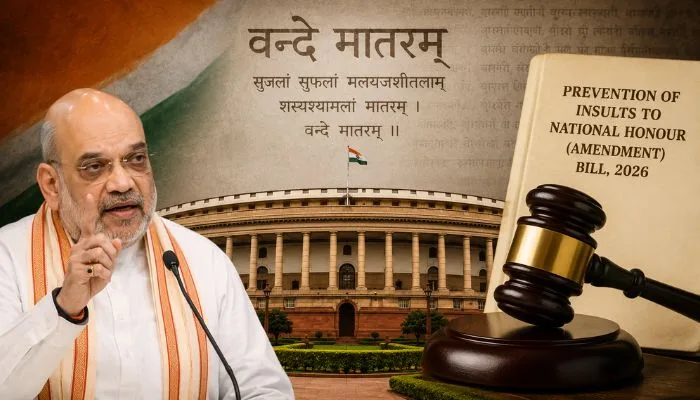
The Central Government is preparing to introduce the Prevention of Insults to National Honour (Amendment) Bill, 2026, a legislation that seeks to provide statutory protection to India’s National Song, Vande Mataram. The proposed amendment would place the National Song under the same legal protection currently enjoyed by the National Anthem under the Prevention of Insults to National Honour Act, 1971.
The Bill, listed for introduction in the Rajya Sabha during the Monsoon Session beginning July 20, has triggered sharp political reactions. While the government maintains that the amendment only seeks to prevent the deliberate obstruction or disruption of people singing the National Song at official public functions, several Muslim organisations, Left parties and opposition leaders have objected to the move, citing concerns over religious freedom and constitutional rights.
The debate has also revived memories of the 2018 Kasganj violence, in which 22-year-old Chandan Gupta was killed during a Republic Day Tiranga Yatra.
Supporters of the proposed legislation argue that the incident demonstrated how hostility towards national symbols can sometimes escalate beyond ideological disagreement into violence.
What proposed amendment seeks to change
At present, Section 3 of the Prevention of Insults to National Honour Act, 1971 penalises any person who intentionally prevents the singing of the National Anthem or causes disturbance to an assembly engaged in singing it.
The proposed amendment would simply insert the words “national song” alongside “national anthem”, thereby extending identical legal protection to Vande Mataram.
Once enacted, any individual found intentionally preventing the singing of Vande Mataram or disrupting an assembly singing the National Song could face: Imprisonment of up to three years; A fine; Or both.
The Bill also proposes stricter punishment for repeat offenders, prescribing a minimum imprisonment of one year upon a second conviction.
Importantly, the proposed amendment does not criminalise a person’s decision not to sing Vande Mataram. Instead, it targets only the deliberate obstruction, intimidation or disruption of others participating in its rendition.
Background to the amendment
The proposed legislation follows recent guidelines issued by the Union Home Ministry directing that the complete version of Vande Mataram be sung during official state functions and civil investiture ceremonies.
According to the Statement of Objects and Reasons accompanying the Bill, the amendment seeks to address a long-standing legal anomaly.
On January 24, 1950, a day before the Constitution came into force, Constituent Assembly President Dr Rajendra Prasad declared that while Jana Gana Mana would be India’s National Anthem, Vande Mataram, because of its historic contribution to the freedom movement, would enjoy equal honour and respect.
Despite that declaration, only the National Anthem received explicit statutory protection under the 1971 Act. The National Song remained outside the ambit of penal protection for over five decades.
The government argues that the amendment merely seeks to extend the same legal safeguards already available to the National Anthem, National Flag and Constitution.
Opposition to the Bill
The proposal has drawn criticism from several Muslim organisations and opposition parties.
The All India Muslim Personal Law Board (AIMPLB) described the government’s decision as unconstitutional and argued that compelling Muslims to sing all six stanzas of Vande Mataram violates religious freedom.
AIMPLB General Secretary Maulana Mohammed Fazlur Rahim Mujaddidi stated that certain later stanzas contain references to Hindu deities which, according to Islamic monotheistic beliefs, Muslims cannot recite.
Both factions of the Jamiat Ulama-i-Hind also opposed the decision.
Maulana Arshad Madani alleged that the move infringed upon minority rights and religious freedom.
Left parties similarly criticised the proposal.
The CPI(M) demanded withdrawal of the government’s directive, accusing it of manufacturing unnecessary controversy over national symbols.
CPI Rajya Sabha MP Sandosh Kumar P alleged that the government was “weaponising culture”, while the Trinamool Congress accused the Centre of distorting the historical understanding of Vande Mataram.
Congress MLA Arif Masood also opposed mandatory rendition of the complete song in Madhya Pradesh, arguing that it interfered with religious freedom.
The amendment does not prescribe punishment for refusing to sing the National Song or for expressing theological objections through lawful means.
Instead, it criminalises acts such as:
intentionally stopping people from singing Vande Mataram;
disrupting official ceremonies where it is being sung;
intimidating participants;
preventing assemblies from peacefully rendering the National Song.
The Chandan Gupta case returns to the spotlight
The debate surrounding the amendment has once again brought attention to the murder of 22-year-old Chandan Gupta during the Republic Day celebrations in Kasganj, Uttar Pradesh.
On January 26, 2018, Chandan Gupta joined a Tiranga Yatra along with his brother Vivek and several other participants.
The procession carried the Indian Tricolour while participants raised slogans including “Bharat Mata Ki Jai” and “Vande Mataram.”
According to the FIR, witness statements and findings presented before the court, the procession was stopped near the Government Girls’ Inter College by an armed mob.
Court records stated that members of the mob allegedly snatched the National Flag from participants, threw it to the ground, raised pro-Pakistan slogans and demanded that the procession participants chant “Pakistan Zindabad” before being allowed to proceed.
When Chandan Gupta allegedly refused, violence erupted.
Stone pelting followed, after which firearms were used.
Saleem, identified by investigators as one of the accused, allegedly fired the fatal shot that struck Chandan Gupta in the chest, causing injuries to his lungs and heart.
He later succumbed to his injuries.
Conviction in the case
Nearly seven years later, on January 2, 2025, a Special NIA Court convicted 28 accused in connection with the murder.
The following day, the court sentenced all 28 convicts to life imprisonment.
The court observed that the accused were armed with firearms, sticks and iron rods and had engaged in organised communal violence against participants of the Tiranga Yatra.
The judgment also remarked that communalism places religious interests above those of society and the nation.
During the trial, Chandan Gupta’s father, Sushil Gupta, informed the court that the family faced intimidation and difficulty securing legal representation due to the alleged influence of some of the accused in Kasganj.
Accepting concerns over a fair trial, the Allahabad High Court transferred the proceedings outside Kasganj.
Debate over religious freedom and public order
The proposed amendment has also revived broader questions regarding the relationship between constitutional freedoms and national symbols.
Reports point out that the Constitution protects freedom of conscience and religion while also permitting reasonable restrictions in matters concerning public order.
Citizens remain free to challenge government policies before courts, abstain from participation or express disagreement through peaceful and lawful means.
Many contend that deliberate disruption of official ceremonies involving national symbols cannot be justified merely by invoking religious objections.
The larger ideological debate
Beyond the immediate legal questions, the controversy has evolved into a wider ideological discussion.
Some argue that opposition to Vande Mataram extends beyond specific references contained in later stanzas and reflects differing conceptions of nationalism and identity.
They contend that certain Islamist organisations prioritise the idea of the global Muslim community, or Ummah, over territorial nationalism, leading to repeated objections to symbols associated with the Indian nation-state.
The competing interpretations continue to shape the political discourse surrounding Vande Mataram.
Equal legal status for the National Song?
One of the central questions raised by the proposed legislation is whether a national symbol recognised by the Constituent Assembly as deserving equal honour should also receive equal statutory protection.
The National Anthem has enjoyed legal protection against deliberate disruption for more than five decades.
The government argues that extending the same protection to the National Song represents legal parity rather than the creation of a new offence.
Opposition parties, however, continue to argue that any official directive concerning Vande Mataram must remain consistent with constitutional guarantees relating to freedom of religion and individual conscience.
What happens next
The Prevention of Insults to National Honour (Amendment) Bill, 2026, is expected to be introduced during the ongoing Monsoon Session of Parliament.
If passed by both Houses and receiving Presidential assent, Vande Mataram would, for the first time, receive explicit statutory protection under the Prevention of Insults to National Honour Act.
The debate surrounding the Bill has moved beyond questions of legislative drafting. It now encompasses constitutional interpretation, the balance between individual liberty and public order, the legal status of national symbols, and differing understandings of patriotism and national identity.
With Parliament set to debate the proposal, the legislation is likely to remain at the centre of political and public discourse in the coming weeks.