
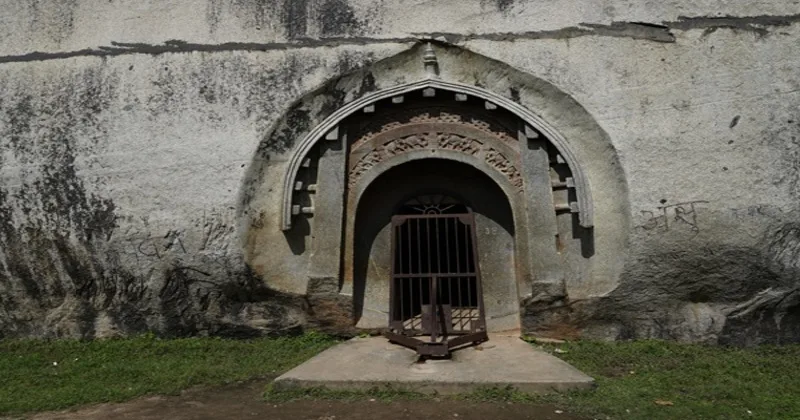
Jehanabad: Hidden amid the granite hills of Bihar, the Barabar Caves stand as India’s oldest surviving rock-cut caves and one of the greatest engineering achievements of the ancient world. Built over 2,300 years ago during the Mauryan Empire, their mirror-like polish, remarkable acoustics, and astonishing precision continue to intrigue historians, archaeologists, and engineers alike.
The BARABAR CAVES in Bihar are among India's greatest archaeological enigmas…🚩
💠 Carved over 2,300 years ago during the Mauryan Empire (3rd century BCE) under Emperor Ashoka and his grandson Dasharatha, they are the oldest surviving rock-cut caves in India.
🎯 WHY ARE THEY… pic.twitter.com/M2IcNR5oPg
— Vibhu Vashisth 🇮🇳 (@Indic_Vibhu) July 19, 2026
The Oldest Rock-Cut Caves in India
Nestled in Bihar’s Jehanabad district, around 40 kilometres from Gaya, the Barabar Caves are among the most extraordinary monuments of ancient India. Dating back to the 3rd century BCE, these caves were excavated during the reign of Emperor Ashoka and later expanded under his grandson Dasharatha Maurya.
Unlike natural caves, the Barabar complex was painstakingly carved out of massive granite hills, making it the oldest known surviving example of rock-cut architecture in India. The caves were primarily dedicated to the Ajivikas, an ascetic religious sect that flourished alongside Buddhism and Jainism during the Mauryan era. Ashokan inscriptions engraved at the entrances leave little doubt about their origin, confirming that these caves were royal donations to the Ajivika monks.
The Mirror-Like Polish That Defies Time
The most striking feature of the Barabar Caves is the extraordinary Mauryan polish. The interior walls and ceilings possess an almost glass-like sheen, reflecting light with remarkable clarity. Since the caves were carved from extremely hard granite, achieving such a flawless finish more than two millennia ago remains one of archaeology’s most fascinating questions.
Modern experts generally agree that the finish was likely produced through an intensive process involving repeated grinding, abrasion, and polishing using natural materials over long periods. However, no definitive historical record explains the exact technique or tools employed.
What makes the mystery even more compelling is that this level of polish is rarely seen after the Mauryan period, suggesting either that the technique gradually disappeared or that it was no longer considered practical for later rock-cut monuments.
Engineering Precision Ahead of Its Time
The Barabar Caves showcase remarkable architectural accuracy.
The interiors display:
-Perfectly straight walls
-Smooth barrel-vaulted ceilings
-Symmetrical layouts
-Precisely carved entrances
-Uniform geometric proportions
Considering that the caves were excavated entirely from solid granite using ancient iron tools, their precision continues to impress engineers today. Each chamber appears carefully planned before excavation began, indicating sophisticated surveying methods and exceptional craftsmanship.
One of the most fascinating characteristics of the Barabar Caves is their unusual acoustics. The highly polished surfaces and curved interiors create powerful echoes that can reverberate for several seconds. Even a soft chant or spoken word resonates throughout the chamber. Researchers believe these acoustics were not accidental. Since the caves served as meditation retreats for Ajivika monks, the echoing environment may have enhanced spiritual practices, chants, and rituals, creating an immersive meditative atmosphere.
Who Were the Ajivikas?
The Barabar Caves were dedicated to the Ajivikas, one of ancient India’s major philosophical traditions. Founded by Makkhali Gosala, the Ajivikas believed that every event in life was predetermined by fate rather than human effort. They lived austere lives devoted to meditation, simplicity, and renunciation. Although the sect gradually disappeared over the centuries, Ashoka’s inscriptions provide valuable historical evidence of its once-prominent status during the Mauryan Empire.
The caves represent one of the finest achievements of the Mauryan dynasty, which transformed the Indian subcontinent through administrative reforms, monumental architecture, and artistic innovation. While Emperor Ashoka is best remembered for spreading Buddhism after the Kalinga War, his inscriptions show that he also patronised other religious communities, including the Ajivikas. His grandson Dasharatha continued this tradition by dedicating additional caves to the sect. Perhaps the greatest historical puzzle is not how the caves were built, but why their extraordinary finish largely vanished afterwards.
Later masterpieces such as Ajanta, Ellora, Karla, and Kanheri display magnificent sculptures and paintings, yet none replicate the distinctive mirror-like granite polish seen at Barabar.
Several theories have been proposed:
-The polishing process may have been extremely labour-intensive and expensive.
-The technique may have depended on specialised artisans whose knowledge gradually disappeared.
-Later builders may have prioritised sculpture and ornamentation over polished interiors.
-Changing religious and architectural preferences could have made the technique unnecessary.
No single explanation has yet been universally accepted. The Barabar Caves have often inspired sensational claims about “lost technology” or unknown civilisations. However, archaeological evidence tells a clearer story.
Established Facts
-The caves date to the 3rd century BCE.
-They were excavated during the Mauryan Empire.
-Ashokan inscriptions authenticate their construction and dedication.
-They were intended for the Ajivika sect.
-The polish and engineering are genuine achievements of ancient Indian craftsmanship.
The mystery is not whether humans built the caves, they unquestionably did. The enduring question is how Mauryan craftsmen achieved such exceptional smoothness, symmetry, and polish on solid granite using the tools and techniques available more than 2,300 years ago. Until new archaeological evidence emerges, the precise methods remain uncertain.
A Testament to Ancient Indian Engineering
Far from being an unsolved supernatural puzzle, the Barabar Caves are a testament to the extraordinary skill, planning, and craftsmanship of ancient Indian engineers and artisans. Their flawless interiors, remarkable acoustics, and enduring inscriptions continue to attract historians, architects, and visitors from around the world. More than two millennia after they were carved, these caves remain one of India’s greatest archaeological treasures—reminding us that many achievements of the ancient world still have lessons to offer modern science and engineering.