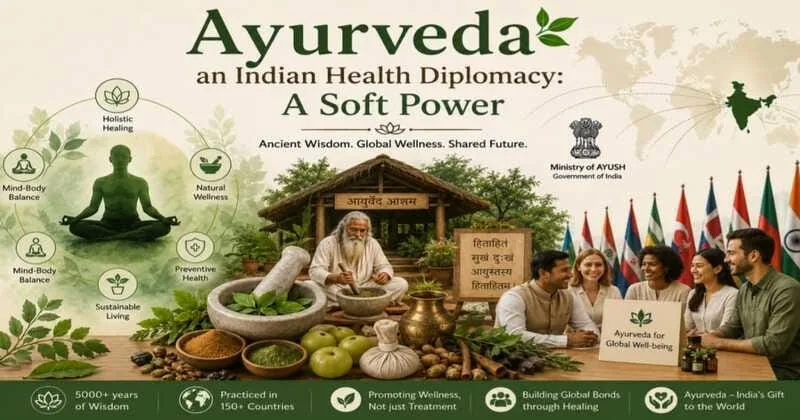
“Sarve bhavantu sukhinah, sarve santu niramayah”
May all be happy, may all be free of disease.
The ancient saying that once echoed through gurukuls is today being written into the architecture of global health governance. When the World Health Organisation chose Jamnagar, Gujarat, as the seat of its first-ever Global Traditional Medicine Centre in 2022, it was more than the inauguration of an institution. It was an acknowledgement, at the highest level of multilateral health governance, that the future of traditional medicine would be shaped from Indian soil. NITI Aayog’s newly released report, Strategic Roadmap for Making Ayurveda Global (2026), describes the GTMC as a global hub for policy development, data analytics and innovation in traditional medicine, a platform for international collaboration and standardised classification with Ayurveda at its core. In the grammar of diplomacy, this is what arrival looks like.
Soft power is a country’s ability to influence other nations and shape global outcomes through attraction and persuasion rather than coercion or military force. And India is a believer in non-violence until and unless it needs to save its dignity. The Sukta Sarvaṁ Śāntiḥ Śāntireva Śāntiḥ Sā Mā Śāntiredhi, it means May peace be everywhere and pervade all, reflects the true nature of India and its diplomacy.
A Ministry with a Global Mandate
The report traces a governance journey that mirrors India’s own civilisational reawakening. For nearly five decades after Independence, Ayurveda had no dedicated home in government, managed as an afterthought within the Ministry of Health and Family Welfare. The first formal step came only in 1995 with the Department of Indian Systems of Medicine and Homoeopathy, renamed the Department of Ayush in 2003. The decisive turn, which the report calls the most significant milestone, came in 2014, when the department was elevated to a full-fledged Ministry of Ayush, signalling, in the report’s words, the government’s commitment to mainstreaming traditional medicine and positioning it as a key component of India’s health strategy.
The dividends of that elevation are now measurable in treaty ink. The Ministry has signed around 75 Memoranda of Understanding with foreign governments and institutions, with 25 country-to-country agreements, 52 institute-level MoUs and 15 dedicated to establishing Ayush Academic Chairs in foreign universities. The International Cooperation Scheme knits these together, supporting chairs, information cells and educational outreach across continents. And it was the same year, 2014, that Prime Minister-led diplomacy secured the International Day of Yoga at the United Nations General Assembly an initiative, the report credits with elevating global awareness of holistic health and of Ayurveda itself.
The WHO Corridor: From Classification to Regional Capitals
If Jamnagar gave Ayurveda a headquarters within the WHO ecosystem, the International Classification of Diseases gave it a language. The inclusion of Ayurveda in ICD-11 Module 2, the report notes, codifies Ayurvedic morbidity classifications into the world official disease lexicon, the indispensable precondition for integration into national health data systems, hospital records and, eventually, reimbursement frameworks. The WHO has published benchmarks for the training of Ayurveda, defining the minimum criteria for establishing Ayurveda education in any member state. Sanskrit nosology now has ISO-grade standing.
The roadmap urges India to press this advantage deeper into the WHO’s regional architecture. It recommends deploying regional Ayurveda advisors on secondment from India to each of the WHO’s six regional offices, from AFRO to WPRO, where they would align Ayurvedic interventions with regional health priorities such as non-communicable diseases, mental health and ageing, host regional symposia under the WHO umbrella and pilot TM2 coding in live clinical settings. It is a blueprint for making Ayurveda a working vocabulary of global public health, not a visiting exhibit.
The Jamnagar centre carries a quieter, more strategic function too. The report envisions the GTMC acting as a neutral forum for developing core outcome sets and common data standards, the technical scaffolding that makes multi-country Ayurveda research comparable and therefore compelling, to regulators everywhere. It further points to the WHO’s worldwide network of Collaborating Centres, recognised hubs for scientific research and clinical trials, as natural partners for multi-country Ayurvedic studies. It is being organised as deliberately as diplomacy.
Academic Diplomacy: Chairs, Scholarships and Classrooms Abroad
Every enduring civilisational export begins in a classroom. The Ayush Scholarship Scheme, administered through the Indian Council for Cultural Relations, currently supports 277 international students from 32 countries who study Ayurveda in India and return home as its ambassadors. Ayush Chairs have been instituted in universities in Bangladesh, Australia, Latvia, Mauritius and Malaysia, carrying Indian faculty and curricula into foreign academia.
This outward push rests on a formidable domestic base that the report documents in detail: roughly 415 Ayush colleges, institutions of national importance such as the Institute of Teaching and Research in Ayurveda at Jamnagar and the All-India Institute of Ayurveda in Delhi, and regulatory modernisation through the NCISM Act, 2020, aligned with the National Education Policy 2020. The Ayush Research Portal has digitised a repository of over 42,000 publications, while the Ministry promotes dual PhD programmes, simulation laboratories and virtual anatomy tools to bring classical pedagogy into the digital century. Looking ahead, the roadmap proposes Ayurveda electives in international medical schools, strategically integrated with the Chair initiative normalising Ayurveda within integrative health education and widening recognition in countries that already permit complementary medicine practice.
Embassies as Ayurveda Frontline
Perhaps the most striking recommendation in the report is the conscription of India’s diplomatic missions into the Ayurveda mission. Ayush Information Cells already operate in 43 locations across 39 countries, serving as cultural and educational bridges. The roadmap now wants embassies positioned as the first line of credible information and rapid response for Ayurveda in their respective geographies, armed with crisis-response communication protocols, curated multilingual information education communication content and continuous myth-busting backed by transparent quality and safety data.
This is soft power with standard operating procedures. A digital-first IEC suite, localised and distributed through embassies, diaspora networks and partner platforms, would ensure that the first answer a curious foreigner receives about Ayurveda comes not from a sceptical tabloid but from the Indian state. Where fragmented messaging once left Ayurveda’s identity to be defined by others, the roadmap insists on unified, culturally adaptable communication, region-specific narratives that present the system as natural, holistic and scientifically validated healing, spoken in the listener’s own tongue.
The Multilateral Chessboard: UNESCO, WIPO and Beyond
The report’s most sophisticated passages read like a campaign map of the United Nations system. At UNESCO, where Yoga already stands inscribed as intangible cultural heritage of humanity, the roadmap calls for a strategic push to secure the same recognition for Ayurveda, a designation that would anchor its cultural legitimacy in international law.
At the World Intellectual Property Organisation, the report envisages India’s Traditional Knowledge Digital Library showcased as the flagship implementation model for protecting traditional knowledge, with proposals for technical sessions on database governance and training for patent examiners worldwide. It presses for Ayurveda-specific Geographical Indication tags; Kerala Panchakarma and Himalayan herbs are named, and active engagement with WIPO’s Intergovernmental Committee, the principal forum negotiating international instruments on traditional knowledge and genetic resources. Guarding the ancestral pharmacopoeia against biopiracy is treated not as defensive housekeeping but as sovereign duty.
The Ayurvedic products at the WTO under the TRIPS and TBT agreements, integration of Ayurveda into SDG-linked community health programmes with UNDP and collaboration with FAO on Ayurvedic agriculture and medicinal plant conservation. In parallel, the report urges Mutual Recognition Arrangements across friendly nations and multilateral groupings, the G20, BRICS and ASEAN to give Ayurvedic practitioners legal mobility across borders.
Visibility as Statecraft: The Civilisational Dividend
Diplomacy also has a street address. The roadmap proposes premium Ayurveda Experience Centres at the world’s most symbolic locations: Geneva WHO headquarters zone, New York’s United Nations precinct and Times Square, London’s Trafalgar Square, Singapore’s Marina Bay and Tokyo’s Shibuya Crossing, supported by structured partnerships with global hospitality, tourism, pharmacy and retail chains. Ayurveda, the message runs, belongs wherever the world gathers.
The Ayush Visa completes the circuit, offering foreign nationals dedicated entry with the AY-1 treatment category, the AY-2 attendant category and their e-visa counterparts to seek authentic Ayurvedic care in its homeland. With around 30 countries already recognising Ayurveda as a system of medicine in some form, from Nepal and Sri Lanka to the UAE, South Africa and several European states, the diplomatic groundwork is visibly compounding.
What emerges from the NITI Aayog roadmap is a portrait of statecraft rarely attempted, a nation systematically translating its oldest inheritance into contemporary multilateral currency. The report is candid that the journey is young; many MoUs await milestone-based implementation, and Ayurveda’s presence in WHO regional offices remains thin compared to its potential. But candour is the mark of serious intent and the direction is unmistakable.
The report’s own conclusion frames the prize with Ayurveda as a scientifically credible, regulation-ready, globally accessible system of medicine, contributing to universal health coverage and to India’s soft power leadership. When the WHO writes its classifications in Jamnagar, when patent examiners in Geneva consult the TKDL, a student in Riga studies under an Ayush Chair; each is a small ratification of an old truth that India’s gifts to the world were never conquered territory, but conquered suffering. Sarve santu niramayah is no longer only a prayer whispered at dawn. It is the declared policy of a rising nation.