
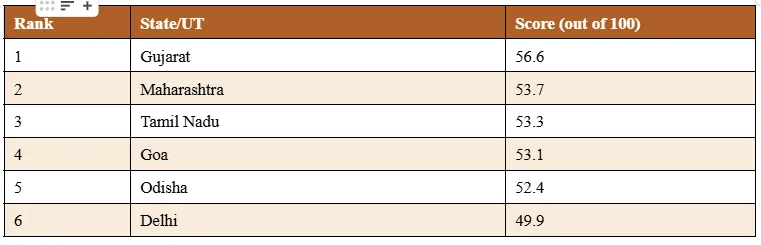
Gujarat has emerged as India most investment-friendly state, scoring 56.6 out of 100 on NITI Aayog’s newly released Investment Friendliness Index (IFI) 2026, with Maharashtra (53.7), Tamil Nadu (53.3), Goa (53.1) and Odisha (52.4) completing the list of five ‘top performers. Released in July 2026 and prepared by Crisil under the Research Scheme of NITI Aayog, the index is the most comprehensive state-level assessment of investment readiness the country has produced, covering all 28 states and eight Union Territories.
India gross domestic product has grown at an average of 6.1 per cent in real terms between fiscals 1992 and 2025 and investments have accounted for over half of that growth since the landmark reforms of the early 1990. But the bar for the next leg is higher, according to the World Bank, India must average 7.8 per cent real GDP growth over the next two decades to become a high-income economy by 2047. As NITI Aayog Vice Chairman Ashok Kumar Lahiri notes in the report, while central reforms provide the framework, the next phase of growth will increasingly be shaped by the competitiveness of states because investors ultimately make location-specific decisions.
How the Index Was Built
The IFI is not a perception poll. Its formulation began with an exhaustive compilation of 953 indicators, refined through top-down and bottom-up screening into a final set of 84 indicators 62 drawn from secondary data and 22 from perception surveys. Inputs from 165 stakeholders across ministries, industry associations, regulators and financial institutions shaped the framework, while over 1,850 investors were interviewed as part of the primary research, giving the rankings a rare ground-truth quality.
Eight pillars anchor the assessment, with weights reflecting what investors actually prioritised the infrastructure (25 percent), business climate (20 percent), resources (15 percent), regulatory ease (12 percent), government policy (10 percent), financial health (7 percent), institutional environment (6 percent) and environment resilience (5 per cent). Each state was scored on a 100-point scale using a mix of publicly available data and primary surveys.
The Four-Tier Ladder
Based on scores, states fall into four groups: top performers (above 50), frontrunners (45–50), emerging performers (40 to below 45) and aspiring states (below 40). Five states made the top tier, fifteen are frontrunners including Delhi (49.9), Madhya Pradesh (48.9), Andhra Pradesh (48.7), Karnataka (48.7) and Rajasthan (48.1), while eight states and Union Territories each populate the emerging and aspiring categories. To keep comparisons fair, the report also groups states into three geographical classes: large states, hilly and northeastern states and city states and Union Territories.
A notable design feature is the split between evidence and experience: of the 100 points available, 65 flow from verifiable data and 35 from the investor survey, ensuring that neither statistics nor sentiment alone can carry a state to the top. State profiles in the report display both components separately, allowing readers to see whether a state’s data performance matches how investors actually perceive it on the ground.
The real contest, however, lies in the crowded middle of the table. Chhattisgarh (47.5), Telangana (47.3), Haryana (47.1) and Kerala (46.6) sit within a single point of one another among the frontrunners, meaning marginal reforms in a single pillar could reshuffle several positions in the next edition. Chandigarh, posts the highest infrastructure pillar score in the city-states category at 15.0 ahead even of category topper Goa’s 14.0 showing that pillar leadership and overall leadership do not always coincide. In the emerging-performers band, Bihar, Jammu and Kashmir, Jharkhand, Meghalaya, Nagaland, Puducherry, Punjab and West Bengal cluster between 40 and 45. With West Bengal, Jharkhand and Bihar separated by barely a tenth of a point (41.3, 41.3 and 41.2 respectively) a statistical dead heat that turns the eastern race into one of the index’s most watchable contests.
Reason for Gujrat Friendliness Development
Gujarat supremacy rests on hard fundamentals. The state records the lowest port turnaround time in the country weighted by capacity, offers power to industrial users at roughly 29 per cent below the pan-India average, and delivers 23.8 hours of supply a day. It accounts for about 31 per cent of India’s merchandise exports nearly twice the next-highest state and hosts 614 Atal Tinkering Labs as of fiscal 2025. Its fiscal discipline stands out too, with a fiscal deficit of just 2.81 per cent of GSDP in fiscal 2024, the lowest among states and outstanding liabilities contained at around 18 per cent of GSDP.
Maharashtra leads the business climate pillar outright, attracting 35 per cent of the country’s private equity and venture capital investments and hosting 1,033 Atal Tinkering Labs a tenth of India’s total. Tamil Nadu, ranked first among large states in infrastructure, combines the third-best port turnaround time with a memorandum of understanding conversion rate of nearly 100 per cent and an export-to-GSDP ratio 36 per cent higher than the large-state average a testament to policy consistency that investors specifically commended.
Ranking a New Parameter of Development
NITI Aayog is explicit that the IFI is conceived as a strategic reform instrument, not a mere league table. Each state receives a detailed profile benchmarking its pillar-wise performance against the top performer and category average, alongside candid investor feedback on what works and what does not. By fostering healthy competition alongside cooperative federalism, the index aims to accelerate reforms, reduce information asymmetry for investors and enable states to learn from one another best practices.
The report frames the stakes in civilisational terms as global supply chains undergo structural realignment, India has a unique window to emerge as a preferred destination for investment-led manufacturing the sector that generates large-scale employment, deepens domestic value chains and integrates the country with global production networks. Realising that opportunity requires an enabling ecosystem across every state, not merely a handful of coastal champions.
The message running through the report supports Indian aspiration to become a developed nation by 2047 will depend on mobilising productive investment at an unprecedented scale and the states now stand at the forefront of that national endeavour. The IFI gives every state a mirror and a future roadmap towards Viksit Bharat 2047.