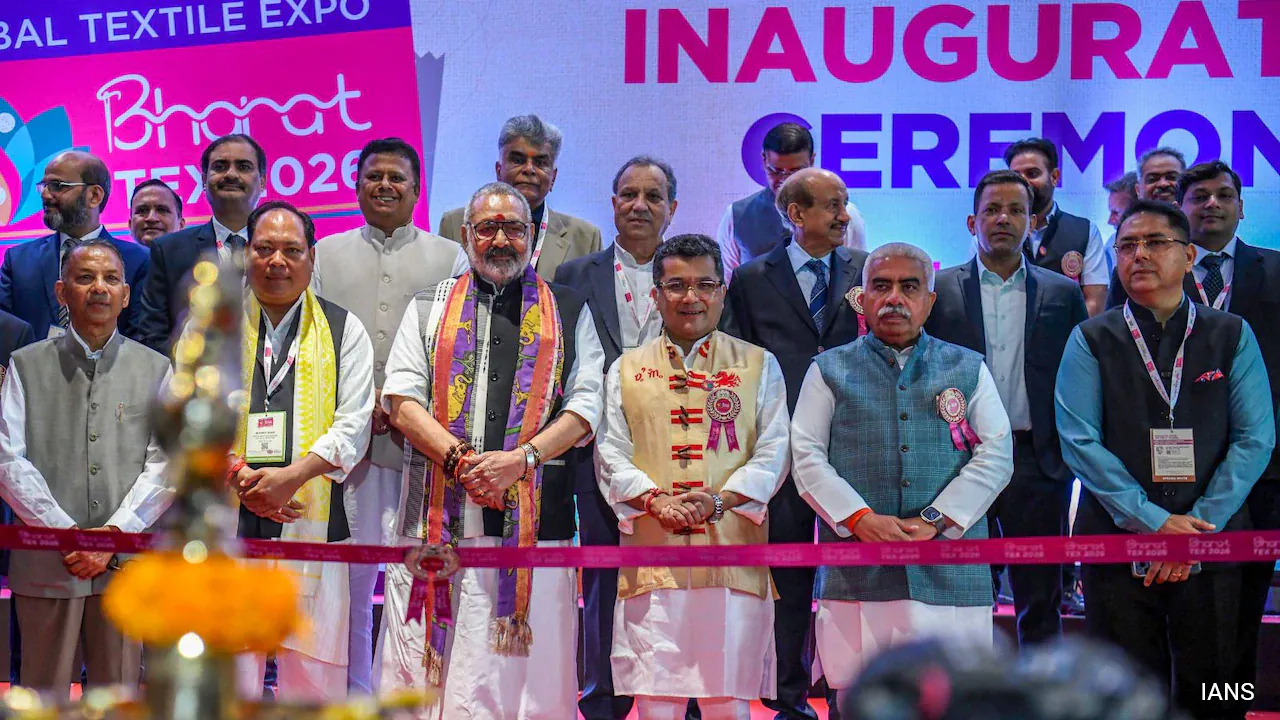
India’s textile sector is going through a quiet but significant shift. Traditional crafts, regional enterprises and sustainability-focused startups are increasingly finding their way into formal domestic and global markets. Bharat Tex 2026, one of the country’s largest textile exhibitions, captured this shift by bringing artisans, handloom cooperatives, exporters, manufacturers and technology-led businesses onto a single platform.
The numbers behind the event
By the time it closed, Bharat Tex 2026 had hosted more than 1,600 exhibitors and over 11,000 buyers, including more than 6,000 international buyers from 138 countries. The event facilitated more than 28,000 business to business meetings, along with over 100 government to government and business to government interactions.
Organisers said the event generated investment commitments worth more than Rs 14,300 crore. Around 15 lakh visitors attended over the four days.
Addressing a press conference in New Delhi, Narendra Kumar Goenka, Chairman of the Bharat Tex Trade Federation, said the event witnessed enthusiastic participation from industry leaders, exhibitors and global buyers. He said Bharat Tex brought together the entire textile value chain, from fibre and yarn to fabrics, apparel and home furnishings, and that buyers from around 130 countries attended, reflecting the growing international recognition of the platform.
Bhadresh M Dodhia, Co-Chairman of the organising committee, said the event attracted around 15 lakh visitors and over 11,000 buyers, including nearly 6,000 international buyers from 138 countries. He added that nearly 70 per cent of the exhibitors were MSMEs and that 95 first-time exporters took part this year.
A platform guided by the 5F vision
The exhibition covered the entire textile value chain, spanning fibre, yarn, fabric, apparel, home textiles, technical textiles, handlooms and handicrafts. It was guided by the government’s “5F vision”: Farm to Fibre to Factory to Fashion to Foreign. Spread across 1.6 million square feet, the event featured more than 20,000 textile products.
Craft clusters move beyond local markets
Many of India’s craft clusters and small scale producers have traditionally worked within limited regional markets. Growing global demand for sustainable products, handmade textiles and culturally rooted designs created new commercial opportunities for many of them at this year’s edition.
One example on display was Tikuli art from Bihar, an 800 year old craft once largely associated with decorative forehead ornaments. At Bharat Tex, artisans showed how the art form has evolved into contemporary products spanning home décor and textile applications.
Six generations of block printing, live at the stall
At the Weaves stall, visitors watched fabric making and block printing unfold in real time. Kashyap Kedia, manager at Weaves, represents an enterprise built on six generations of textile experience. The business works with around 200 artisans and reportedly produces nearly 2.5 lakh metres of block printed fabric using traditional styles such as Dabu, Bagru and Batik.
“Of our six printing styles, five can only be produced in India, particularly in Rajasthan, where the climate supports the process,” Kedia said. He added that potential customers from Qatar, Sri Lanka and Myanmar had visited the stall.
Tribal textiles enter contemporary fashion
Johargram, a Jharkhand-based brand, is turning tribal textiles, traditionally woven by the Uraon and Munda communities, into contemporary apparel such as jackets, shirts and trench coats. Pawan Kumar, the brand’s creative and operations head, said the designs are drawn from traditional patterns associated with these communities.
“Around 80 weavers are now engaged as global demand has increased,” Kumar said. “The business to business experience has been very encouraging. We are connecting with many buyers and exporters.” Now participating for the third time, Johargram used the platform to present Jharkhand’s textile traditions beyond silk.
Handloom cooperatives chase export markets
Kanpur based Niryaatak Handloom Cooperative Society Limited used Bharat Tex to explore export opportunities for rugs, carpets and other home furnishing products made from cotton, wool and recycled PET yarn. Around 120 weavers are part of the cooperative, some working on looms at its premises and others weaving from home.
Mohammad Imran, president of the cooperative, said discussions were held with buyers from Iraq and Algeria, including a company that supplies to European markets. A subsidised stall facilitated by the Handloom Export Promotion Council allowed the cooperative to access the trade event and begin these conversations.
Sustainability as a growth driver
Textile waste management and recycling emerged as another major theme at the exhibition. Startups such as ReFiber demonstrated technology enabled systems for collecting post consumer textile waste.
Manoj Wanvari, Chief Operating Officer of ReFiber, said the company collects used garments and sends them to partner NGOs for recycling, while also facilitating a marketplace for upcycled products. Exhibiting for the first time, Wanvari said the response was “very good, very phenomenal,” with visitors from Bangladesh, Spain, the United States, Portugal and Sri Lanka showing interest. The company now plans to expand its collection network across India.
Crafts on a parallel stage
Running alongside Bharat Tex, Indie Haat 2026 at the National Crafts Museum in Delhi showcased India’s handloom and handicraft heritage. It drew 48 artisans and weavers along with 12 design led brands, spanning crafts such as Gulabi Minakari, Dokra, Usta Kala, Pichwai, Sozni embroidery, Blue Pottery, silver filigree, Cheriyal painting, Mata Ni Pachedi, papier mâché, Bagru block printing, Jamdani sarees, Muga and Eri silk, and Odisha Ikat.
India remains one of the world’s largest producers of textiles and apparel, with the sector contributing significantly to manufacturing, exports and employment. The industry continues to face rising global competition, changing consumer preferences and increasingly strict sustainability requirements.
With nearly 70 per cent of exhibitors this year being MSMEs and 95 first time exporters taking part, organisers say Bharat Tex 2026 has widened its role from a trade exhibition into a platform that strengthens linkages across the textile value chain, from heritage artisans to modern manufacturers, export oriented enterprises and sustainability focused startups.