
“Rapid development coupled with distributive justice cannot be achieved, without first ensuring stable peace and security in the country. Hence, the task of effectively safeguarding the country’s security assumes an overriding primacy and demands that the systemic reforms required for achieving this goal must be implemented without delay”
– Report of the Group of Ministers on National Security, (Kargil Committee Report), 2000
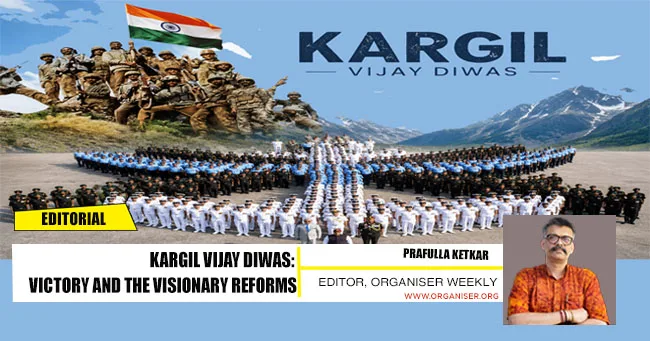
The Pakistani intrusion in the Kargil, Dras, and Batalik sectors of the Ladakh in the year 1999 was shocking for everyone. Politically, opposition parties used it as a failure to target the Vajpayee government alleging intelligence failure. After the Lahore bus diplomacy, such a backstabbing was unaccepted, that also in Ladakh, which is generally not patrolled during winters on both the sides. Bharat later turned the tables and achieved glorious victory and operational success by reclaiming lost territory in one of the most difficult terrains. Yet, the loss of more than five hundred brave hearts and many other issues, opened up possibilities for introspection in the form of Kargil Review Committee report. The Government, intelligence agencies, and armed forces all were taken on board along with the experts to review and reform the national security management. First time ever, national security was seriously discussed in a comprehensive manner as the need to overhaul the British colonial theatre system had become obsolete. The expected approval to the integrated theatre command, around the 27th anniversary of Kargil Vijay Diwas, was one of the key reforms that was evolved through this review process.
The intrusion in the Kargil sector was detected on May 3, 1999. The “shepherds” from the Bakkharwal community and the nationalist villagers from Garkon village, occasionally retained by the Brigade Intelligence Team for forward information gathering, informed the army, and on May 7, it was confirmed by the patrols sent out. Within three months of PM Vajpayee’s historic Lahore Bus Diplomacy on February 19, 1999, this was clearly another blow to the peace efforts by Pakistani Army. This misadventure of Pakistan proved to be a blessing in disguise for Bharat as it gave an opportunity to New Delhi to review and strengthen its military apparatus.
From snow boots to defence equipment, everything was trapped in the bureaucratic hurdles. Overdependence on foreign supply for artillery and guns was noted. The possible participation of the private sector in the defence production was explored. Media relations and communication strategy was identified as the important dimension of national security by the committee. Kargil was the first televised war involving Bharat. The need for border infrastructure upgradation was identified. The two most important recommendations were related to bringing jointness in the military operations. To introduce the post of the Combined Defence Staff (CDS) and transform the existing colonial-era command structure into an integrated theatre command. Realising that the future nature of war would be non-linear, with real-time surveillance, integrated Command, Control, Communications, Computer, Intelligence and Information (C4 I2 ) assets, target acquisition, and highly lethal precision weapon systems, the KRC did not focus just on the learnings from the past but undertook the herculean task of setting Bharat ready for future warfare.
Originally, the KRC had recommended a ten-year timeline to complete the overhaul. Unfortunately, the Sonia Gandhi-led UPA Government could not make much progress on the defence reform and modernisation front due to policy paralysis and rampant corruption. Only after PM Modi assumed the Prime Ministership, and especially when Late Manohar Parrikar became the Defence Minister, transparency and expediency in defence procurement became the national agenda with adequate budgetary provision. The private participation in defence production has improved. DRDO has become competitive, and we are now exporting significant parts of defence technology and equipment. The border infrastructure has improved a lot. The post of the Combined Defence Staff was an important decision, and Gen Bipin Rawat set the process in motion from January 1, 2020. Even as the proposal for the Integrated Theatre Command is taking its final shape, our armed forces hitherto displayed operational jointness and synergy during Operation Sindoor.
As we celebrate the valour and commitment of our armed forces in protecting our borders, on the 27th Kargil Vijay Diwas, it is also an occasion to review the lessons that the Armed Forces, Intelligence agencies, Parliament, Government, media, and the nation as a whole haslearnt We need to realise that national security goes beyond state security, defined in terms of border security. – Now information and narratives are among the enemy’s most potent tools in the fifth generation warfare. Therefore protecting our culture, institutions, and social fabric cannot be left to the security forces alone., It is an opportune time to discuss the changing nature of war, understand the roles of each stakeholder, and act in accordance with the expected roles as responsible constituents of this great civilisation. This way, we can pay tribute to soldiers for their sacrifices and ensure that “Kargils,” like intrusions of any description, will never ever be repeated.