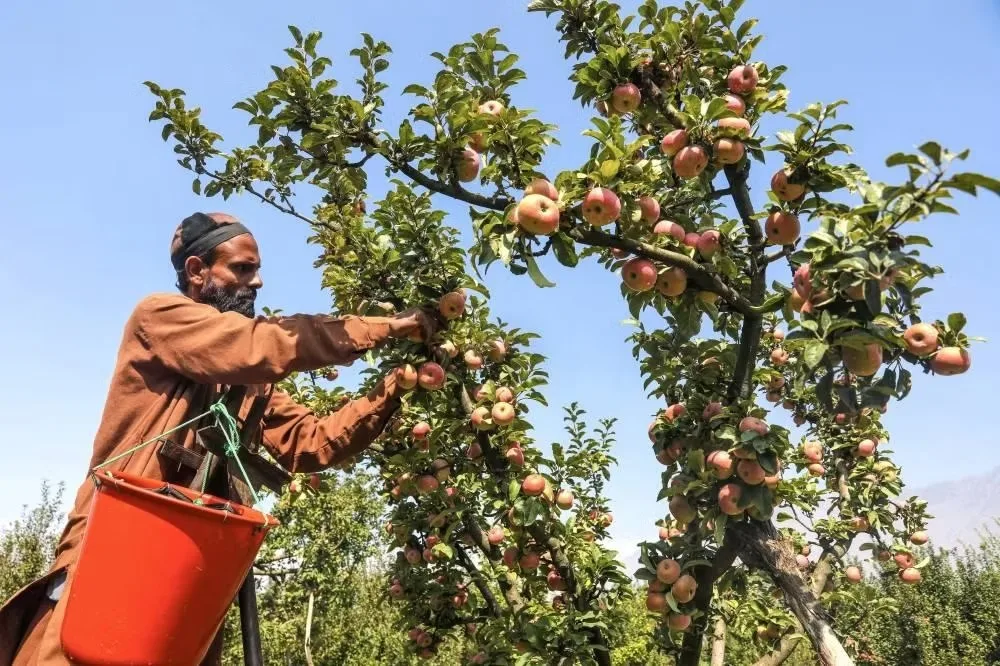
Nestled in the high-altitude hills of Kathua district, the Bani region has long depended on conventional agriculture for livelihoods. Today, however, its agricultural landscape is changing as more farmers embrace high-density apple cultivation, a modern horticulture practice that promises higher productivity and better returns.
Across the region, orchards planted with advanced apple varieties are replacing traditional crops, signalling a gradual transition towards commercial fruit cultivation. The transformation is being driven by favourable climatic conditions, growing awareness among farmers and sustained support from the Department of Horticulture through various government initiatives.
Officials believe the move towards scientific horticulture has the potential to reshape Bani’s rural economy by increasing farm incomes, creating employment opportunities and encouraging sustainable agricultural practices.
Government Support Encouraging Farmers
The expansion of high-density apple orchards has been supported by government welfare schemes aimed at modernising agriculture and promoting self-reliance among farmers.
Under these initiatives, growers are receiving quality planting material, technical guidance, training and other forms of assistance required to establish modern orchards. The Department of Horticulture has also been working closely with farmers to introduce improved cultivation techniques and ensure better orchard management.
These interventions have encouraged many cultivators to diversify from traditional crops and invest in fruit cultivation, which offers significantly higher returns over the long term.
Officials said continued technical support and awareness programmes are helping farmers understand the benefits of adopting scientific horticulture practices and modern farming technologies.
Farmers Embrace New Opportunities
Among those benefiting from the transition is local farmer Kartar Singh, who recently established a high-density apple orchard using advanced varieties of apple saplings.
Singh said government welfare schemes have played an important role in encouraging farmers to adopt modern farming practices.
According to him, financial assistance and technical support have enabled cultivators to take up commercial horticulture with greater confidence.
He said the shift towards improved apple varieties has given many farmers a fresh beginning and helped them move closer to becoming self-reliant. Singh added that government initiatives aimed at strengthening agriculture have encouraged growers to embrace new technologies and diversify their sources of income.
His experience reflects a broader trend across the region, where an increasing number of farmers are viewing horticulture as a sustainable and profitable alternative to conventional agriculture.
Nature Continues to Test Growers
Despite the growing success of high-density apple cultivation, farmers say horticulture in the mountainous region remains a challenging venture.
Abdul Razak, another farmer from the area, said cultivating apples at high altitudes requires patience, determination and the ability to cope with unpredictable weather conditions.
According to him, farmers regularly face heavy snowfall, hailstorms, strong winds and other climatic challenges that can affect young orchards and delay production.
He said establishing an orchard requires years of consistent effort before trees begin yielding fruit, making it a long-term investment rather than a quick source of income.
However, Razak said the rewards make every challenge worthwhile. Watching trees bear fruit after years of care and hard work brings immense satisfaction and motivates farmers to continue investing in horticulture despite natural hardships.
Farmers believe that with improved technology, better weather management practices and continued institutional support, many of these challenges can be addressed more effectively in the future.
Department Plans to Develop Bani as Horticulture Hub
The Department of Horticulture sees immense potential in transforming Bani into one of Jammu and Kashmir’s important fruit-producing regions.
District Horticulture Officer Mohammad Shakil said the area’s climate and geographical conditions are particularly suitable for cultivating apples and several other temperate fruit crops.
He said the department is implementing various government schemes to encourage farmers to adopt modern horticulture by providing quality saplings, technical guidance and other essential support.
According to Shakil, officials are continuously engaging with growers to promote scientific orchard management practices and expand the area under fruit cultivation.
The long-term objective, he said, is to establish Bani as a major horticulture hub while giving a fresh direction to the local economy through increased commercial fruit production.
The department also expects that wider adoption of high-density orchards will improve productivity compared to traditional plantations and help farmers achieve better returns from smaller landholdings.
Economic Benefits Extend Beyond Farmers
Officials believe the expansion of horticulture will generate benefits beyond individual farm households.
The growing network of orchards is expected to create employment opportunities in nursery management, plantation work, harvesting, grading, packaging, transportation and marketing.
As production increases in the coming years, allied sectors such as cold storage, logistics, fruit processing and agri-business services are also expected to witness growth.
The development of these support industries could provide additional livelihood opportunities for local youth while strengthening the rural economy of Kathua district.
Experts say commercial horticulture has the potential to reduce migration from remote hill areas by creating sustainable income opportunities closer to home.
High-Density Cultivation Offers Better Returns
High-density apple cultivation has emerged as a preferred farming model because it allows more plants to be grown on the same piece of land compared to traditional orchards.
The method uses scientifically selected planting material and modern orchard management practices to improve productivity and fruit quality while enabling earlier commercial harvesting.
Agriculture experts say high-density plantations require careful planning and technical supervision during the initial years but generally provide better economic returns over time.
For small and marginal farmers, the technology offers an opportunity to maximise productivity and diversify income sources while making better use of limited agricultural land.
A New Direction for Bani’s Rural Economy
The transformation underway in Bani reflects a broader effort to modernise agriculture and promote sustainable livelihoods in Jammu and Kashmir’s hill districts.
With increasing adoption of high-density apple orchards, government support and favourable climatic conditions, the region is steadily emerging as a promising horticulture destination.
Officials remain optimistic that continued investment in modern farming practices, improved infrastructure and farmer training will accelerate this transition in the coming years.
As orchards mature and production expands, Bani is expected to witness higher farm incomes, stronger local employment and greater economic activity, reinforcing horticulture’s role as an important driver of rural development in Kathua district.