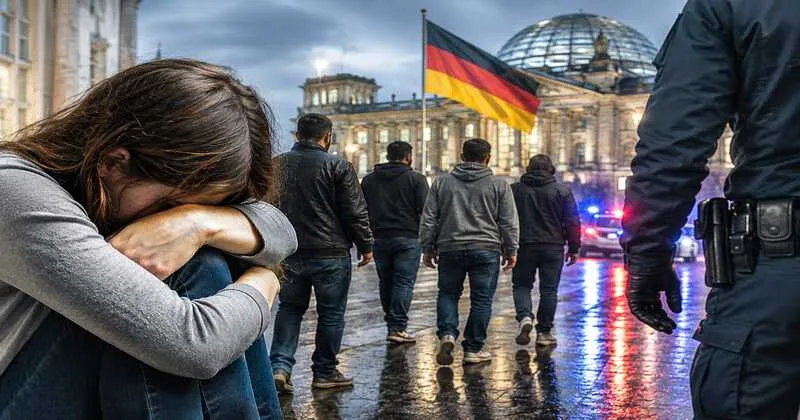
Germany has witnessed a sharp rise in the share of foreign nationals implicated in gang rape cases, with official data showing that 53 per cent of suspects in such crimes during 2025 were non-German citizens. The figures, released by the German federal government in response to a parliamentary query submitted by the Alternative for Germany (AfD), have reignited a fierce political debate over migration, crime reporting and public security.
According to the statistics, a total of 751 victims were gang-raped across Germany in 2025. Authorities identified 1,083 suspects in these cases, of whom 574 did not hold German citizenship, accounting for 53 per cent of all suspects. By nationality, Syrians formed the largest group with 110 suspects, followed by Afghans (64), Iraqis (46) and Turks (44). The remaining suspects came from a range of other countries.
The data also reveal that around 80 per cent of the victims were German citizens. While 509 suspects were recorded as German nationals, the federal statistics do not separately identify whether these individuals had a migration background or dual citizenship. Previous studies analysing the first names of gang rape suspects have suggested that approximately 75 per cent of offenders had foreign first names, indicating that citizenship figures alone may not provide a complete picture.
The release of the figures comes amid a period in which Germany has naturalised growing numbers of migrants. Millions of residents also possess dual citizenship, meaning offences committed by such individuals are recorded as crimes committed by Germans in the federal crime statistics.
Debate over crime statistics and migration background
The AfD has called on the Interior Ministry to expand crime reporting by including migration background alongside citizenship. The party argues that such data would allow authorities to better assess integration outcomes and crime patterns among German citizens with foreign backgrounds.
AfD politician Stephan Brandner said the latest figures demonstrated an urgent need for stronger action. “Although the issue has been on the political agenda for years, there is clearly a lack of effective political and legal measures to prevent these crimes,” he said.
🇩🇪 Four Syrian brothers have been jailed in Germany for luring their teacher to a parking lot and stabbing him multiple times in the lung, neck, and back, in the belief that he was having an affair with their mother.
After a lengthy trial, the defendants, aged between 17 and 21… pic.twitter.com/I6DixESiXa
— Remix News & Views (@RMXnews) July 14, 2026
Brandner also pointed to another statistic showing that 72 per cent of all solved gang rape cases involved suspects who were already known to police. He described this as evidence of failures within the judiciary, security agencies and political leadership, calling for consistent prosecution, faster court proceedings, tougher punishments and the termination of residence permits for foreign offenders convicted of such crimes.
The issue has also dominated debates in the Bundestag. Earlier this month, AfD leader Alice Weidel referred to an alleged case in Nuremberg in which migrants drugged underage girls and forced them into prostitution. According to the official Bundestag record, her remarks were interrupted by loud reactions from other lawmakers, including laughter from Left Party MP Katrin Fey.
Weidel argued that violent and sexual offences were “not cold statistics” but reflected the daily fears experienced by many families. She specifically referred to allegations that young men from Syria, Iraq, Pakistan and North African countries targeted girls aged between 13 and 18 around Nuremberg Central Station, driving vulnerable teenagers into drug addiction before forcing them into prostitution.
North Rhine-Westphalia changes reporting rules
The controversy has also prompted changes in crime reporting in Germany’s most populous state, North Rhine-Westphalia (NRW). Interior Minister Herbert Reul of the Christian Democratic Union (CDU) has ordered police to record all nationalities held by suspects with dual citizenship instead of listing only their German nationality.
Under the current federal reporting system, dual nationals are counted solely as Germans, a practice critics argue distorts crime statistics. Reul defended the decision, saying, “If we don’t capture all nationalities, we’re in the dark. If you want to see reality, you have to measure it.”
He added that recording multiple nationalities would improve transparency, help police identify potential risks earlier and strengthen crime prevention efforts.
The state government said the new system would provide a more realistic and detailed understanding of who is committing crimes. Official figures for 2023 showed that non-Germans accounted for 35.6 per cent of all suspects despite representing only 16.1 per cent of Germany’s population.
The data further showed that one in six suspects recorded as German citizens also possessed another nationality, accounting for 49,825 recorded crimes. The most common dual nationalities were German-Turkish (10,307), German-Polish (6,652), German-Russian (3,484), German-Moroccan (3,125) and German-Syrian (2,185).
The Interior Ministry said recording multiple nationalities would also assist police in identifying suspects who present a greater risk of absconding and resolving difficulties arising from multiple identities.
In Germany, a polygamous Syrian refugee family is causing outrage.
Ahmed lives with his 2 wives and 6 children in a rent-free house. He says he is looking for 2 more wives and wants to have 20 children.
He is illiterate, doesn’t work, and claims his only goal is to have as… pic.twitter.com/ZWO2d5tnqa
— Dr. Maalouf (@realMaalouf) July 10, 2026
The move, however, has drawn criticism from the Green Party. Domestic policy spokeswoman Julia Holler argued that the measure would not improve police work and instead echoed the rhetoric of the AfD. She said that a passport did not explain why someone committed a crime and warned that highlighting dual citizenship risked treating such individuals as “second-class Germans.”
In contrast, German Police Union (DPolG) federal chairman Rainer Wendt welcomed the reform, arguing that transparency was essential in a democratic constitutional state. He said clear crime statistics were necessary to prevent misleading interpretations and ensure informed public debate.
Although North Rhine-Westphalia will continue to transmit only one nationality, the German nationality of dual citizens,to the federal database, the state will publish its own statistics showing all nationalities held by suspects. Consequently, the change will not immediately alter Germany’s national crime statistics.
Supporters of the reform believe other German states could eventually adopt similar reporting practices, potentially revealing hundreds of thousands of additional crimes involving dual citizens. They also argue that existing statistics remain incomplete because they do not record the migration background of German citizens whose parents or grandparents migrated to Germany but who hold only German citizenship.
As Germany’s debate over immigration, integration and public security intensifies, the newly released figures have become a focal point in wider discussions about crime reporting, transparency and how official statistics should reflect the country’s changing demographic landscape.