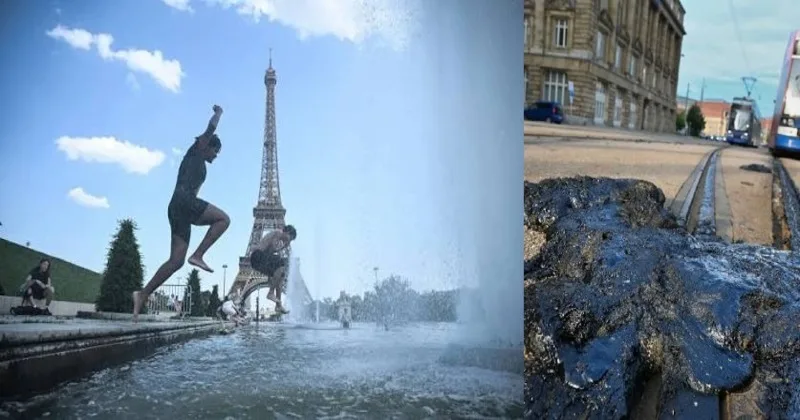
The deadly heatwaves engulfing the European continent have jeopardised lives to a severe extent. Temperature has breached all the caps and the death toll has crossed 1,300. Thousands of schools have been closed, cultural events are cancelled and the landmark tourist spots including the Eiffel Tower, Louvre Museum remain shut. Critical infrastructures across the continent are crumbling & melting, due to extreme heat. The railway tracks, power grids are buckling & nuclear power plants have halted the operations. Meanwhile, hospitals are flooded with patients who are suffering from heatstrokes and other climate induced health catastrophes.
Soaring heatwaves & record deaths: Europe is the fastest warming continent
As per the reports of the World Health Organisation(WHO) reports, as of June 28, Sunday. 1,300 people have succumbed across the continent unable to bear the intensity of the heatwaves. Among them, 1,000 deaths have occurred in France alone, as the country is breaching all temperature caps and Paris is turning into a hotbed. This death rate in France is beyond the anticipated impact of the heatwaves. Infact, Europe is the fastest warming continent on Earth. Europe is heating twice as much as the global average.
Among them 85 per cent of the people who have died are aged above 65, thus the elderly population are more vulnerable to the catastrophic heatwaves as they do not possess the physical & mental strength to tolerate the soaring temperature. On June 28, Germany also recorded its highest ever temperature, with 41.7 degree celsius. The Czech Republic recorded 41.9 degree celsius. Poland also broke its all-time temperature record with 40.5C and Hungary recorded 40.7 degree celcius. The WHO quoted this catastrophe as “once-in-a-generation heatwave” which is driven by human-caused global warming and climate change. WHO also described the heatwaves as “silent killers”.
The deaths are associated with heart attacks, strokes, dehydration, increased blood pressure, respiratory illnesses, kidney failure and worsening chronic diseases triggered by prolonged exposure to heat. Heatwave induced stress also causes severe impact on mental health. During the worst days of the heatwave, France recorded over 1,400 deaths per day. In fact, many died inside their homes rather than in hospitals, highlighting one of the biggest dangers of heatwaves as they often kill silently.
Schools shut, cultural events cancelled as govt. rushes to cooling techniques
The soaring heatwaves across the European continent have severely disrupted lives. For example, in the United Kingdom(UK) more than 1,000 schools have been shut, as children are most vulnerable to the heatwaves. On June 26, in the Netherlands, Dutch music festival Defqon.1 was cancelled following an unprecedented red alert warning about the extreme heat. In Paris, officials banned drinking takeaway alcohol in public and cancelled the city’s pride march in order to help emergency services, such as rushing the victim of heatwaves to the hospital to render immediate treatment.
Music festivals including Garorock in France and Solidays in Paris were cancelled because of weather risks. Meanwhile, Berlin(Germany) police used water cannons to provide cooling relief to residents and planned further operations as temperatures remained dangerously high. A Red Alert has been issued in Romania as well. Forecasts suggested that around 191 million Europeans could experience temperatures of at least 35 degrees Celsius. Also, the closed schools are used as cooling centres & community shelters to protect oneself from the heat.
Europe is experiencing an intensifying heatwave across the continent. Germany has just reached a record 41.7°C. Water cannons were used to help cool crowds as temperatures continued to soar.📍 Berlin. pic.twitter.com/TKuDEp4ZLv
— Weather Monitor (@WeatherMonitors) June 28, 2026
Railways melt, nuclear plants shut & agriculture hit
The heatwaves are severely disrupting the economic lifeline of Europe. The railway tracks are melting due to soaring temperatures. In many places across Europe, the steel railway tracks are expanding & buckling due to the sharp rise in temperature. Trains transiting on such ruptured tracks can derail. Thus, several countries have imposed speed restrictions and delayed services to ensure passenger safety. In Leipzig, Germany, authorities halted tram operations after intense heat caused problems with tracks and rail components.
🚨🇩🇪 HOLY SH*T! The heat has gotten so extreme in Germany that tram tracks have started to melt!
The Leipzig Transport Authority has suspended every single tram line, after sealant in the rails and points liquefied across the network.
They planned to resume service last night,… pic.twitter.com/il1oeu7Efr
— Mario Nawfal (@MarioNawfal) June 28, 2026
In France, Germany, Spain and other countries, even the traffic lights are melting, unable to bear the heat. Road infrastructures across the European continent have also suffered due to spiralling heatwaves. Asphalt softens under prolonged exposure to temperatures above 40°C, leading to cracked roads and damaged surfaces. This increases vulnerability to accidents.
🥵 Europe’s Heatwave Is Melting Traffic Lights: France, Spain, and Germany See Temperatures Above 40°C
Due to the extreme heat, hospitals and morgues in Paris are overwhelmed, while emergency services report more than 100 deaths in a single day pic.twitter.com/oAquaGilTj— XSpirit (@TubeSpirit) June 27, 2026
In many places, nuclear power plants & power grids have been shut down to avoid heat induced disasters. This has affected Europe’s electricity supply. For example, France generates two-third of its electricity from nuclear energy and the nuclear reactors use river water to cool the systems. However, due to the heatwaves, the temperature of the river water has increased. This warm water cannot be used for the cooling of nuclear reactors. Thus, several reactors have reduced electricity generation. On the other hand, the demand for electricity has surged as millions of households have begun to use air conditioners and cooling systems. This bottleneck has further complicated the heatwave catastrophe of Europe.
Meanwhile, the instances of wildfire also rise due to increased heatwaves. The dry vegetation in Germany, Italy, France and the Balkan region can catch fire as an impact of soaring temperatures. Scientists warn that the hotter and drier summers are lengthening Europe’s wildfire season each year.
Meanwhile, the agricultural sector and farmers are also worst hit due to heatwaves. Farmers across parts of France, Germany and Central Europe have raised concerns over wheat, maize and sunflower crops, while livestock farmers are struggling to keep animals cool. These heatwave induced impacts are further mounting the crisis & burden on the European economy.
NRIs recall India & miss home
Amidst an escalating heatwave in Europe, the Non-Resident Indians(NRIs) residing in the continent are missing their hometown in India. Many Indians residing in Europe have taken to social media and are expressing their unusual, unanticipated and unbearable experience in Europe. Indians residing in Germany and other Western & Central European countries are explaining how difficult it is to reside in houses that are not air conditioned and heat-resistant. This exposes the unpreparedness of Europe for the heatwaves.
Desis report Europe heat crisis; Fans are all sold-off, roads and even tracks are melting … and more pic.twitter.com/e2gWD8TPPH
— Shadow IND (@ShadowIND_IN) June 28, 2026
In contrast, Indians have multiple options to deal with the soaring temperatures. If not ACs, India has many other cost-effective means such as ceiling fans, table fans, coolers to beat the heat. However, Europe doesn’t have such options. Whereas, the houses of Europe are suitable to accommodate only harsh winters but not summers, thus making lives in summer miserable.
An Indian woman named Neha Rai, residing in Germany said she was experiencing temperatures around 33°C along with heat warnings. She added that having previously lived in Uttar Pradesh, where temperatures reached 45°C to 50°C, she did not expect the conditions to be that difficult in Germany. She also revealed that she spent three days visiting different stores to purchase a fan. However, every shop she visited told that they were out of stock. This intense heat and lack of cooling mechanisms has severely affected sleep and health, Neha added.
Thus, Europe is grappling with the once-in-a-generation heatwave exposing the structural loopholes in its infrastructure and falutlines of the western model of growth. Scientists reiterate that such a catastrophic heatwave is impossible without human-caused global warming and climate change. Rapid industrialisation, unsustainable consumerism, houses that are not heat-resistant, exhaustive fossil fuel combustion and other unscientific methods of development that Eurpe adopted for centuries, is yielding today’s intolerable heatwaves that is causing massive deaths and disruptions.