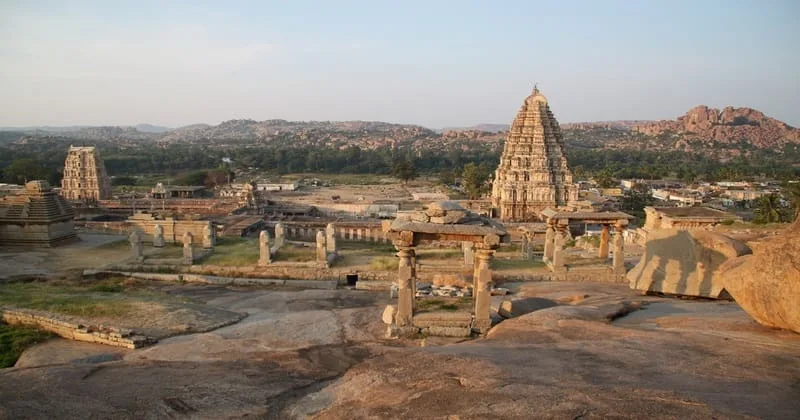
On the southern banks of the Tungabhadra River in present-day Karnataka lies a landscape where every granite boulder seems to preserve a fragment of history. Broken mandapas, roofless temples, weathered sculptures, abandoned bazaars, and towering gopurams stand as silent witnesses to one of the greatest civilisations India ever produced. Today, the world knows this place as the ruins of Hampi, a UNESCO World Heritage Site. Yet these ruins were once the thriving capital of the Vijayanagara Empire, the last great Hindu empire of medieval South India and one of the wealthiest cities of the early modern world. To walk through Hampi is to experience both awe and melancholy. Every surviving monument celebrates extraordinary artistic achievement, while every shattered idol and collapsed pavilion recalls a devastating chapter in India’s cultural history. The ruins of Vijayanagara are not merely archaeological remains; they are a civilisational memory carved into stone.
The Vijayanagara Empire was established in 1336 CE by the brothers Harihara I and Bukka Raya under the guidance of the philosopher-saint Vidyaranya. At a time when much of northern India was witnessing political instability under the Delhi Sultanate, Vijayanagara emerged as a powerful centre of Hindu political authority, economic prosperity, and cultural renaissance. The founders envisioned a kingdom that would safeguard indigenous traditions while encouraging trade, learning, and artistic excellence. Nestled amidst rugged granite hills and protected naturally by the Tungabhadra River, the capital developed into one of the most spectacular urban centres of the medieval world. The natural landscape itself became an integral part of the city’s defensive strategy, while successive rulers transformed the rocky terrain into a magnificent imperial capital.
The empire reached the pinnacle of its power during the reign of Krishnadevaraya between 1509 and 1529. His reign is widely regarded as the golden age of Vijayanagara. Literature flourished in Sanskrit, Telugu, Kannada, and Tamil, while poets, philosophers, scholars, and artists found generous royal patronage.
Monumental temples rose across the empire, irrigation projects transformed agriculture, and international trade connected Vijayanagara with Persia, Portugal, Arabia, and Southeast Asia. Foreign travellers who visited the capital struggled to find words adequate to describe its splendour. The Persian envoy Abdur Razzaq declared that he had seen no city comparable to it anywhere in the world. Portuguese chronicler Domingo Paes marvelled at its bustling markets filled with diamonds, pearls, horses, silk, spices, precious metals, and luxury goods. Their accounts portray Vijayanagara as one of the largest and most prosperous cities of the sixteenth century.
Unlike many medieval capitals that revolved solely around royal palaces, Vijayanagara was conceived as both an imperial and sacred city. Temples formed the spiritual, social, and economic nucleus of urban life. The Virupaksha Temple, dedicated to Lord Shiva, had been an important pilgrimage centre even before the empire’s foundation, but Vijayanagara rulers expanded it into the religious heart of the capital. Remarkably, it continues to function as a living temple today, maintaining an unbroken tradition of worship that links modern India with its medieval past. The magnificent Vittala Temple represents the highest achievement of Vijayanagara architecture. Its iconic stone chariot has become an enduring symbol of Hampi, while its celebrated musical pillars demonstrate an astonishing understanding of engineering and craftsmanship. Though visitors are no longer permitted to strike these pillars to protect the monument, they continue to testify to the remarkable ingenuity of the artisans who created them.
The greatness of Vijayanagara, however, extended far beyond its temples. Archaeological excavations reveal a sophisticated urban civilisation with carefully planned streets, expansive marketplaces, residential quarters, administrative complexes, granaries, water reservoirs, aqueducts, and canals. Temple avenues doubled as commercial centres where merchants from across Asia traded diamonds, gemstones, textiles, spices, perfumes, and Arabian horses. The city’s elaborate hydraulic system supplied water not only for agriculture but also for gardens, fountains, and domestic consumption. This remarkable infrastructure demonstrates that Vijayanagara’s prosperity rested upon efficient governance, technological innovation, and extensive commercial networks as much as upon religious patronage. The empire’s wealth attracted traders from distant lands, making the capital one of the most cosmopolitan cities of its age.
Yet history often reminds us that even the greatest civilisations are vulnerable to sudden catastrophe. In 1565, the Vijayanagara Empire confronted a confederacy of the Deccan Sultanates at the Battle of Talikota. Initially, Vijayanagara’s forces resisted fiercely, but strategic reversals, internal defections, and battlefield miscalculations ultimately resulted in a crushing defeat. The victorious armies advanced towards the imperial capital, and what followed has remained one of the most tragic episodes in medieval Indian history.
Contemporary and later historical accounts describe months of systematic plunder and destruction. Magnificent palaces were burnt, temples desecrated, sculptures mutilated, and public buildings demolished. Treasures accumulated over centuries disappeared, while one of the world’s richest cities was transformed into a landscape of ruins. Although historians continue to debate the precise chronology and extent of the devastation, archaeology unmistakably confirms that the city suffered immense destruction during this period.
The empire itself did not vanish immediately after Talikota. Successor rulers attempted to continue governance from alternative capitals, but Vijayanagara never recovered its former political or cultural dominance. The once-bustling imperial metropolis gradually fell silent. Nature slowly reclaimed abandoned streets, while granite structures weathered centuries of neglect. What survives today represents only a fraction of the original city, whose scale and magnificence once astonished visitors from across the known world.
Modern scholarship encourages us to approach Vijayanagara with both honesty and historical nuance. There is substantial evidence that the city experienced widespread destruction after the Battle of Talikota. At the same time, historians also recognise that not every damaged monument resulted exclusively from the events of 1565. Centuries of abandonment, natural weathering, reuse of building materials, and later occupations all contributed to the condition in which the monuments survive today. A careful reading of history, therefore, requires distinguishing between evidence, interpretation, and later popular narratives. Such an approach strengthens rather than weakens our understanding of the past by grounding it firmly in historical inquiry.
Today, Hampi enjoys international recognition as a UNESCO World Heritage Site and attracts scholars, archaeologists, pilgrims, and tourists from across the globe. Conservation efforts undertaken by the Archaeological Survey of India seek to preserve its extraordinary architectural heritage despite challenges posed by environmental degradation, tourism, and the sheer scale of the archaeological landscape. Visitors wandering through the Lotus Mahal, Elephant Stables, Hazara Rama Temple, Queen’s Bath, Virupaksha Temple, and Vittala Temple encounter not merely isolated monuments but the remnants of a civilisation that harmoniously combined architecture, engineering, spirituality, governance, and commerce.
The ruins of Vijayanagara continue to occupy a unique place in India’s civilisational consciousness because they remind us of both the heights a society can achieve and the fragility of cultural heritage. They testify to the creativity of architects who transformed granite into poetry, engineers who mastered water management, rulers who fostered literature and learning, and artisans whose craftsmanship continues to inspire admiration centuries later. At the same time, they remind us that cultural achievements, however magnificent, require constant preservation. Cities may fall, monuments may crumble, and sculptures may be broken, but historical memory survives only when societies choose to remember.
The Vijayanagara ruins are, in many ways, among India’s greatest classrooms of history. They reveal that civilisations are built through vision, sustained through creativity, and remembered through collective effort. Standing amidst the granite hills of Hampi, one realises that while empires may disappear, the ideals they embody often endure. The stones of Vijayanagara may have been scarred by time and conflict, but they continue to speak of a civilisation that reached remarkable heights, of a city that once dazzled the world, and of a cultural legacy that remains an inseparable part of India’s historical inheritance.