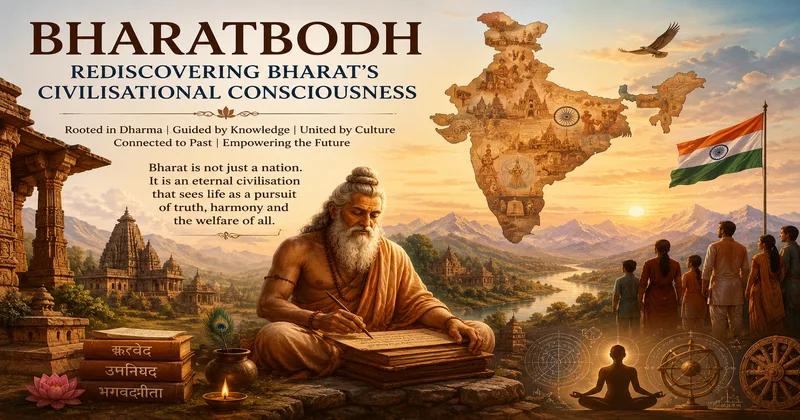
The term ‘Bharatbodh’ has gained remarkable prominence in recent years. Yet one must first ask: what is Bharat? Is it merely a geographical territory, a political entity, or a sovereign nation-state? Or does it possess distinctive characteristics that transform this vast expanse from the Himalayas to the Indian Ocean into an organic society and an eternal nation? In the West, the nation is fundamentally state-centric. By contrast, the Bharatiya concept of Rashtra is civilisational and cultural rather than political. Bharat is the sacred land of the Vedic seers—a civilisation devoted to spirituality, knowledge, and truth.
This leads to another question: does every Bharatiya truly comprehend the essence of Bharat? Can voting rights alone be regarded as evidence of an understanding of Bharat’s identity, ethos, and national consciousness? Does every Bharatiya regard Bharat as both Matrubhoomi and Punyabhoomi, identifying with its joys and sorrows, triumphs and setbacks? If not, should this not be seen as a deficiency of Bharatbodh? In reality, an understanding of Bharat inevitably leads to Bharatbodh.
Broadly speaking, two perspectives exist. One maintains that Bharat came into existence in 1947 and that nation-building remains an ongoing process. The other holds that while Bharat attained political independence in 1947, its civilisational existence stretches back thousands of years. Despite repeated invasions and the assimilation of diverse external influences, Bharat never lost its essential character and spiritual core. This uninterrupted civilisational continuity is the essence of Bharatbodh. A comprehensive understanding of Bharat requires an appreciation of its cultural identity, often described as Sanatan Sanskriti, the Hindu worldview, or Hindutva. Although its historical origins and evolution have long been debated, Hindutva expresses Bharat’s civilisational consciousness in a comprehensive manner and forms the foundation of authentic Bharatbodh.
Many misconceptions have become associated with it. One common assertion is that the term “Hindu” was coined by foreign invaders. Historical, textual, and linguistic evidence, however, suggests that cognate expressions existed in ancient Bharatiya sources and that the term travelled from Bharat into Persia rather than the reverse. At its core, Hindutva is the expression of Sanatan Dharma — that which is eternal and remains valid despite changing historical circumstances. These misconceptions arose largely from history. For over a millennium, Bharatiya society confronted repeated foreign invasions and cultural challenges. Yet Bharat’s past is as much a history of resistance, resilience, renewal, and reconstruction as of subjugation. Despite centuries of Islamic expansionism and colonial rule, Bharatiya civilisation preserved its identity, continuity, and values.
After Independence, Bharat did not fully follow the course its civilisational inheritance demanded. Political freedom was expected to nurture institutions rooted in indigenous ethos, yet colonial intellectual frameworks largely remained intact. The transfer of power did not result in the decolonisation of thought. Western assumptions became increasingly dominant in governance, education, and intellectual discourse, distancing successive generations from their cultural roots and reinforcing the notion that modernisation equals Westernisation. This shift progressively marginalised indigenous conceptions of development, aesthetics, and excellence. Meditation, yoga, and traditional yogic practices gained wider acceptance within Bharat only after recognition in the West. Likewise, Ayurveda is often denied parity with modern medicine, while traditions of astronomy and time-reckoning are frequently reduced to religious ritual.
Bharat’s traditions of architecture, urban planning, heritage conservation, and aesthetic philosophy have been exceptionally rich. Yet uncritical imitation of the West has often led to cultural simplification and homogenisation. Likewise, Bharat’s traditional food habits, lifestyle, social customs, and ethical practices embody ecological consciousness and harmony with nature, yet Bharat has often looked outwards for models of sustainability despite its own long-standing traditions. Such developments fostered misconceptions about Bharat, Bharatiyata, and the Bharatiya Knowledge Systems. The absence of Bharatbodh is the consequence of this civilisational amnesia. When a society loses touch with its swa (inner self), swatva (self-identity), and cultural foundations, confusion, inferiority, and self-doubt follow. One of the foremost objectives of Bharatbodh and the Bharatiya Knowledge Systems is therefore to overcome these misconceptions and restore civilisational self-confidence.
The Essence of Bharatbodh
From this perspective, Bharatbodh is the civilisational foundation of the Bharatiya Knowledge Systems, while the latter is its intellectual, spiritual, and practical expression. The sages of Bharat regarded knowledge as a means of self-realisation, social well-being, and the welfare of the world. Its purpose was not domination over nature or narrow self-interest but the realisation of the interconnectedness of the individual, society, nature, and the Supreme Reality. While the modern Western tradition has often equated knowledge with power, the Bharatiya tradition has regarded it as a means of inner purification, self-transformation, and the realisation of higher truth.
The foundational principle of the Bharatiya Knowledge Systems is the vision of oneness (Ekatva), expressed in the Vedas, Upanishads, Darshanas, Puranas, and the great epics. Bharatiya thought views the universe as an integrated reality, with spirituality, philosophy, yoga, Ayurveda, mathematics, astronomy, grammar, literature, and the arts evolving as interconnected branches of knowledge. Accordingly, it cultivates humility, wisdom, restraint, and duty alongside learning, scientific inquiry, power, and rights, recognising that knowledge is incomplete without ethical responsibility.
Another defining characteristic of Bharatiya thought is that it never confined the search for truth to a single scripture, individual, or doctrine. Inquiry, reason, dialogue, lived experience, and spiritual realisation are all regarded as legitimate paths to truth. The Vedic invocation, “Ā No Bhadrāḥ Kratavo Yantu Viśvataḥ” (Let noble thoughts come to us from every direction), reflects this spirit of intellectual openness. It enabled Bharat to nurture remarkable philosophical diversity while preserving cultural unity, treating differences as opportunities for dialogue rather than conflict.
According to the Hindu worldview, every individual is organically connected with the family, society, the nation, humanity, and the cosmos. The sages understood the Atman and Paramatman as manifestations of the same universal consciousness. This understanding is reflected in the Mahavakyas “Sarvam Khalvidam Brahma,” “Yat Pinde Tat Brahmande,” and “Atmavat Sarva Bhuteshu,” affirming the unity of existence and the ultimate purpose of human life.
The Bharatiya conception of the four Purusharthas — Dharma, Artha, Kama, and Moksha — is rooted in this integral worldview. It accords equal significance to material and spiritual dimensions of life, with Artha and Kama pursued within the ethical discipline of Dharma, and Moksha representing self-realisation and complete oneness with existence. Likewise, man and woman are regarded as complementary rather than hierarchical. Thus, the Bharatiya Knowledge Systems constitute a holistic vision of life rather than merely an accumulation of knowledge.
To understand Bharatbodh, it is equally essential to appreciate the Bharatiya conception of Dharma. It is not synonymous with a particular religion or mode of worship but signifies that which upholds life, society, nature, and the cosmic order. As expressed in the maxim “Dharayati Iti Dharmaḥ,” it encompasses duty, moral responsibility, and righteous conduct. Likewise, the expressions “Neti, Neti” and “Charaiveti, Charaiveti” symbolise an unending spirit of inquiry, enabling Bharat to nurture diverse philosophical traditions united by the pursuit of truth and self-realisation.
From the Bharatiya perspective, the human being is a multidimensional entity comprising body, mind, intellect, and spirit. Unlike approaches that emphasise a single dimension of human existence, Bharatiya philosophy recognises a deeper consciousness connecting the individual with society, the nation, culture, and humanity. This is reflected in the lives of Maharshi Dayananda, Swami Vivekananda, Guru Gobind Singh, Maharana Pratap, Chhatrapati Shivaji Maharaj, Bhagat Singh, Chandrashekhar Azad, and Netaji Subhas Chandra Bose, whose inspiration arose from duty, spiritual conviction, and civilisational consciousness.
The Bharatiya Knowledge Systems also understand the relationship between human beings and nature through coexistence, harmony, and kinship rather than conflict or domination. Human beings are integral participants within nature; the Earth is revered as Mother, rivers as life-givers, forests as protectors, and all creation as manifestations of the Divine. The Isha Upanishad teaches that consumption should be guided by restraint, responsibility, and reverence rather than unrestricted entitlement. At a time of climate change and ecological degradation, this civilisational insight has acquired renewed relevance.
While modern civilisation has often understood development as the conquest of nature, the Bharatiya Knowledge Systems seek to harmonise development with sustainability, enjoyment with renunciation, rights with duties, and individual aspirations with the larger interests of society. This vision finds expression in “Vasudhaiva Kutumbakam,” “Sarve Bhavantu Sukhinah,” and “Ekam Sat Viprā Bahudhā Vadanti,” reflecting the universal and inclusive character of Bharatiya civilisation.
An equally important dimension of Bharatbodh is the consciousness of duty. While contemporary discourse often emphasises rights, the Bharatiya tradition maintains that rights are safeguarded through the faithful discharge of duties. This organic relationship, expressed through Vyashti, Samashti, and Parameshti, affirms that the individual, society, and the Supreme Reality are united by the same universal consciousness.
Ultimately, Bharatbodh is not merely an understanding of Bharat’s geography, history, or political evolution but a comprehensive awareness of its civilisation, culture, and knowledge tradition. Bharatbodh and the Bharatiya Knowledge Systems are inseparable; without familiarity with the latter, one’s understanding of Bharat remains incomplete.
Every Bharatiya should possess a foundational familiarity with the Vedas, Upanishads, the Ramayan, the Mahabharat, the Puranas, Darshanas, Agamas, the Buddhist Tripitaka, the Jain Agamas, Arthashastra, Yoga, Ayurveda, astronomy, mathematics, architecture, literature, and Bharat’s educational traditions, together with an appreciation of the contributions of scholars and sages such as Panini, Patanjali, Kautilya, Aryabhatta, Varahamihira, Brahmagupta, Bhaskaracharya, Charaka, Sushruta, Nagarjuna, Bharat Muni, Kalidasa, Adi Shankaracharya, Ramanujacharya, Madhvacharya, and many others.
Bharat’s temples, pilgrimage centres, Gurukulas, ancient universities, inscriptions, monuments, folk traditions, festivals, family institutions, village life, ecological wisdom, and ideals are integral components of this civilisational inheritance. To know Bharat is therefore not merely to study its past but to understand the civilisational consciousness that has preserved its cultural unity across millennia. This is the essence of Bharatbodh and the true spirit of the Bharatiya Knowledge Systems, providing the foundation on which Bharat can interpret its past, guide its present, and shape its future with wisdom and purpose.