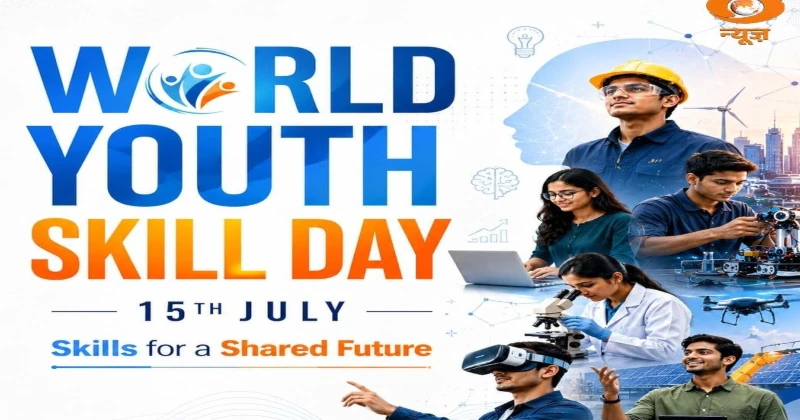
NEW DELHI: As the global workforce undergoes a rapid transformation driven by artificial intelligence (AI), digital innovation, climate action, and evolving economic demands, World Youth Skills Day 2026 is being observed across the world under the theme “Skills for a Shared Future.” The day highlights the urgent need to equip young people with a diverse set of competencies that extend beyond traditional technical education, enabling them to thrive in an increasingly interconnected and technology-driven world.
Observed annually on July 15, World Youth Skills Day serves as a global platform to emphasise the critical role of skills development in promoting employment, entrepreneurship, and sustainable economic growth. The occasion also fosters dialogue among governments, technical and vocational education and training (TVET) institutions, the private sector, development partners, and young people on strengthening skill ecosystems that are inclusive and future-ready.
The world of work is changing at an unprecedented pace. Emerging technologies such as AI, automation, and digital platforms are reshaping industries, while the green transition is creating new employment opportunities that require specialised knowledge and sustainable practices.
On World Youth Skills Day, we celebrate the power of skills in shaping a brighter future.
Through the Skill India Mission and its key initiatives, India is empowering youth with industry-relevant skills, promoting employability, entrepreneurship, and lifelong learning.
Swipe… pic.twitter.com/L1HTvVxlAP
— DD News (@DDNewslive) July 15, 2026
Recognising these shifts, this year’s theme underscores the importance of preparing youth with a balanced combination of competencies. Alongside technical and vocational expertise, young people are encouraged to develop digital literacy, AI-related knowledge, green skills, social-emotional intelligence, civic awareness, creativity, resilience, and cross-cultural communication qualities that remain uniquely human and cannot be replicated by machines.
The 2026 observance focuses on developing innovative youth skill programmes that prepare young people not only for jobs but also for active participation in building inclusive, sustainable, and resilient societies.
On the occasion of World Youth Skills Day, India is showcasing the progress made under the Skill India Mission, one of the country’s flagship initiatives aimed at transforming the nation’s workforce into a globally competitive talent pool.
Launched in 2015, the Skill India Mission seeks to bridge the gap between industry requirements and workforce capabilities by providing industry-relevant training, enhancing employability, promoting entrepreneurship, and encouraging lifelong learning.
Over the past decade, the mission has expanded through multiple flagship schemes designed to cater to different sections of society, including school students, unemployed youth, rural communities, women, and aspiring entrepreneurs.
Among the prominent programmes driving India’s skilling ecosystem is the Pradhan Mantri Kaushal Vikas Yojana (PMKVY), which provides free short-term skill training and certification in sectors aligned with market demand. The programme aims to improve employability while recognising prior learning and existing skills among workers.
The National Apprenticeship Promotion Scheme (NAPS) encourages industries to provide on-the-job training through apprenticeships, allowing young people to gain practical work experience while enhancing their employability.
Another key initiative, Jan Shikshan Sansthan (JSS), focuses on vocational education for non-literate, neo-literate, and school dropout populations, particularly in rural and disadvantaged communities, helping them become self-reliant through livelihood-oriented training.
The Skill India Digital Hub (SIDH) has emerged as a digital platform integrating skilling, education, employment opportunities, and entrepreneurship support, making skill development more accessible through technology.
The government has also introduced initiatives supporting emerging sectors such as AI, robotics, semiconductor manufacturing, drone technology, renewable energy, and advanced manufacturing, reflecting the changing needs of India’s economy.
The Skill India Mission places equal emphasis on wage employment and self-employment. Through entrepreneurship development programmes, financial literacy, startup support, and industry partnerships, the mission aims to encourage young Indians to become job creators rather than only job seekers.
Industry collaborations continue to play a central role in designing training curricula, ensuring that certification programmes remain aligned with evolving labour market requirements.
Experts note that while technological advancements are creating new opportunities, they are also widening the gap between those equipped with future-ready skills and those without access to quality education and training.
This year’s World Youth Skills Day therefore emphasises strengthening technical and vocational education while ensuring that young people from marginalised communities, women, persons with disabilities, and rural populations are not left behind in the global skills revolution.