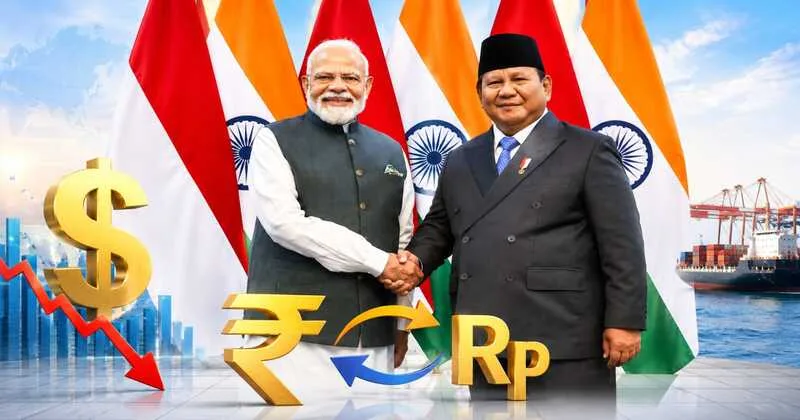
New Delhi: India and Indonesia have strengthened their economic partnership by accelerating bilateral trade in local currencies, marking a significant step towards reducing dependence on the US dollar while reinforcing their broader strategic partnership. The initiative has gained renewed attention during Prime Minister Narendra Modi’s July 6–7, 2026 state visit to Jakarta, where both countries elevated their relations to the Comprehensive Strategic Partnership focused on maritime defence, digital public infrastructure and critical minerals.
At the centre of the economic agenda is the operationalisation of the Local Currency Settlement System (LCSS) framework between the Reserve Bank of India (RBI) and Bank Indonesia. The framework enables exporters and importers to invoice and settle bilateral trade directly in Indian Rupees (INR) and Indonesian Rupiah (IDR), eliminating the need to route transactions through the US dollar.
The mechanism follows the Memorandum of Understanding signed on March 7, 2024, between the two central banks. The agreement has acquired fresh momentum during Modi’s visit as New Delhi and Jakarta seek to deepen trade, improve supply-chain resilience and strengthen economic cooperation across the Indo-Pacific.
Local currency trade gains momentum
The Local Currency Settlement framework allows businesses in both countries to conduct transactions without converting their payments into US dollars. By settling trade directly in rupees and rupiah, exporters and importers can reduce dual conversion costs, minimise exchange-rate risks and make cross-border trade more efficient.
The shift comes amid rapidly expanding local-currency transactions in Indonesia. According to official figures, Indonesia’s local currency transaction volumes surged 163 per cent year-on-year, reaching US$8.45 billion during the first two months of 2026, reflecting growing acceptance of alternative settlement mechanisms.
The initiative was first highlighted in the joint statement issued during Indonesian President Prabowo Subianto’s state visit to India in January 2025. It was subsequently reinforced during the India-Indonesia Joint Commission Meeting in June 2026, which laid the groundwork for Modi’s Jakarta visit and the expansion of bilateral financial cooperation.
I am happy that India and Indonesia are writing a new future together, built on mutual trust. The Indian community living in Indonesia will be among the greatest beneficiaries of this partnership. pic.twitter.com/en4SDy3whc
— Narendra Modi (@narendramodi) July 7, 2026
Indonesian Embassy Deputy Chief of Mission Yudho Sasongko said economic integration, resilient supply chains and maritime cooperation remain the principal pillars of the bilateral relationship.
The growing economic engagement coincides with a wider strategic convergence between the two democracies, which are seeking to balance trade deficits, enhance supply-chain security and promote a growth-oriented Global South partnership while contributing to stability across the Indo-Pacific.
Digital payments and strategic cooperation
Beyond trade settlement, India and Indonesia are also working to integrate their digital payment ecosystems. Officials are advancing efforts to link India’s Unified Payments Interface (UPI) with Indonesia’s Quick Response Code Indonesian Standard (QRIS) payment platform.
Once operational, the connectivity will enable tourists, businesses and citizens in both countries to make retail payments directly in rupees or rupiah, further reducing reliance on the US dollar for everyday cross-border transactions while expanding digital financial inclusion.
Both countries are simultaneously advancing central bank digital currency programmes. India is piloting the e-Rupee, while Bank Indonesia is developing the Digital Rupiah as part of its long-term digital finance strategy.
Despite expanding local currency trade, New Delhi and Jakarta are pursuing a measured approach rather than an outright rejection of the dollar. Both governments continue to maintain stable strategic and financial ties with the United States while promoting local-currency settlements primarily to lower transaction costs and strengthen bilateral and regional commerce.
India has maintained a cautious regulatory stance towards private cryptocurrencies even as it aggressively pilots the e-Rupee. Indonesia has similarly concentrated its digital finance ambitions through its central bank instead of embracing decentralised cryptocurrencies.
The strengthening of the Rupee-Rupiah settlement mechanism forms part of a broader India-Indonesia strategic agenda that combines maritime security, digital public infrastructure, critical minerals cooperation and financial connectivity. As the Local Currency Settlement framework expands and digital payment integration progresses, both countries are positioning themselves to build a more resilient bilateral economic architecture while contributing to a more diversified and multipolar regional financial order.