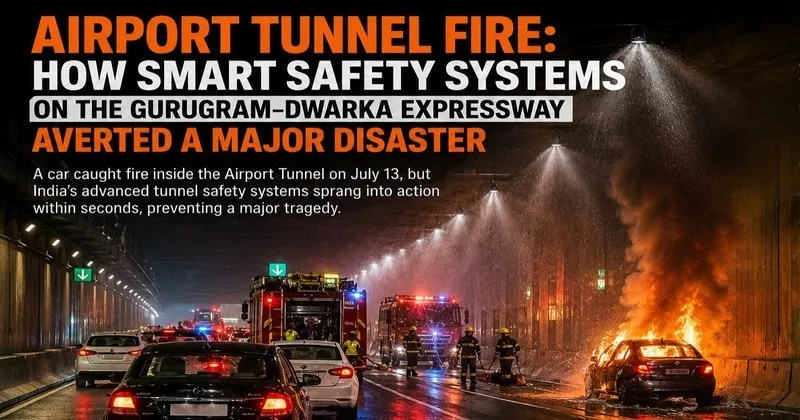
Gurugram: A car that caught fire inside the Airport Tunnel on the Gurugram–Dwarka Expressway on July 13 turned into a real-life test of India’s modern highway safety infrastructure. As smoke rapidly filled the tunnel and visibility dropped, the tunnel’s automated fire detection and suppression systems activated within moments, preventing what could have become a major disaster.
A car caught fire today inside the Airport Tunnel on the Gurugram–Dwarka Expressway, filling the tunnel with smoke.
As visibility dropped, vehicles halted outside the tunnel, while the tunnel's automatic fire safety system activated immediately, switching on the sprinklers. The… pic.twitter.com/MfmL8Ouavb
— Megh Updates 🚨™ (@MeghUpdates) July 13, 2026
Panic briefly gripped commuters after a car caught fire inside the Airport Tunnel on the Gurugram–Dwarka Expressway, one of the country’s most technologically advanced highway projects. The fire generated thick smoke that quickly spread through the enclosed tunnel, reducing visibility for motorists. Vehicles approaching the tunnel were halted outside to prevent additional traffic from entering the affected stretch, while those already inside were guided to safety.
Within seconds of detecting the fire, the tunnel’s integrated emergency response system came into action. Automatic sprinklers switched on, spraying water directly over the affected section to contain the flames before they could spread to nearby vehicles. Emergency response teams soon reached the site, and the fire was brought under control without any casualties or injuries. Although the exact cause of the fire is yet to be established, authorities have initiated an investigation.
How the Tunnel’s Safety Systems Worked
The incident highlighted the importance of intelligent tunnel design, where safety mechanisms operate automatically without waiting for manual intervention.
Modern road tunnels are equipped with multiple layers of protection, including:
* Automatic fire detection sensors that identify heat and smoke within seconds.
* Sprinkler systems that activate immediately to suppress flames.
* High-capacity ventilation systems that extract smoke and maintain breathable air.
* Smoke detection and monitoring equipment that continuously assesses air quality.
* Closed-Circuit Television (CCTV) cameras allow operators to monitor incidents in real time.
* Public Address Systems to issue emergency instructions to motorists.
* Emergency telephones and communication networks connect tunnel users directly with the control room.
* Traffic management systems that automatically stop vehicles from entering the tunnel during emergencies.
These systems are connected to a central control room that continuously monitors tunnel operations around the clock.
Engineering Safety Into India’s New Infrastructure
Unlike conventional highways, long tunnels require highly specialised safety engineering because fires can spread rapidly in enclosed spaces, while smoke poses an even greater danger than flames. Globally, tunnel fires have resulted in major tragedies due to delayed detection and inadequate ventilation. Learning from international best practices, India’s newer highway tunnels have incorporated advanced fire suppression technologies and intelligent transportation systems (ITS).
The Airport Tunnel on the Dwarka Expressway represents this new generation of infrastructure, combining engineering excellence with digital monitoring and automated emergency response.
The Airport Tunnel forms an important section of the Dwarka Expressway, providing seamless connectivity between Gurugram, Delhi, and the Indira Gandhi International Airport. Designed to ease congestion on the Delhi-Gurugram corridor, the tunnel carries thousands of vehicles every day and has been equipped with sophisticated operational and safety technologies comparable to those used in international road tunnels. Its infrastructure includes continuous surveillance, automated incident detection, advanced ventilation, intelligent traffic control, and integrated fire management systems.
A Reminder That Safety Matters as Much as Speed
India has invested heavily in expanding its expressway network over the past decade. While these projects are often recognised for reducing travel time, incidents like the Airport Tunnel fire demonstrate that equally significant investments have been made in safety infrastructure.
Modern highways are increasingly being equipped with:
* Intelligent Transportation Systems (ITS)
* Automatic Incident Detection (AID)
* Variable Message Signboards
* Real-time traffic monitoring
* Emergency response coordination
* Integrated fire detection and suppression systems
* AI-assisted surveillance technologies
Such systems are designed to ensure that emergencies are detected immediately, emergency services are alerted without delay, and motorists receive timely guidance.
The Airport Tunnel fire serves as a practical example of how modern infrastructure can minimise the impact of unexpected emergencies. Had the fire occurred in a tunnel lacking automated detection, sprinkler systems, and smoke management, the outcome could have been far more serious. Instead, the built-in safety mechanisms responded exactly as intended, containing the fire, protecting motorists, and allowing emergency responders to manage the situation efficiently.
As India continues expanding its network of world-class expressways and tunnels, this incident reinforces the importance of investing not only in faster roads but also in smarter and safer infrastructure that protects lives when emergencies arise.