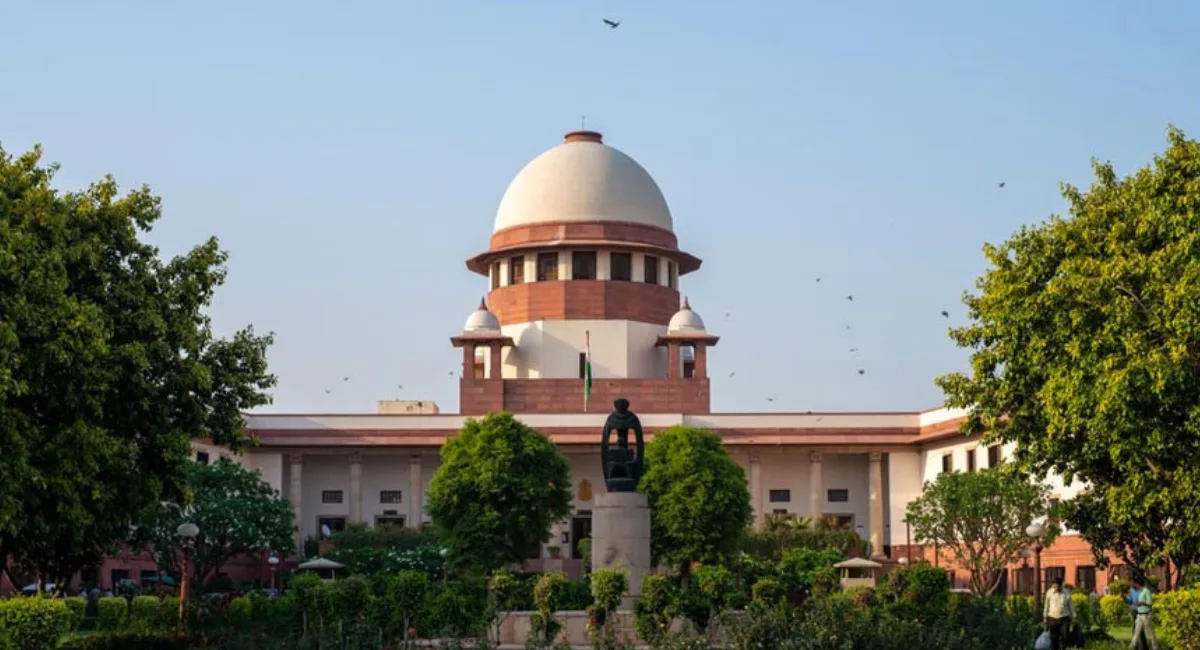
The Supreme Court on July 13 stayed a Madras High Court order directing the Tamil Nadu government to ensure that no cow or calf is slaughtered in the state. A Bench of Justices Vikram Nath and Sandeep Mehta passed the interim order while hearing a plea filed by the state government challenging the High Court’s May 27 directive. The Bench agreed to hear the matter and issued notice to the respondents.
The Tamil Nadu government challenged the May 27 order of the High Court, which directed the state authorities to ensure that no cow or calf is slaughtered across the state either on the eve of Bakrid on May 28 or on any other day.
The Bench said, “We allow this writ petition with a direction to the State of Tamil Nadu to ensure that no cow or calf is slaughtered on the eve of Bakrid or on any other day.”
The High Court order was based on a 1976 order, which prohibited cow slaughter in the interest of milk production and improvement of the rural economy. In its plea, the state government termed the order contrary to the Tamil Nadu Animal Preservation Act, 1958.
In its petition, the state government termed the order contrary to the Tamil Nadu Animal Preservation Act, 1958. The Act permits the slaughter of cows aged over 10 years that are unfit for work and breeding, on the basis of a certificate issued by a competent authority.
A vacation Bench comprising Justices GR Swaminathan and V Lakshminarayanan passed the order while hearing a public interest litigation seeking to prevent the slaughter of cows in places other than designated slaughterhouses.
In the May 27 order, Justice GR Swaminathan, who authored the verdict, said, “The question that calls for consideration in this PIL is whether cows and calves can be sacrificed in places not designated as slaughter houses on the occasion of Bakrid…. His complaint is that for the purpose of qurban (sacrifice) on the occasion of Bakrid, arrangements have been made for slaughtering cows and calves in areas not designated as slaughter houses. He submitted a representation to the authorities. Since it was not considered, he filed the present writ petition for directing the authorities to take steps to prevent such slaughter.”
A counter-affidavit has been filed and paragraphs 4 and 5 of it read as follows: “4. It is respectfully submitted that, on 21.05.2026, the respondent police visited the scene of occurrence and inspected the place designated for cow slaughter (Qurban). Upon such inspection, the respondent police came to understand that the concerned authorities had erected a temporary shed for the purpose of conducting cow slaughter in a non-public area, without causing any obstruction to traffic or offending the religious sentiments of persons belonging to other communities. 5. It is submitted that now the petitioner filed this present petition before this Hon’ble High Court, Madras seeking a writ of mandamus directing the respondents to consider the petitioner’s representation dated 18.05.2026 and take steps to prevent the slaughter of cows in public places and pass such further or other orders.”
The court said, “Article 48 of the Constitution of India mandates that the State shall take steps for prohibiting the slaughter of cows and calves and other milch and draught cattle. During the debates in the Constituent Assembly, it was pointed out that cow is a revered animal and that it has been associated with our civilization from the time of Lord Krishna. During the rule of many Muslim Kings cow slaughter was abolished. Cow protection was an issue so dear to Mahatma Gandhiji.”
The judge said, “Supreme Court observed that many Muslims do not sacrifice cows on BakrI’d day. Sacrifice of a cow on that day is not an obligatory overt act for a Musalman to exhibit his religious belief and idea (Mohammed Hanif Quareshi -vs- State of Bihar AIR 1958 SC 731). Sacrifice of any animal by the Muslims for the religious purpose on BakrI’d does not include slaughtering of cows as the only way of carrying out that sacrifice. Slaughtering of cows on this occasion is neither essential to nor necessarily required as part of the religious ceremony (State of West Bengal -vs- Ashutosh Lahiri (1995) 1 SCC 189).”
The court said, “State authorities are obliged to act in the matter in view of the provisions found in the Tamil Nadu Animal Preservation Act. Section 4 of the Tamil Nadu Animal Preservation Act, 1958.”
The judges said, “Therefore, no cow can be slaughtered unless it is over 10 years of age and is unfit for work and breeding. Or it should have become permanently incapacitated for work or breeding due to injury, deformity or any incurable disease. Since this provision enables cow slaughter and is at variance with Article 48 of the Constitution of India, the provision will have to receive a strict construction. In Section 4(3)(a) of the Act, the expression used is ‘and’. Thus, the animal should be unfit both for work as well as breeding. It should be aged above 10 years. The certificate must have been issued by the competent authority in the prescribed form…”
The court highlighted, “Since the executive power is co-terminus with the legislative power, a Government Order issued by the Government banning cow slaughter is very much sustainable and has to be enforced, as it has the force of law.”
The judges said, “We allow this writ petition with a direction to the State of Tamil Nadu to ensure that no cow or calf is slaughtered on the eve of Bakrid or on any other day. The authorities, particularly the Chief Secretary to the Government and the Additional Director General of Police (Law and Order), are obliged to issue suitable instructions to all the officials concerned to ensure that there is no breach of this order.” The court posted the matter for reporting compliance on May 29.
Tamil Nadu Police on May 29 filed a compliance report in the Madras High Court in connection with its earlier directions, saying that no cow or calf was slaughtered in the state either on May 28 (Bakrid) or on any other day. The HC Bench, after being satisfied with the report, said no further orders were necessary in the matter.