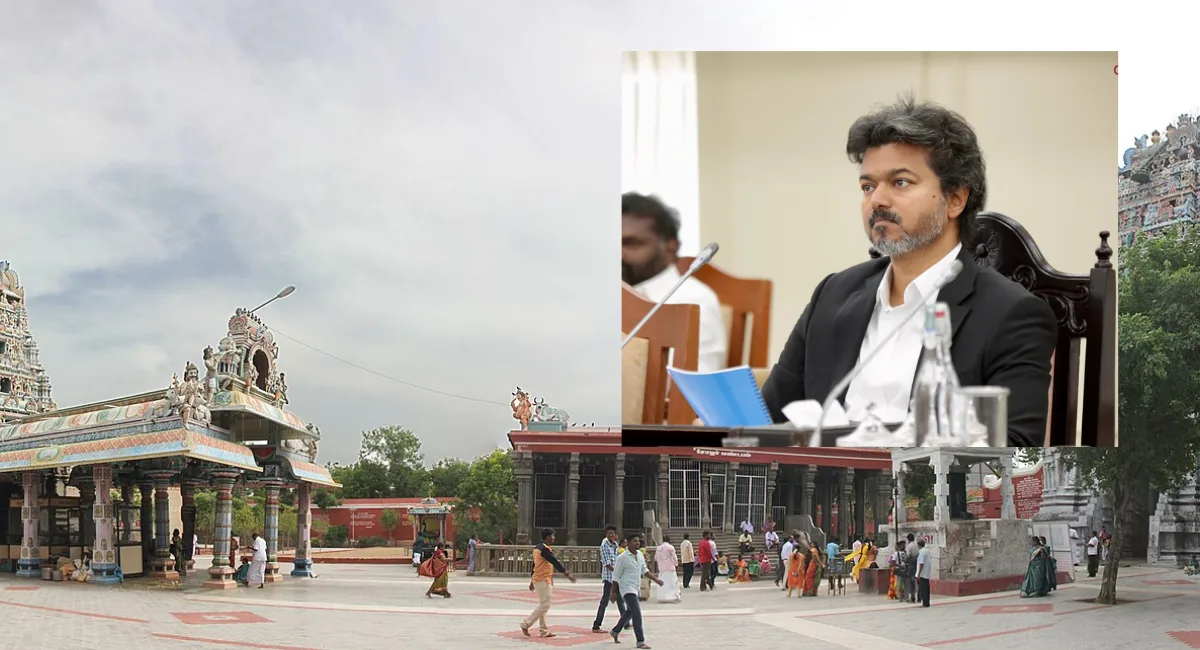
Hindu Munnani has urged the TVK government to constitute a panel headed by a Madras High Court judge to examine the controversy over 3,084.95 acres spread across 471 survey numbers in 15 villages and linked to four temples in Karur district. The demand comes after a July 9 communication from the Hindu Religious and Charitable Endowments (HR&CE) Department directing its Joint Commissioner in Tiruppur to remove the specified survey numbers from the Prohibitory Module, triggering a political row on July 10.
The lands had earlier been brought under registration prohibition based on requests from temple authorities. Following representations from private pattadars claiming ownership, the Karur Collector recommended that the restriction be lifted. The order only removes the registration bar and neither determines ownership nor confers title. The order was issued a day before CM Joseph Vijay’s Karur visit to hand over letters offering government jobs to stampede victims’ family members.
This has created a stir among devotees and temple activists, with the BJP, VHP and Hindu Munnani opposing the move and offering in-depth legal interpretations against the government’s move. TN BJP chief Nainar Nagendran and former BJP MLA Vanathi Srinivasan have questioned the speed with which the Karur District Collector, the Joint Commissioner in Tiruppur and the HR&CE Commissioner processed the order issued on July 9.
Hindu Munnani state president Kadeswara Subramaniam, in a statement, demanded that the TN government appoint a panel led by a judge of the Madras High Court, as the TVK government’s decision on the Karur temple lands has shocked and created confusion among devotees. “We are firm that it should not cause any hindrance to farmers, but temple lands should not be encroached upon by anyone,” he said.
Drawing a distinction between Inam and other lands, he said that, in appreciation of service in the fields of education, religion, spiritual activities and service to mankind, the government or the king would give land to individuals, mutts and organisations. They are categorised as Deva Dhanam — for temples, Brahmadeyam — for Brahmins, Mutt Inam — for mutts, Service Inam — for village service or social activists, and private individual Inam.
Subramaniam said that, in the current case, according to the Acts, the government is the owner of the Inam lands, but eligible farmers would get ryotwari pattas. Lands would be categorised and ownership would be reviewed.
There has been confusion in categorising them, which continues to date, in arriving at which are government lands and which are individual lands. The government’s hasty action has raised several questions, besides confusion and counterclaims. There is no clarity.
The TVK government owes explanations: “Why has it lifted the embargo on temple lands in a hasty manner? Is it to reap gains in the forthcoming bypolls? The Nayak and Vijayanagara kings had donated these lands to the temples and their employees for their use. While this is so, how could they be categorised as non-temple lands? The Madurai Bench of the Madras High Court has ordered the eviction of encroachers from 507.88 acres of land belonging to the Karur Vennaimalai Balasubramania Swamy Temple. Of the encroachers, 27 are government employees, 49 are industrialists and 38 are highly influential VIPs.”
The court had observed that while a deity lacks voting power, it is recognised as a “juristic person” in law. The court ruled that temple properties are sacred endowments and that a deity cannot be left without legal remedies against powerful encroachers simply because it cannot vote in elections.
Hindu Munnani urged the TVK government: “Status quo should be maintained by putting the recent GO on hold; an independent judicial panel should be set up to go into the issue and ensure the protection of temple lands while safeguarding the livelihood of farmers. We appeal to the government, considering the urgency of the issue, to act without any delay.”
Tamil Nadu BJP senior spokesperson Narayanan Thirupathi, in a post on X, said: “I strongly condemn the order issued by the Hindu Religious and Charitable Endowments (HR&CE) Department on July 9, 2026, directing the removal of 471 survey numbers — totalling approximately 3,084.95 acres of land belonging to four major temples (including Kalyana Pasupatheeswarar Temple in Karur, Balasubramaniya Swamy Temple in Pugalimalai, Raveeswarar Swamy Temple, and Vikrutheeswarar Temple) — from the Prohibitory Module.”
He wanted the “immediate withdrawal or stay of the July 9 order; full transparency on the selection of these 471 survey numbers and the basis for the Collector’s recommendation; referral of all disputed parcels to civil courts for expeditious title adjudication, with the Prohibitory Module maintained as a safeguard until final resolution; and assurance from the government that no temple lands will be alienated or allowed to slip away through such measures”.
The BJP leader said: “Temple properties belong to the deities and the devotee community — they are not administrative assets to be traded or compromised for short-term convenience or electoral considerations.”
